
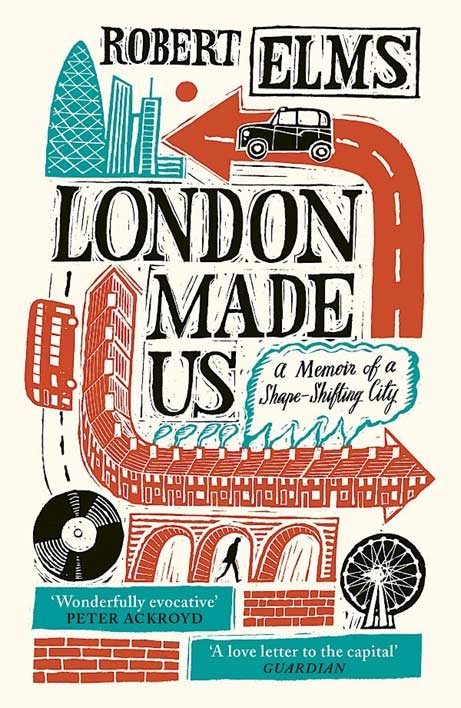
London Made Us. A Memoir of a Shape-Shifting City, Robert Elms (Canongate)
I’d agree with Robert Elms that London – like a lot of major cities – is made up of smaller ‘villages’ and that London is constantly evolving and reinventing itself, but Elms seems to have grown up in a parallel universe to me in the 70s and 80s. I never had much time for Elms, he was too much of a clothes-horse for fashion journalism, desperate to be noticed, but parts of this book are brilliant evocations of events and places.
Although hung on the idea of the Elms family and previous generations living in London, a lot of it, however, is clearly researched and tells of historical myths, events and occurrences, not to mention architecture and planning, whilst the more original parts of the book are when Elms chills a bit and gets personal about situations and places he found himself in.
Unfortunately, these are also the places where he drops into faux cockney slang (refusing to accept that Cockneys inhabit a very small part of London) and can’t resist namedropping. It’s all very well and good spinning out yarns about famous people you have met over a pub table in conversation but it is less acceptable in print, especially when Sting, McCartney or whoever have little or no bearing on the story they are inserted in. One extreme example is in an otherwise excellent chapter on changing cuisine in the city, where Elms is recalling his first kebab, only to then mention that when he met George Michael years later, he was informed that that particular kebab shop was owned by Michaels’ father and that it was possible that George Michael himself as a child was sitting at the back of said shop. I mean, really?
Anyway, away from namedropping, Elms has some brilliant chapters about parts of the London suburbs he has inhabited, particularly Notting Dale and Latimer Road, then Burnt Oak. He chronicles the Westway cutting through to Marylebone and it’s spur road the (M)41 – since downgraded to an A road – down to Shepherds Bush, along with squatting, reggae, punk, the carnival and the now long-gone pubs and venues; and Grenfell and gentrification are in there too.
Elms is a football kind of chap, a game which bores me stupid and seemed to encourage a rather young version of the author to become an associate skinhead early on. He liked soul music and dances in suburban halls, although later loved the few months of genuine punk that sprang from pub rock, but is dismissive of the gloriously experimental and hybridising post-punk, preferring to wait for its commercialisation as New Romantic music. Even then he seems more interested in the clothes and make-up worn back then, the ‘exclusive’ clubs he visited (i.e. there was some arsey poseur on the door letting his mates in) and the people he met there who would go on to become stars, including Sade, who was his partner for a while before she went to the top of the charts.
If Elms is to be believed (and he isn’t), most of the 70s was a desolate wasteland without any nightlife or culture. Since he is only a year older than me I find it hard to reconcile that with the slow burnout of the hippie movement and the rise of indie music, both of which prouced cheap gigs and beer in great pubs, independent bookshops and record shops, etc., that were all around us. True, he mentions Compendium Books in Camden Town, The Nashville, The Greyhound and other venues, not to mention the pubs along from Hammersmith Bridge, but they don’t seem to count in his eyes… he is waiting for that big break that dressing up for nightclubs would facilitate. Alternative London was not what Mr. Elms aspired to, he preferred saving up for made-to-measure suits, hanging out at the Groucho Club, mingling with as many stars as possible and buying a house just at the right time, before the property boom priced most of us out of the capital.
Yeah, I’m being snide. None of us can keep up with the way London changes, most people who live there can only adapt to certain changes, usually in a small geographical area. My Mum’s house and street may be the same but now there are tall blocks of flats where factories used to be, express supermarket stores not independent shops, and the bus routes have all been renumbered and their routes changed. Thankfully the tube trains still connect West London with the West End and beyond, and although Portobello Road market and Rough Trade Records are not ‘alternative’ any more, they are still there, as are several bookshops, museums and galleries further into town. But the centre has shifted East and it’s often Brick Lane and Spitalfields I visit now, places I’d never been to growing up in London.
This is where Elms and I agree. When he stops cor-blimeying (or worse, using ridiculous rhyming slang) and namedropping he is good at personal, familial and social history. His stories about his mates, local ‘characters’, teenage escapades and family gatherings are exceptional, as are some of the questionable legends and tall tales he reconstructs. Like him, I now find it difficult to keep up with London’s shifts and changes. Elms seems fairly apolitical in the book, family not politics seems more important to him, and only rarely do his memories turn into nostalgia. I enjoyed most of the book, however, because however different the places we lived in there are/were similarities and it is clear that London made us both.
.
Rupert Loydell
.