
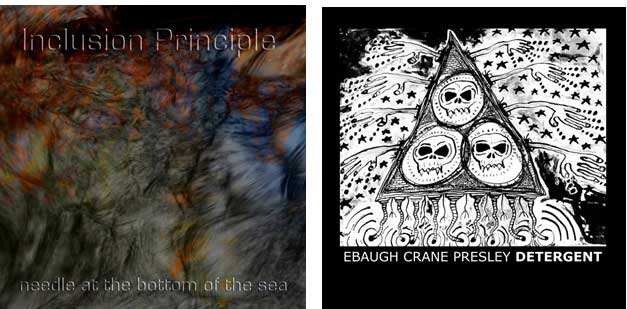
needle at the bottom of the sea – 9015DL (2025), Inclusion Principle (Discus Music)
Detergent, Ebaugh / Crane / Presley (Scatter Archive)
Martin Archer and Hervé Perez have spent this year celebrating their twenty years together making music under the moniker Inclusion Principle by releasing a series of EPs (they refer to to them as EPs but if I remember right, they’re all long enough to identify as albums). They describe them collectively as being a prelude to a CD they plan to bring out next year. needle at the bottom of the sea is the fourth and last.
The title intrigued me. On investigation, I discovered it’s a phrase richly layered with meaning. ‘Needle at Sea Bottom’ (Hǎidǐ zhēn, 海底针) is a Tai Chi posture. It refers, too, to the legend of the Monkey King, who takes an iron pillar from the underwater palace of the Dragon King. It had originally been used to measure the depths of the rivers and seas and could shrink to the size of a needle. It crops up, too, in a Bengali folk-tale in which a Sufi saint helps Badé Khān Gāji, in a final test of the latter’s spiritual status, to find a needle on the sea-bed.
There are three tracks here, all named after Tai Chi postures, but track separations are optional – you can listen with or without track breaks. I found myself preferring the unbroken version, saving the separated tracks for when I might want to listen to a particular section. Having had a listen to it all, I turned to the album notes to find Hervé Perez taking the very words I was about to say about it out of my mouth, or, at least the gist of them; he and Archer have made an art-form out of combining two superficially different ways of making music: their improvised electronic ruminations proceed according to their own intuitive logic, whereas their sax duets are thought out far more conventionally, as they put it, ‘using clear melody and harmony’. The result is it’s hard not to imagine them playing their saxes is some exotic forest, alien landscape or – thinking of the title here – at the bottom of some tropical sea.
The music begins with a faint, disconcerting electronic sound which is gradually absorbed into a texture which includes a deep tritone and – as befits the title – what sound like processed sea-sounds. Other sounds join in the mix. When the saxes finally come in, the effect is monumental. In the album-notes, Perez describes how ‘the electronic material was improvised in one session’ and ‘subsequently we added wind instruments and further production to the mix.’ I’m not sure what the ‘further production’ entails, but they brilliantly, in my view, create layers of sounds and spin-off musical lines that mediate between the electronics and the saxes. I don’t know how they’d put it, but that’s how I hear it. I love the creative use they make, too, of the stereo space.
Three tracks in, the saxes become less monumental and more elegiac. What was an intermittent drum beat, you suddenly realise, has become a busy, but unobtrusive bass line. There are high, sustained chords, then birdsong (is it real, or electronically generated? With IP, I’m never sure). A sax tries to imitate the birdsong, although it can never succeed, never capture the lightness. Saxes are replaced by shakuhachi, a gentler sound that can more easily coexist with the birds. The music moves into a state of stasis which, paradoxically, never seems to stand still. As it all comes to an end, we hear the sea.
Birdsong, sea-sounds, shakuhachis, drone-like chords – it could all be so predictable, but in the hands of Inclusion Principle it’s anything but. Think less a mass-produced Hawaiian shirt and more a painting by Henri Rousseau. (It’s not the first time IP have put me in mind of that artist – and, this time, there’s even a tiger in one of the track-titles!) Perez and Archer pay minute attention to the way they put sounds together and do so in a way that is always original and arresting. As with the other EPs they’ve issued this year, they’ve created a rich, immersive sound-world. When you hear the waves lapping on the beach at the end, you find yourself thinking, do I really have to come out, already?
Detergent is a very different musical life-form. Its roots go back years to the 1990s, to a UCSD gig at which guitarist Cameron Presley found himself ‘awestruck … by Matt Crane’s unrelenting, stream-of-consciousness drumming’. Fast-forward twenty-five years or so and Presley found himself playing with sax-player Ryan Ebaugh. Ebaugh’s playing reminded him of Crane. He got in touch with the drummer and the three of them got together. Detergent is the result.
Listening to the album, you can immediately see how Ebaugh’s at times high octane, skronking sax might’ve put Presley in mind of Crane. However, underneath the superficial impression of action-packed chaos, there’s a lot of responsiveness and creativity going on, a sense of three musicians working together to one end. What we get is almost an hour of music that is at once dense, intense and engaging: to continue the metaphor of the title, it may not be the sort of thing you want to get in your eyes (as Martin Schray put it on The Free Jazz Collective blog, it’s ‘not for wimps’), but it’s definitely an album you’ll want to wash your ears out with.
Schray’s review, by the way, is quoted extensively in the album notes and includes a useful potted history of the Scatter Archive label. Scatter was set up by Liam Stefani in 1994. Dedicated to showcasing improvised music and with a focus on non-idiomatic improv, each release financed the next. When it became Scatter Archive and moved to Bandcamp, as Schray quotes Liam Sefani: ‘As the name changed, so did the business model. It was no longer reliant on each physical release selling enough copies to finance the next physical release … It was now possible to remove the commercial aspect from the label, becoming a non-profit organisation’. Scatter Archive Bandcamp albums are invariably ‘name your price’ offerings – you can listen to them indefinitely and download them for free if you want to.
I might be wrong, but I make Detergent to be Scatter Archive’s 270th online release. And the word ‘archive’ wasn’t added to the label for nothing: all the preceding 269 are there to listen to on the label’s Bandcamp page, beginning with a live album by a US experimental group, the excellent Jackie-O Motherfucker. I won’t single any others out – where to start? – but there’s everything there from recent recordings right back to classic twentieth century gigs. Detergent is in good company, as it deserves to be.
.
Dominic Rivron
LINKS
needle at the bottom of the sea – 9015DL (2025):
https://discusmusic.bandcamp.com/album/needle-at-the-bottom-of-the-sea-9015dl-2025
Detergent:
https://scatterarchive.bandcamp.com/album/detergent
.
I’d just like to add that, although Scatter Archive is a not-for-profit venture and you can listen to the albums there for free (it’s a great cultural resource!), any money received by Scatter Archive does go straight to the artists. So, if you discover music there you want to listen to, do consider shelling out what you can afford!
Comment by Dominic Rivron on 14 December, 2025 at 9:42 am