
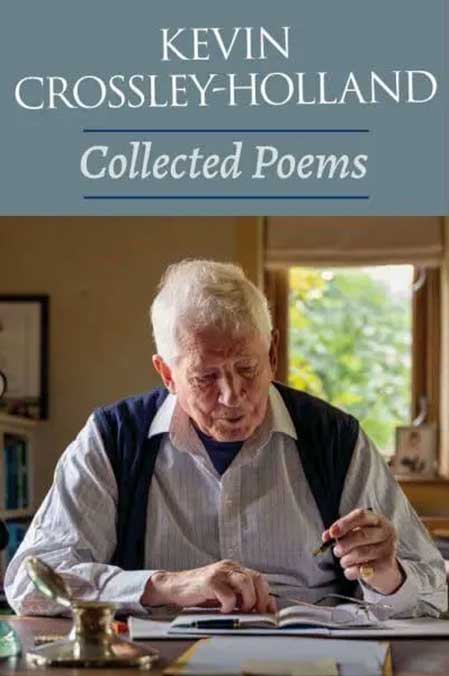
Collected Poems, Kevin Crossley-Holland (Arc Publications, 2025)
Some poets become associated with particular locations and geographies. I’m thinking of R.S. Thomas and the parishes in Wales in which he lived or John F. Deane and his lifelong association with Achill Island. Kevin Crossley-Holland is another such poet, given his love for the landscapes of North Norfolk in particular, and Norfolk and Suffolk more generally. Ronald Blythe, who, with his knowledge of these parts of the country, knew of what he was speaking, said that Crossley-Holland’s ‘language has been honed by the Norfolk and Suffolk climate itself and has the polish of split flint’.
However, while the spirit of place in Norfolk and Suffolk characterises much and infuses more of Crossley-Holland’s poetry, this is a very full and varied collection that, as Joanne Harris notes, contains ‘anthems, war cries, memories, love songs and hymns to the glory of nature’.
Another of Crossley-Holland’s key foci is also very much in evidence; a fascination with Norse myths that was reinforced early in his career when W.H. Auden, after reading Crossley-Holland’s translation of Beowulf, told him to ‘Look north – there are so many northern stories and sagas and you’re a northern creature’. Crossley-Holland’s historical focus on and emotive understanding of the world of Icelandic sagas, eddaic poems, Germanic heroic legends, and Norse myths are also much in evidence here, with his Harald in Byzantium cycle – short poems in the persona of Harald Hardrada during his formative years in Byzantium – being among the most significant.
Multi-talented, Crossley-Holland has, in addition to poetry, also written translations, historical fiction, and libretti. Well-connected from early years, when he was involved with ‘The Group’, he made a successful career in both writing and publishing, making a lasting contribution to the poetry world, not just as a poet, but also as editor and publisher, by championing writers such as R.S. Thomas, Elizabeth Jennings, Michael Longley and Eavan Boland. His connections even go back to childhood. He tells a story of falling in love aged sixteen with a girl whose dad was a writer. After showing the girl’s father his poems, he received a challenge to write poems in a number of different forms, so that that once he had something to say, he would know how to say it. This was advice he clearly took to heart and utilised in his teaching work, as well as his poetry, particularly in his time with ‘The Group’, where poetry workshops were de rigueur.
Themes of myth, magic, landscape and history are found throughout Crossley-Holland’s work and the roots of these fascinations also lie in his childhood. His father recited folk tales to his son, accompanying himself on a Welsh harp, while the young Crossley-Holland was so entranced by medieval and ancient history that he set up a museum in a garden shed. He has said that, like most poets, he revisits his childhood from time to time with ‘quite a handful of poems’ included that are to do with childhood. He views childhood as among ‘the most interesting years of our lives, being so sharply defined, so singular, so passionately lived’ and is ‘interested in the psychology of childhood’. Waterslain combines his interest in childhood perceptions with his historical foci in a cycle of poems about some of the people, seen from a child’s perspective, living in the village of the same name, Waterslain being an old Norfolk word meaning ‘flooded’.
These themes are explored through the music of language. ‘Dusk, Burnham-Overy-Staithe’, from his first collection The Rain-Giver, begins the emotive evocations of North Norfolk with the magical image:
The blue hour ends, this world
floats on a great stillness.
A later poem, ‘Here, at the Tide’s Turning’, also takes us to the staithe ‘in the dark or almost dark’ when:
You close your eyes and see
the stillness of
the mullet-nibbled arteries, samphire
on the mudflats almost underwater,
and on the saltmarsh whiskers of couch-grass
twitching, waders roosting, sea-lavender
faded to ashes.
His depth of observation is acute and, as Blythe notes, his creative use of language is infused with the qualities of the landscape he inhabits.
Crossley-Holland says that he absolutely adores language and is ‘aware that every syllable counts, and every silence too’: ‘The music of language is part of our meaning, and we must harness it, and have it help us to sing.’ For him, ‘assonance, alliteration, consonance, rhyme, what is not said – the silence – is also part of the meaning’. We see all this encapsulated in the opening lines of ‘Here, at the tide’s turning’ and these characteristics of his work carry through to the penultimate poem in the collection, ‘La Part des Anges’, which also opens in marvel and wonder through the music of language:
No matter and no mist,
not a speck, mote or crystal.
Below her tapering neck, her apron
is lettered with muted gold, gris
and siskin, watermarked with twists,
twirls, buds and curlicues we see
when they catch the light.
In all this, he emphasises the skill of the poet to set the reader free to imagine because, as the poet Mallarme said, ‘suggestion makes the dream’. Crossley-Holland says that he is ‘not interested in impaling my reader to the cork like a butterfly’, rather, he ‘would like to build a room made largely of glass through which, a bit like Merlin’s glass room on his island after he disappears, the reader is free to move around’.
In the silence, the stillness, of ‘the blue / hour on this blunt jetty’ – ‘This flux, this anchorage’ – it is ‘Here you watch, you write, you tell the tides. / You walk clean into the possible.’ (‘Here, at the Tide’s Turning’). ‘In this stillness’, ‘Anything could happen’ (‘Dusk, Burnham-Overy-Staithe’). It is the creative moment when, in and through nature, inspiration emerges.
In this moment, and in Crossley-Holland’s poems, there is one further factor that features. In the stillness ‘he still moves’, ‘the god working his way back’, meaning that ‘Anything could happen’ (‘Dusk, Burnham-Overy-Staithe’). The encounter with ‘Elemental trinity’ in the wildness of nature means ‘I can go, prepared for the possible’ (‘Confessional’). His ‘Prayer’ is to be given ‘the grasp to apprehend, and / the grace to make light of my understanding’. With ‘Each sound or movement of what’s hidden’, ‘The word on the tip / of your tongue may be sacramental’ (‘Sacramental’). At the end:
Before the alphabet scrambles, before
words fail …
Before dust falls to dust and the spirit soars:
with a handful of quietness draw near to
your creator.
His Collected Poems span a lifetime; a lifetime, as Lucy Newlyn writes, spent ‘mining the resources of elegy, myth, lyric, prayer, and dramatic monologue to form delicately crafted meditations on love and loss, time and memory, spiritual longing and emotional growth’. In them, he harnesses the music of language and uses it beautifully, insightfully, and with depth of meaning to help us to sing. His poems invite us in to the landscape of the creative moment where we are set free to imagine. There, suggestion makes the dream and we are prepared for the possible, whilst becoming aware that anything could happen. There can be no greater goal for poetry and no greater commendation for this transformative collection.
.
Jonathan Evens
.