
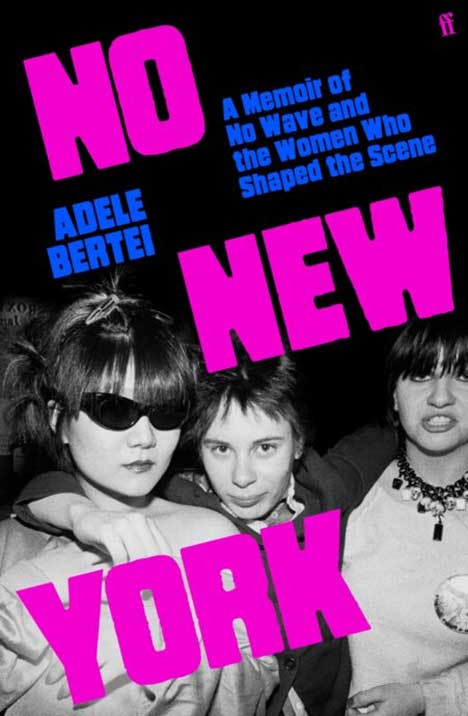
No New York. A Memoir of No Wave and the Women Who Shaped the Scene, Adele Berteri. (Faber)
Adele Bertei’s new book starts as it means to go on: assertively, perhaps even provocatively, but with statements she can back up through personal observation and experience. Here’s the start of her ‘Prologue’:
New York City was once a haven for reinvention. No Wave was born there,
a counterculture that brought punk, rock, jazz, funk, hip-hop, film, art, and
outlaw sensibilities into a vibrant and volatile mix. If the Lost Generation
strayed because of the wasteland of World War I, we eclipsed their ghosts
by howling ‘NO’ to the dead-eyed cultural and political landscape of the
1970s. Art guerillas, esoterrorists, and wild Mary Shelleys, we stitched
together our own Frankenstein monster – a moveable feast of No. […]
No Wave was downntown NYC. Our No New York.
Bertei makes it clear she knows how nostalgia and time distorts memory, and notes that this is her version of things rather than any definitive version. It is about her friends, her relationships and love affairs, her views and the bands, musicians and authors she met and associated with.
She tells us about these, with a focus on women, in short punchy episodes. Each chapter is hung on a certain moment or person, a gig, reading or encounter, such as meeting Lydia Lunch and Kathy Acker (not together!), James Chance & the Contortions’ – a band she played keyboard for – first gig, not to mention her first trips to NYC from Cleveland, Ohio, and her then actual arrival when she moved there. In fact the first chapter is about that arrival and her detour on the subway to St Patrick’s Cathedral en route to her East Village accommodation.
The episodes aren’t always in chronological order, and sometimes the timeline within sections aren’t sustained (for instance, a chapter about meeting Brian Eno in 1978 mentions that he ‘had been instrumental in Bowie’s LPs Low (1977), “Heroes” (1978) and Lodger (1979)’, which is an awkward bit of time travel) but it doesn’t matter. Bertei is warmhearted, generous and seemingly still enthusiastic about and delighted by life back then.
It’s not all sunshine, avant-garde music and great times though. She is dismissive about Ginsberg and his hippy associates, Warhol and his acolytes, even some of her band members and musical associates – especially when she doesn’t get paid, and also encounters misogny and sexual violence. She is witness to heroin addiction sweeping across the city and AIDS decimating the queer community which she was part of; also how quickly the original CBGBs and No Wave bands either sold out or (mostly) folded after shining brightly and provocatively for a few years.
But new music, musicians and bands continued, both in the States and across the water in the UK, where Bertei has one eye on the likes of The Slits and Poly Styrene. Just as musicians and bands from Ohio and elsewhere in America would move to New York to make their name, there was musical traffic and influence across the Atlantic. (I remember seeing Television’s first UK gig, and also UT at Riverside Studios; Patti Smith’s influence is still at work across the world; and Bertei meets Sid Vicious and others visiting NYC.) Zines and records also made their way to the UK’s alternative record shops, but little could prepare visitors for the desolate, dirty and vermin-filled city of late 1970s New York City. Squalid was not the word, even in 1980 when I first visited, though it facilitated opportunity, enthusiasm and opportunity.
Gradually, of course, the city started being cleaned up, though it took a long time to become the yuppie overpriced place it is now, and – of course – Bertei and her associates became older People found places to live and studios to work in, formed new bands and artistic collaborations, made films, music and theatre. Bertei started writing poetry and formed The Bloods, who toured as support band to several big acts, and played gigs across Europe.
Nothing, however would be the same. Hybrids of punk, dance, rap and jazz were great; reinventing pop was accepted too; some of the old venues managed to stay open whilst new ones joined them; NYC was never dull; but, but, but… Bertei succumbed to alcohol and drugs, punk became a bit passé, disco – even in its subverted forms – became for the well-heeled, there was nowhere left to squat or rehearse; and Geffen lose interest in promoting Bertei’s band’s single as she didn’t have an album ready.
Bertei remains pretty upbeat about even the later days she writes about, especially about her lovers and friends, including Lesley from the Au Pairs and Madonna, not to mention a gradual if grudging acceptance of feminist, androgyny and queer politics by the mainstream. But you can see her struggling with change, even when she sobers up and kicks her habit. As the 1980s come to an end the book ends with a prose eulogy for artist Nancy Brooks Brody, and then a poem, ‘Town of Empty’, as an Epilogue, which talks of ambition and action turning in to absence, mentioning Icarus and his melted wings in passing.
It is a phrase from the eulogy that sums this lively and engaging book up best, and which it documents to good effect: ‘We were young and free and on fire to be.’
.
Rupert Loydell