
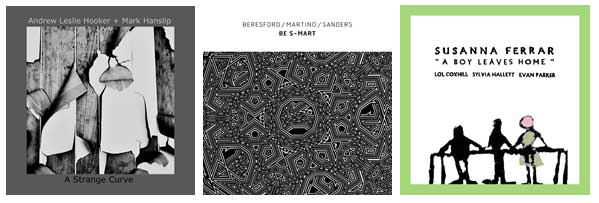
A Strange Curve, Andrew Leslie Hooker / Mark Hanslip (Scatter Archive)
Be S-Mart, Steve Beresford / Pierpaolo Martino / Mark Sanders (Confront Recordings)
A Boy Leaves Home, Susanna Ferrar (Scatter Archive)
Andrew Leslie Hooker is both a visual artist and a composer of no-input music. No-input music, for those who don’t know, takes the internal noise of electronic devices as its starting point. The idea dates at least as far back as the 1960s – various musicians, including David Tudor and Pauline Oliveros, explored it. An early, obvious, example would be Steve Reich’s Pendulum Music which dates from 1968. In it, microphones are set swinging in front of amplifier speakers – as the microphones pass the fronts of the speakers, feedback is generated. Sonic Youth created a version of the piece for their Goodbye 20th Century album (which, for anyone who doesn’t know it, is well worth checking out. It’s one they released on their own SYR label).
However, development of the possibilities of no-input music only really took off in the twenty-first century. People began to explore what could be done with mixers. One might, for example, connect the output of a mixer to one of its input channels and amplify the result. If you do, all kinds of changes can be made to the pitch and timbre of the sound by manipulating the mixer controls. Hooker has talked about how one can, to an extent, exert at least some control over the process, but there is always a degree of unpredictability involved: no-input improvisation is all about the challenge of trying to control semi-controllable chaos. It’s almost an extension of what Miles Davis said about wrong notes in jazz (‘It’s not the note you play that’s the wrong note – it’s the note you play afterwards that makes it right or wrong’). For notes read sounds of all kinds. Only it’s even more exciting – for both the performer and the listener – since ‘what you play afterwards’ is also difficult to control, which can leave one still chasing the sound that makes sense of the sound that came before it.
Hooker’s no-input soundscapes are so lacking in conventional points of reference that, I imagine, it must be quite challenging, when playing duets with more conventional instruments, to find points of contact. It’s a challenge Hooker and his collaborators have set themselves time and time again. A Strange Curve is the latest in a series of duet albums – it’s a growing list, which already features artists as diverse as recorder-player Sylvia Hinz and harpist Rhodri Davies. On this occasion, he’s paired up with sax-player Mark Hanslip. Hanslip has been a key presence on the jazz scene for over twenty years. He’s performed at many major festivals and venues and has featured on over thirty albums. He’s no stranger to collaborative duo formats either, having previously worked with drummer Javier Carmona on the album Dosados (released in 2012, on the Babel Label). And, as well as working in contexts more readily identifiable as jazz, he’s at home, too, in the more left field – and, as here, the left field of the more left field – world of free improv.
I was going to say, all credit to Hanslip here for finding things to say that fit into the musical conversation, but there’s less a sense of conversation here and more a sense of two musicians working closely together to create a homogeneous musical world which, though fundamentally electronic, admits the sound of the sax. And I should add, too, that as well as the no-input electronics, Hooker is also credited on the album as using a snare drum. From what I can hear, it sounds as if, rather than hit it, he gets it to resonate with the electronic sounds he generates, while varying the contact the snare has with the drum. The results are really effective, I think.
I found A Strange Curve a compulsive listen. Hooker and Hanslip have managed to create something really quite special. It’s definitely an album I’ll be coming back to.
Double bass-player Pierpaolo Martino has worked with Steve Beresford in the past, as part of the trio, Frequency Disasters. Together with drummer, Valentina Magaletti, they’ve already had two albums released on Confront Recordings. Here, on B-Smart, they’re working together, again as a trio, but this time with drummer Mark Sanders.
The result is forty-five minutes of very approachable, high-energy music: jazz-based, certainly, but pushing limits. Grooves are established, ideas elaborated, sometimes more straightforwardly, at others, drawing on noise and electronics. The titles of the two tracks at first put me in mind of Philip Pullman’s His Dark Materials, but, on reflection, it seems more likely that they refer to the quote from John Milton Pullman took his title from. Milton’s ‘dark materials’ are the raw, chaotic, and unformed matter from which the God of Paradise Lost forged the world:
Into this wild Abyss
The womb of Nature, and perhaps her grave –
Of neither sea, nor shore, nor air, nor fire,
But all these in their pregnant causes mixed
Confusedly, and which thus must ever fight,
Unless the Almighty Maker them ordain
His dark materials to create more worlds, …
I’m sure choosing titles is a constant headache for most musicians, and anyone coming across this quote would probably think they’d struck gold, but the allusion to Milton here really does capture a quality of the music: the confusion of elements in a ‘wild Abyss’ coalescing into compelling musical shapes is a great way to describe what’s going on here.
Tutanekai and his friend Tiki lived on Mokoia, an island on Lake Rotorua. In the evening, they used to make music together. The sound drifted across the waters of the lake to the mainland, where it was heard by the noblewoman, Hinemoa. One day, Tutanekai visited the mainland. He and Hinemoa fell in love. Sadly, though,Tutenakai had to return to Mokoia. Every evening, he played his music for Hinemoa to hear, hoping she’d follow him. Her people, fearing Hinemoa would leave them, hid all the boats. Undeterred, Hinemoa, using empty gourds as floats to help her, swam across the lake to the island, where she and Tutanekai lived happily ever after.
This Maori legend is the story behind half of the title, ‘Hinemoa (Women of Ireland)’, of one of the tracks on A Boy Leaves Home, a solo album by violinist Susanna Ferrar, which first came out on CD in 1997, but which has recently been re-released as a digital album by Scatter Archive. For me, it was perhaps the most striking track on the album. Ferrar’s improvisations often remind me of Samuel Beckett in the way they seem to struggle to articulate something that may be unsayable. It’s a struggle which sometimes resolves itself by morphing into the simple gestures of folk music (in this case, the song from the other side of the globe, ‘Women of Ireland’). Of course, it’s always presumptuous to speculate what lies behind a piece of music, but I’d say this is music about women finding their voice, struggling to live the way they want to live, and succeeding. It was recorded at a London Musicians Collective concert back in 1992 and, not that it needs any help, but the ambience certainly adds to the power of the performance.
I qualified my judgement by saying it was only perhaps the most striking track, as there is much else here that is remarkable. For example, and especially if you’re a fan of his sax-playing, it’s impossible not to be touched by Lol Coxhill singing ‘Shenandoah’. One critic noted, back when it first came out, that there was ‘too much unremarkable folk singing’ on the album, which kind of misses the point, I think (and it’s a fact which, I assume, is worn as a badge of honour, as it’s quoted in the album notes!) The thing is, Ferrar assembles her music the way one might a cabinet of curiosities. An allusion to a folk story, a folk song, someone whistling in a stairwell, her riding a motorbike, her son, as a small boy (he grew up to be actor Dickon Tolson), telling a story. And it’s the cabinet of a well-travelled curator, which is hardly surprising, as she’s a Fellow of the Royal Geographical Society. There is, inevitably, much we don’t get to see. Her grandfather, geologist HT Ferrar, was part of Captain Scott’s first Antarctic expedition. She holds a Postgraduate Certificate in Antarctic Studies and has performed on her violin both in Scott’s hut and on the Ross Ice Shelf. She has a special interest in site-specific improvisation and is an artist who, very visibly, weaves her art from the threads of her life.
Not that one needs to know the backstories to appreciate what’s happening. The music of A Boy Leaves Home speaks for itself, as it should. I described it as a solo album, but it features collaborators, too. I’ve already flagged up Lol Coxhill and Ferrar’s son, Dickon, but there are duets here, too, with sax-player Evan Parker and fellow violinist, Sylvia Hallett (‘Shenandoah’ is a trio, with Hallett and Coxhill). In ‘Oak, Ash and Thorn’, Ferrar’s folk music gestures morph into fractured free improv, converging with Evan Parker’s note-stream. And hearing Ferrar and Hallett play duets together (in ‘Ho (Scherzo)’ and ‘Art Music (Minuet and Trio)’), it’s clear that they’re improvisational soul-mates.
.
Dominic Rivron
LINKS
A Strange Curve: https://scatterarchive.bandcamp.com/album/a-strange-curve
Be S-Mart: https://confrontrecordings.bandcamp.com/album/be-s-mart
A Boy Leaves Home: https://scatterarchive.bandcamp.com/album/a-boy-leaves-home
.