

Sam Burcher visits L’ Hôtel in St Germain-des-Prés one hundred and twenty five years
after Oscar Wilde died here.
There would be no more luxury for the witty and feted playwright, novelist and poet Oscar Wilde following his disastrous libel trial in London in 1895. The case he brought against the 9th Duke of Queensbury’s claims of homosexuality, at the time a criminal offence, had led to Wilde’s conviction of gross indecency with a sentence of two years hard labour in Reading Gaol.
In prison he was allowed to write his famous eighty page letter De Profundis (From the Depths) “for medicinal purposes.” It starts, Dear Bosie, addressed to his lover Lord Alfred Douglas, the son of the Duke of Queensbury, who had encouraged Wilde’s pursuit of the libel claim against his father, with whom he was embattled.
His letter recalls with passion and bitterness Bosie’s vanity and greed whilst taking responsibility for his own part in the affair. In the second part Wilde describes with humility his profound spiritual and emotional transformation in jail. He eschews shallowness as the supreme vice and writes, “For the secret of life is suffering. It is what is hidden behind everything.”
When he arrived in Paris in February 1898 his health was considerably weakened. Wilde checked into the shabby rather than chic Hôtel d’Alsace, its atrium open to the elements, under the pseudonym of Sebastian Melmoth. Today, this building is L’Hotel, one of Paris’s best loved five star boutique hotels.

His eighteen month residency in the draughty boarding house was an unhappy one, not least because he once had been accustomed to and craved beauty. From his sickbed Wilde famously said, “My wallpaper and I are fighting a duel to the death. One or the other of us will have to go.”
The libel trial had bankrupted him, and although he still received royalties from his English and Irish publishers, the cheques were slow to arrive. To tide him over, the French Government acted to give Wilde some money demonstrating its benevolence towards the arts, a tradition which it extends to foreign artists to this day.
When Oscar Wilde died aged 46 there were no funds left. He succumbed to a swelling on his brain caused by a fall in prison, and the infection from two surgeries performed in his room to remedy it. His final bill went unpaid for two years after his death, until his literary agent Robert Ross arrived in Paris to pay it.
The last invoice is amongst the framed mementos on the opulent green and gold peacock walls of Room 16 of L’Hotel. The Oscar Wilde Suite represents a luxurious homage to the place where the writer died. As his health deteriorated, he was too ill to climb the spiral staircase to his first floor room. So, a bed was brought into a small room beyond the lobby where his surgeries took place.
No-one can be completely sure, but it’s possible this room is now an elegant niche in Wilde’s Lounge where champagne and classic cocktails are served with bright green Italian olives and roasted cashews. I think Oscar would approve. The Oscar Wilde Appreciation Society states he moved downstairs to have surgery, but for the final two weeks returned to his room on the upper floor.
Sadly, his fall from grace was irrevocable. He was mercilessly reduced from the celebrated author of witty plays, intriguing novels, poems and charming children’s stories to a penniless exile. Before the trial Wilde’s life was on course to be a masterpiece, one that required a great ending. But the public and the law had turned against him, consigning him to an unreformed penal system designed to break a man. He had been treated unfairly.
Wilde briefly reunited and lived with Bosie in Naples after his release from prison, but the lovers separated under the pressure of his penury. Bosie later repudiated Wilde and sued Arthur Ransome for publishing libellous passages referring to De Profundis. He lost the case, and in turn, went bankrupt. Bosie’s suffering would be complete when he received a six month prison term for libelling Winston Churchill during the First World War.

Wilde’s downfall had brought him to a closer understanding of Christ, and of himself. In De Profundis he drew parallels between the true life of Christ and the true life of an artist. He viewed Christ as the imaginative poet whose spiritual message was too radical for his time, and as the seasoned man of sorrows unifying life’s beauty and pain on the cross. Both Oscar and Bosie later converted to Catholicism, Wilde on his deathbed at L’Hôtel.
Other Famous Residents of L’Hôtel
In the wake of a forty day trial for allegedly exposing himself on stage, Jim Morrison, the charismatic poet and lead singer of The Doors arrived at L’Hôtel to await the verdict. His intention was to write poetry and his first port of call was Oscar Wilde’s tomb. After whiling away the time at the nearby Café de Flore and Les Deux Magots, just as Wilde had done, he moved into his girlfriend’s rented apartment in the Marais, where he was found dead on 3rd July 1971, aged 27.

Oscar Wilde and Jim Morrison rest in Père Lachaise Cemetery. The winged sphinx on Wilde’s tomb sculpted by Jacob Epstein has been shielded by a glass screen since 2011 to stop adoring fans covering it with lipstick kisses. It was Robert Ross his former agent who commissioned the sculpture on the proviso that his ashes be interred within Wilde’s tomb when he died.
The Paris prefecture demanded the Sphinx’s genitalia be covered by a bronze butterfly after the occultist and author Aleister Crowley unveiled the limestone carving in November 1913. The genitals were later stolen when the tomb was vandalised in 1961. They have never been recovered.

Morrison’s modest plot was at the centre of international media attention last year when his heavily graffitied funerary bust stolen from the graveside forty years ago, suddenly reappeared in Paris. By coincidence I happened to be in Père Lachaise at the time and was interviewed by the Associated Press about my experience of witnessing the bust in situ during the 1980’s. https://www.samburcher.com/index.php/articles/notes-on/jim-morrisons-bust-stolen-from-his-grave-finally-recovered
I met Florian Liger-Bernard, the front desk concierge at L’ Hôtel to discuss the minutiae of Oscar Wilde’s stay until his death in November 1900. He told me about the many other celebrities who have followed in the famous Irish writer’s footsteps since then. “There can be no coincidence if you choose to stay at L’Hôtel. It is a form of decadence,” he said.
At the height of the success of J’taime…moi non plus in 1969 Jane Birkin and Serge Gainsbourg moved into Room 14 whilst his nearby house, now the Maison Gainsbourg, was refurbished https://internationaltimes.it/sam-burcher-enters-the-maison-and-museum-gainsbourg-to-explore-the-life-and-loves-of-frances-most-prolific-modern-composer/ At night, Serge composed Melody Nelson on the hotel piano in the basement. This brilliant concept album was not an immediate success, because the French public in general did not understand it. Only the intellectuals appreciated its unusual and avant-garde sound. One song, Un Particular Hôtel, was directly inspired by his stay.
In the bar Florian showed me the photographs of other famous guests Elizabeth Taylor and Richard Burton, Salvador Dali, Princess Grace, and Frank Sinatra, who romanced Ava Gardner in The City of Love. He points out the grainy deathbed photo of Oscar Wilde. We respectfully discuss his life and death in the library nook.
After several iterations L’Hôtel, which stands on the exact spot occupied by La Reine Margot’s Pavillon d’Amour in the 17th century, underwent a significant refurbishment in 1967. The central atrium once open to the elements is snugly under glass. If you look up directly after entering the lobby it appears as an elegant circular tower with exquisitely lit balconies and arches on each floor interspersed with sculptural reliefs of classical figures.
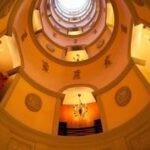
Around the tower a staircase spiralling six floors is covered in a luxurious leopard print carpet. Small indentations on the handrail burnished from hundreds of years of use attest to the innumerable and celebrated hands that may have caressed the same beautiful imperfections.
Over the last twenty years, the new owners have further transformed L’Hôtel. The bedrooms are categorised as L’ Apartment, Bijoux, Chic, Grand, Mignon, Reine Hortense, and of course, the Oscar Wilde Suite. Each room is unique and sumptuously decorated in impeccable French style by interior designer Jacques Garcia (who also designed the piano bar in Museum Gainsbourg). Garcia is the winner of numerous cultural prizes, including the Oscar Wilde Prize in 2002.
For one night I enjoy the Venetian Room 30 on the third floor. The walls are textured in striped golden velvet, the bedhead is a profusion of intricately carved wooden leaves in a Rococo style with burgundy drapes on either side. A crystal chandelier shimmers over the centre of the bed. The Rosso Francia marble that proliferates throughout the building extends to the deep bathtub.
In the stylish lounge a blazing log fire gives the entire place a warm, cosy feel. Beyond the festive breakfast room, where attentive staff and friendly guests mingle, is a view of the peaceful garden with a small ornate stone fountain where Oscar Wilde once sat quietly reading and writing.

My thanks to Florian Liger-Bernard.
L’Hotel is located St Germain-des-Prés, on 13 Rue Des Beaux-Arts, 75006 Paris, https://www.l-hotel.com
.