
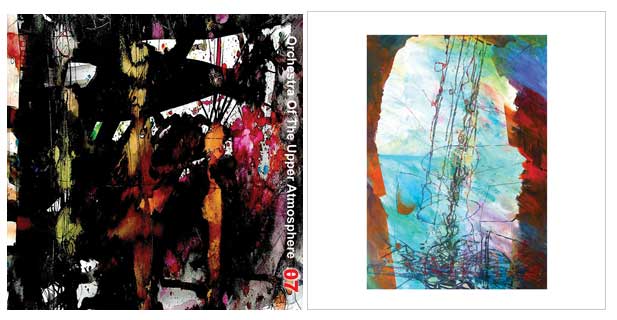
Theta 7, Orchestra of the Upper Atmosphere (Discus Music)
Immersion, Maggie Nicols, Robert Mitchell, Alya Al Sultani (Discus Music)
Theta 7 is, we’re told, to be the last of the albums released by The Orchestra of the Upper Atmosphere. This is a shame, but I guess all projects have a shelf-life and there’s nothing worse than bands, TV series, etc., going on past the date on the packet. At the risk of stating the obvious, Theta 7 is the seventh in a series of albums named after the Greek letter theta (‘θ’). It got chosen, I’m guessing, because it’s also used to describe one kind of brain wave (‘theta rhythms’) which are associated with relaxation, dreaming and effortless creativity: exactly the kind of rhythms orchestra members need to have pulsing through their heads on their journeys to the edge of space.
Inspired by their love of Sun Ra, Alice Coltrane, Stockhausen and Terry Riley, Sheffield-based sax player and electronic musician Martin Archer and his long-time collaborator, keyboard player Chris Bywater put OOTUA together in 2010. The idea was ‘to create a large scale music which would be improvisation-based but would also feature arrangements for massed voices, strings and horns. A process which they … named “Improg”.’ The result was Theta 1. A core group – initially, a septet – was established which, with minor changes, went on to create the subsequent albums, drawing in other musicians as required (notably, but not on Theta 7, the 30-voice avant-garde choir Juxtavoices). What followed was described by Chris Cutler as music founded in ‘a rock-rooted aesthetic, but with acres of space for improvisation, sonic exposition and studio manipulation. Assembled (a lot like Unrest-era Henry Cow) through a process of focused improvisation, extensive editing, customized composition, many overdubs and radical mixing – the results are persuasive and full of musical substance.’
If Theta 7 is your first encounter with OOTUA, it may well leave you with a desire to check out its predecessors. If it does, Sid Smith, writing in Prog Magazine, reckons Theta 4 is a good place to start. Having had a listen myself, I wouldn’t argue with him.
As for Theta 7, I’d really recommend taking the option to listen to the album without track breaks (Track 12 on the Bandcamp page), as the tracks really do, for the most part, flow naturally one into the other. I’d save the seperate tracks for if I wanted to listen to a particular part. It begins with a duet for double bass and guzheng which makes striking use of the stereo space and slips effortlessly into a hypnotic groove entitled ‘A Blessing in Azure’. A restless violin solo from Yvonna Magda introduces a hymn to the dawn (hearing the way the guzheng is used on this album, its hard not to think of Alice Coltrane’s harp). This, in turn, morphs into a celebration of the deep sea: a world of darkness, strange creatures and hydrothermal vents and about as far as you can get on the Earth, physically, from the band’s natural habitat of the upper atmosphere. They sound quite at home there, though. This gives rise to a rich groove, striking for its spiky, high speed glissandi. ‘Cold Mariana’, alluding to the Mariana Trench, is a musical evocation – or so it seems, to me – of the view from a bathysphere window. If we’ve not realised already, this album – perhaps because it’s the last? – sets out to embrace the whole universe. There have been previous forays (one title on Theta 5 references, I suspect, the famous Hubble image of the Pillars of Creation) but what’s going on here is far more systematic. We return to the surface, where the moon is rising. What follows is a hymn to Aether, the Primordial Titaness of the sky, no less. OOUTA name-check Stockhausen as an influence and I couldn’t help being reminded here of the text of that composer’s text-piece, Set Sail For the Sun, in which the performers are asked to gradually transform the music they’re making ‘until you arrive at complete harmony / and the whole sound turns to gold / to pure, gently shimmering fire.’ After this we’re plunged into an evocation of black holes, the darkest places imaginable (at least from the outside. On the inside, who knows?). The next track references the space rock Oumuamua, a visitor from another solar system, music that attempts to give shape to something we can only vaguely discern. The penultimate track is a stonking cover of Sun Ra’s ‘That’s How I Feel’ – an inspired, optimistic way to bring the OOUTA journey to an end. What follows is another duet, mirroring the first track, this time for Jan Todd’s guzheng and violin. (Anyone who finds these duets interesting – and they are – should check out the OOUTA spin-off Private View 185CD (2024), also available on Discus Music, an album Jan Todd and Archer made together, without the rest of the band, although I think OOUTA bassist Terry Todd joins them for one track).
Theta 7 is quite something. Stockhausen and Alice Coltrane would’ve approved, I hope. Sun Ra would’ve been bowled over.
Free improv vocalists Maggie Nicols and Alya Al Sultani have worked together quite a lot in recent years. When, in 2024, they were working on their album Free, Free, Nicols brought along a poem by jazz pianist (and poet) Robert Mitchell, to see what they could do with it. The upshot was that they got together with Mitchell himself to make the album Immersion, recently released by Discus Music and described by Al Sultani as ‘a sonic interpretation of three of Robert’s books of poetry, three poems chosen by each of us’.
There is, a course, something of a tradition of improvising pianists writing poetry – Sun Ra and Cecil Taylor spring to mind. Anyone unfamiliar with Mitchell’s writing should check out his poetry audiobook (available on Bandcamp), A Vigil For Justice, A Vigil For Peace. If, like me, you like to know a bit about a poet’s work before you hear it used in a piece of music, you’ll be interested to know that one of the poems he reads on it, ‘You Are My World’, also appears on Immersion (as ‘My World Is You’). I was wondering how best to explain how his poetry relates to his music and then realised Mitchell had already done a better job than I could in the album notes that go with Immersion: ‘As Wayne Shorter says ‘Our instrument is our humanity’. Our most human job surely is to keep our antenna clean and functioning, and to keep as many channels open as possible. As a result – we might even receive the coordinates to the most important treasure: living in peace. The daily distractions, and thus the deliberate weakening of our abilities to work together while benefitting from our naturally occurring ‘differences’ – are some of the most pressing challenges of these times.’
The first track, ‘Amongst a Trillion Fears’, is all vocal. Mitchell recites the poem with some rhythmic elaboration while Nicols and Al Sultani weave improvisational paths around his words. From hereon in, Mitchell spends most – although not all – of his time on the piano. It soon becomes clear that the words are often hard to follow. It’s best not to try. After all, what we’re being offered is the essence of poetry rendered as music: to try to follow the poem in each case could be considered a distraction. A lot of the time, only the occasional phrase jumps out (‘walk as one’, ‘full immersion: there is no division’, ‘we are free’). The style of the music ranges from the bluesy (especially in ‘My World Is You’ and ‘Soul Speak’) to the avant-garde. Although what’s happening here is obviously on a much smaller scale, I was reminded more than once of the late operas of Michael Tippett and, indeed, the themes of Mitchell’s poems and Tippett’s libretti are not dissimilar.
Nicols’ more natural voice with its wide-ranging vocal effects, Al Sultani’s more trained voice and Mitchell’s piano make a great trio. As I said, there’s everything here from avant-garde pyrotechnics to great bluesy moments, but some of the most spellbinding music they make together (as in ‘Inner Sanctum’ and ‘Where We Are’) succeeds because, it manages to be complex without being dense. Do give it a go.
.
Dominic Rivron
LINKS
Theta 7: https://discusmusic.bandcamp.com/album/theta-seven-206cd-2026-2
Immersion: https://discusmusic.bandcamp.com/album/immersion-205cd-2026
Robert Mitchell’s poetry – A Vigil For Justice, A Vigil For Peace:
https://robertmitchell.bandcamp.com/album/a-vigil-for-justice-a-vigil-for-peace-poetry-audiobook
.
Thanks
I saw Terry Riley a few years ago performing n London and he was in amazing nick. Persian Surgery Dervishes remains a recording I listen to on repeat and repeat ….. because I seem to need a hook or melody of some sort I struggle with a lot of music I really want to like!
Comment by Steven Taylor on 12 February, 2026 at 8:01 amI’d say keep struggling! I remember feeling like that. I was about 14 when I first heard atonal music. I didn’t get it, but had this inkling there was something in it I was missing – so I kept listening. By the time I was 16 it ‘clicked’. Of course, there are pieces you like and pieces you don’t, but people often assume that there’s something ‘clever’ going on that they’re supposed to appreciate at some vague intellectual level in more ‘difficult’ music, when in fact, when you get into whatever it might be, however it’s put together, there’s usually something in there waiting to grab you, just as with other musics.
Comment by Dominic Rivron on 14 February, 2026 at 9:08 am