
I arrive into what feels like Paris of the past, of flea bitten mattresses, and the charming reek of damp furnishings in shuttered corners, out of the sun. Sam Burcher
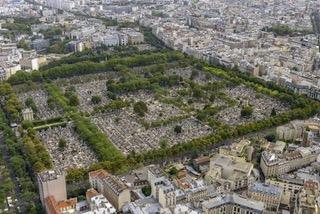
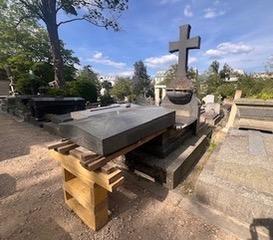
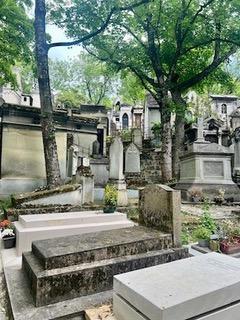
It seems to me that life and death are never far away in Paris. An Artic wind persistently stirs the air in May. Paris wants my bones, but it can wait. It already has millions of bones in seventy thousand tombs in Père Lachaise cemetery, where the burial shafts go surprisingly deep. I peer inside an open tomb, directly behind Oscar Wilde’s glorious flying Sphinx. Its heavy stone lid has been slid to one side and rests on a wooden sawhorse. A ladder placed inside waits for the descent of a climber to receive the freshly interred body on its last journey underground.
Billions more bones are stacked beneath this city. The long bones, small bones and skulls of six million people are piled high in the catacombs running sixty five feet deep under the lively streets. My days of wandering overground have convinced me that Paris is the place where poets come to die. Consider the Irishman Oscar Wilde and the American Jim Morrison, illustrious, but exiled poets reviled by many in their native countries. Yet, Paris welcomed them, then subsumed their bones to rest in peace forever.
The French have long revered the poets buried in Paris’s largest cemetery garden named after the confessor of Louis XIV, Father François d’Aix de La Chaise. Here lie Guillaume Apollinaire, Honoré de Balzac and Molière to name but a few. For me, a homesick outsider, the loveliest structures in this meditative English-style park are the manifold trees forming a purifying canopy. My intention to revisit the graves of Wilde and Morrison and to seek out Chopin and Colette is peppered by distractions. All around ivy twists and turns amongst the trees. I am lost on the cobbled paths of the Divisions.
Père Lachaise is crammed with all sorts of tombs. Vaults house the dead in stone drawers, the mossy epitaphs to who they were in life have weathered. Some lie under thick slabs of glinting black granite with gold symbols and letters which gleam in the sunlight. Others recline in Gothic tombs laden with angels, flower motifs, symbolic handshakes, intertwining snakes, and the grotesque heads of otherworldly animals. Some are now supine bronze likenesses of their former selves hovering over a casket of bones.
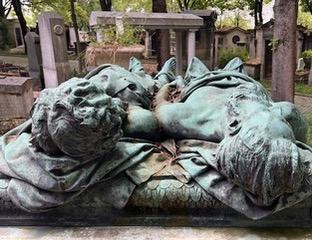
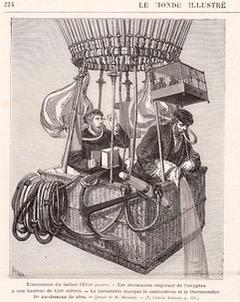
Take for example the hot air balloonists Joseph Croce-Spinelli and Théodore Sivel, a pair of science mad adventurers who died of oxygen depletion at 28,000 feet, an altitude known as, “the death zone.” These co-pilots of the Zenith became indifferent to their perilous situation, and were happy to rise and rise. Now, they lie side by side atop a tomb, their verdigris figures with fingers entwined have been grounded for eternity.
A bronze figure with the unlikely reputation of being a fertility symbol belongs to Victor Noir. His likeness is regularly caressed or even mounted by females hopeful of conceiving. His mouth, nose, crotch and feet gleam against his tarnished prone figure, bearing witness to a bizarre ritual that apparently has brought joy to thousands of women. In life Victor was a journalist who was shot dead in a dual by Prince Pierre Bonaparte, a cousin of the then ruling Emperor Napoleon III, who became a symbol of the Revolution within a year of his death.
Many of the smaller vertical tombs are reminiscent of telephone boxes, but wider and deeper. The hinges of oxidised doors that once secured a place of prayer and reflection are shorn. Inside the rickety chairs, crumbling urns and vases filled with ancient flowers on wonky tomb shelves are dusty and unloved. Stained glass windows that once glowed so beautifully are smashed, the faces of Jesus and the Saints have gone missing.
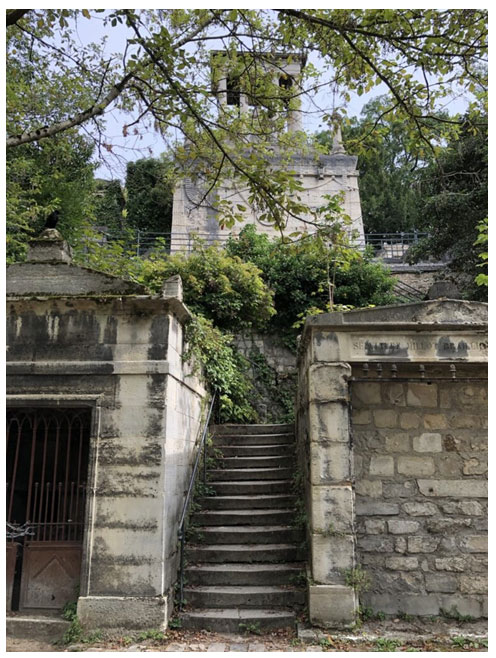
The grand mausoleums akin to small Greek temples which crowd the hills and fields have fared better. Intricately carved symbols meaningful to the family decorate the formal and ornate architecture. A reverence for bygone traditions remains intact and the families of passed on loved ones maintain these well-tended tombs.
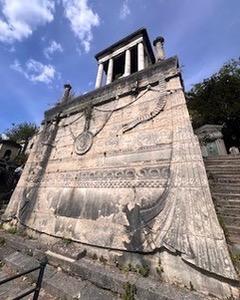
Countess Stroganoff
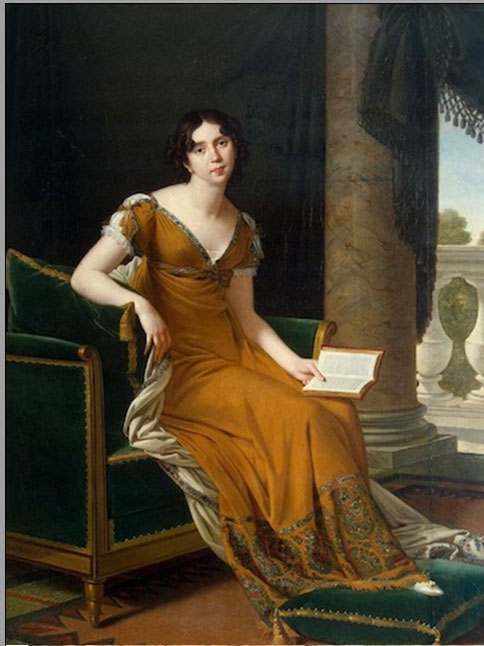
One of the grandest mausoleums is too lofty, too mysterious, and too arcane to overlook. It belongs to the Russian Countess Stroganoff, also known as Elizabeth Demidoff. Her story is too strange not to tell. The Countess Elizaveta Alexandrovna Stroganova, the mother in law of a Napoleonic princess, was a married woman who left her husband and four children in Rome. For a time she lived a glamorous society life in Paris, but succumbed to an illness aged just 41.
Her tomb in the 19th Division is topped with towering white marble columns above magnificent stone mausoleum. Every inch is covered with intricate carvings of knots, hammers and bats, and the protruding heads of wolves and bears. A stone frieze of sables, a small furry animal, similar to a weasel runs around its surface.
The images of the sables trigger memories of a sighting of an unusual and wounded animal a couple of nights before in nearby Belleville. I wondered how it came to be roaming the city streets. Could it be a ferret, a weasel or maybe a mink? I watched it repeatedly fail to jump a lowish wall overhung by a tree. It was limping and the damaged leg impeded its spring.
Other observers had gathered and were shining phone torches on the poor creature. No longer able to watch, I walked away praying it would live another day. And just days later, the animal on the tomb of Countess Stroganoff struck a chord. The sables represented her source of immense wealth from the Russian fur trade. I begin to fantasise the stout legged creature was a sable signalling the presence of the Countess eternally resonates in Paris.
Sometime after her death, a rumour began to circulate about a strange and enticing caveat in her Will. In 1893 the French newspaper La Justice issued a challenge purportedly set by the Countess that anyone who stayed in her tomb for a year would win one million francs. Countless other newspapers around the world ran the story claiming her body was perfectly preserved in a crystal coffin within the walls lined with plate glass mirrors. The willing applicants could leave the tomb twice a day at dawn and dusk for an hour’s walk, could not work, and meals would be brought in to them.
The rumours became wilder with each passing year, as the reward increased to five million francs. One candidate, who lasted the longest, was a gibbering wreck after three weeks. The outlandish claim emerged that the Countess was, in fact, a vampire. The origin of this story is most likely a work of German fiction by Karl Hans Strobl, which translates into The Mausoleum on the Père Lachaise (1917). This was followed by the French tales of The Guardian of the Cemetery and The Graveyard Duchess (1919), translated into English in 1934 and The Cemetery Watchman (1965), a story in which a Countess preys on the men paid to guard her tomb. The reports circulated many years after her death, so although intriguing, are most likely untrue.
In Belleville
I am alive in the enclosed garden yard in Belleville. The bees are humming around me as if my being was a delicious flower. Their hum is relaxing, so is the warm sun, and the sound of the children playing in the apartments above. I luxuriate in my own scent, not quite as sweet as a flower, appreciating the solitude. A lively blackbird hops through the metal railings on one side of the yard and onto the concrete floor. It’s dark plumage contrasts sharply with the red and pink geraniums. Next to them are violets and oxeye daisies and an elegant pink tea rose is poised in a pot on the garden table.The yellow lilies and red brooms that spray out from planters on wooden palettes are buzzing with bees. Tiger lilies jostle with lithe strips of bamboo that grow ever taller.

The birds bustle around the garden chirping and singing, “Oui! Oui Oui! We sing because we are alive. We sing to remember, not to forget.” I recall the grave of the “Little Sparrow” or Edith Piaf in Père Lachaise where people flock to pay their respects to the renowned singer of heart-wrenching torch songs. Her plot is understated, but poignant. She is buried with those she loved most in her life. A modest gravestone, like the chanteuse in her little black dress. A fierce little sparrow appears on the well worn path to Piaf’s plot. A bird so curious, so impeccable, seemingly fearless enough to ward off the crows that caw and scavenge amongst the plots.
On a small crossroads in Belleville, where I have been enjoying the open studios of welcoming artists, I live temporarily in a wood cabin set inside the pretty garden yard. In one long room with a kitchen, bedroom and bathroom the walls are painted white, yellow and green. Books, guitars and a piano keyboard are dotted about the sitting and dining areas. Two sets of sliding glass doors have electric metal shutters that winch up and down noisily at the touch of a button. The reveal of the sunlit garden each morning thrills me and a sense of security pervades with each final descent at night.
At 2.30am I’m awoken by the crazy man’s shouts of, “Fou! Fou! Fou!” His anguished cries echo round the empty streets in agonising intervals that I hope will stop sooner rather than later. He is drunk, mad, but full of fight. I reckon his need to be heard could last for an hour. The crescendos and diminuendos of his unfaltering roar as he roams the crossroads continue for exactly that. The strains of grief and rage spilling from his heart and soul are immense. Yet, he does not cease, he is not dead. His tirade might once have raised an army, got him arrested, or even killed. But now, the cries of the madman go ignored and unheard. He is crying for survival. So, as the rest of Paris sleeps, he gives voice to it.
.
,