
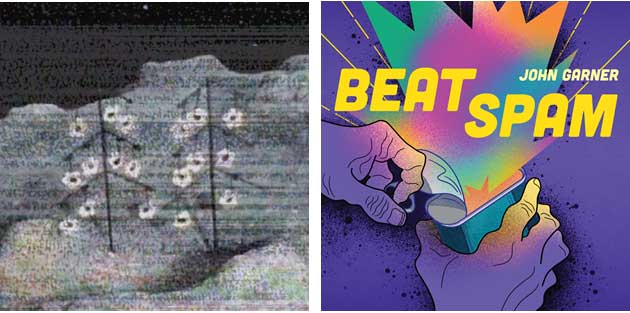
Gerauschhersteller Spielt Klangermusik, Gerauschhersteller (Gerauschhersteller)
Beat Spam, John Garner, (John Garner)
Based in Dorset, Gerauschhersteller (in English, ‘Noise Maker’) is an ensemble specialising in experimental and indeterminate music. They have an impressive track record, having made what I think is the only complete performance on CD of Cornelius Cardew’s Treatise (you can find it – and buy it – on their Bandcamp page), as well as recording works by Luc Ferrari, Ichiyanagi and Cage. They comprise of Paul Allen, Steve Gibson, Adrian Newton and Stuart Riddle although, here, on their latest album, Gerauschhersteller Spielt Klangermusik, they’re reduced to Newton and Riddle playing electronics, noise box, flute and guitar.
In the notes that go with it, Riddle describes how it sprang from their desire to make music inspired by the British, twentieth century stop-motion animated TV series Clangers. Back in the 1960s, they say, ‘Star Trek and Clangers presented us with visions of a future which was moneyless, low growth and based on co-operation and mutual aid. The impact of these events has never left us.’ They perused scores from the original series but decided they really didn’t want to create a pastiche of the original (for a start, Swanee whistles were out). They wanted to reimagine it and create a tribute to it, using the original as a starting-point.
It’s an intriguing project. Clangers ran from 1969 to 1972. It was a part of the popular culture that ran alongside the countercultural and avant-garde work that is so much part of and informs Gerauschhersteller’s repertoire. Cardew finished Treatise two years before Clangers came out and, by coincidence, famously and misguidedly renounced all his avant-garde work the year the original series ended. In the UK, you could say Clangers was part of the wider culture such things swam in. It’s even possible to imagine you might’ve caught a glimpse of it on one of Nam June Paik’s TV set installations.
Electronic music has been used to evoke outer space and alien words probably for as long as it’s been around. Not only does the novel sonic environment it creates echo the novel environment that exists beyond the Earth but, also, as we know, when we hear it, the technology that makes the sound is much the same as that which got us into space. I’m talking, of course, of the kind of electronic music that doesn’t set out to emulate the acoustic kind and, although I described it as ‘novel’, it has, of course, been around for over half a century. ‘Modernistic’ might be a better term; and it’s a strangely disorientating aspect of contemporary life that the term ‘modernistic’ should evoke in us a feeling of nostalgia. It’s disturbing, too, when whatever it is we might be contemplating is explicitly bound up with a radical political vision, although what disturbs us is always there implicitly: the modernistic past affords us a glimpse of a future that has failed to materialise. It confronts us with the reality of the ‘managed decline’ we’re living through and the possibility of great things which have not yet to come to pass. (It’s not fanciful, by the way, for Gerauschhersteller to associate Clangers with radical ideas: the Clangers’ creator, Oliver Postgate, was the grandson of George Lansbury, the pacifist Labour MP who led the Poplar Rebellion).
The result here is an electronic alien soundscape that certainly evokes the clangers’ cratered blue planetoid. The sonic abstractions gradually coagulate into slightly more conventional forms, as in the longest track, ‘Unknown objects, too small to see from here’, which has a sense of dream-like wonder tinged with melancholy (or the other way round). The melodic and harmonic elements that run through this album – sometimes fragmentary, at others, more sustained – have the feel of words whispered on the edge of sleep (the flute in ‘They’re dropping blow-fruit in the soup well’ even put me in mind of Kenneth Grahame’s ‘The Piper at the Edge of Dawn’). This is as it should be, as this is music that imagines other worlds while dreaming of the past. A great listen.
John Garner’s Beat Spam is one of a growing list of albums made entirely with the Koala Sampler, an app you can download to your phone for less than a fiver. There are forty-five tracks: the longest is less than three minutes, almost all are less than two and quite a few last only a few seconds. There are some really ear-catching ones and, given the range of instruments he plays – he has, for example, a ‘sympolin’, a kind of cross between a Hardanger fiddle and a viola d’amore, which was specially built for him – I found myself often wondering what it was he’d been sampling. When I first started listening, I thought the whole thing might be something of a novelty (there are some groovy beats here), but it’s not: there’s a minimalist economy to the means of production, but it’s a limitation Garner exploits to rich effect. Some tracks are obviously a bit of fun (it’s hard not to smile while listening to ‘Big River’, for example) but the whole has a dark side to it, evidenced by allusions to Gaza. In a way, it mimics the society we live in, in which synthetic beats permeate everything with indifference, from headlines about war to adverts for the latest SUV. And it’s packed jam-full with imagination from the off, all the way through to the funky oligarchs of the fifty-six second finale. It’s not only a great listen, but also, if you’re like me, it’ll probably leave you wanting to shell out a fiver for a Koala Sampler, too.
.
Dominic Rivron
LINKS
Gerauschhersteller Spielt Klangermusik: https://gerauschhersteller.bandcamp.com/album/gerauschhersteller-spielt-klangermusik
Beat Spam: https://johnjamesgarner.bandcamp.com/album/beat-spam
.
That’s a really interesting juxtaposition – I’ve always thought about the comfort of a warm soup versus the sheer convenience of a processed food.
Comment by SpamDragon on 14 March, 2026 at 8:13 am