
by Ade Rowe
The relationship between anarchists and the avant garde is not a sealed chapter of cultural history but an unsettled current that reappears whenever people begin questioning authority in both politics and culture. It travels across languages, countries, and generations, shaped by particular local conflicts yet held together by a shared suspicion of imposed order. Beneath it lies a simple conviction: when life and creativity are directed from above, both lose their vitality. Anarchists have long challenged political domination, while avant garde artists have challenged cultural obedience. At many points the two impulses have moved so closely together that they seem less like separate traditions than different expressions of the same restless refusal.
Anarchist thinking begins with a deep doubt about hierarchy. Writers such as William Godwin in Britain, Pierre Joseph Proudhon in France, and later Mikhail Bakunin and Peter Kropotkin argued that authority weakens human responsibility rather than strengthening it. They believed people learn cooperation, care, and moral judgement through shared experience, not through punishment or command. From this perspective, art could never simply exist to decorate institutions or preserve inherited taste. It should remain open, shared, and responsive to human life. The avant garde arose from a similar dissatisfaction. Its artists rejected polite aesthetic rules, established forms, and the expectation that culture must behave obediently toward tradition.
Even before anarchism took shape as a named political philosophy, certain writers were already imagining ways of living beyond strict authority. Daniel Defoe occupies a curious and important place in this earlier landscape. Writing during a period marked by censorship and severe punishments for dissent, Defoe himself faced imprisonment and public humiliation for his words. These experiences contributed to a lasting suspicion of power that runs quietly through his work. His narratives often portray individuals forced to rely on judgement, improvisation, and practical reasoning rather than official guidance.
In Robinson Crusoe, Defoe imagines a setting in which organised government is entirely absent. Crusoe survives not through law or command but through work, observation, and patience. Order emerges from daily necessity rather than formal authority. Later readers sympathetic to anarchist ideas noticed this detail. Godwin admired the possibility that moral behaviour might grow from reflection and habit rather than enforcement, and Kropotkin would later argue that cooperation, not domination, is the real basis of survival. Although Defoe himself defended property and empire, positions anarchists firmly rejected, the image of practical self organisation found in his writing influenced later thinkers and artists who explored the possibility of life beyond the state.
France became one of the richest environments for the encounter between anarchism and avant garde creativity. Paris in particular contained striking contrasts, elegance beside poverty, artistic brilliance alongside intense political repression. Anarchists including Proudhon, Louise Michel, Élisée Reclus, and Sébastien Faure were involved not only in agitation but also in publishing, education, and cultural work. They believed ideas should circulate freely and reach ordinary people rather than remain confined to elites. Writers and artists often lived in the same districts, sharing cramped rooms, cheap cafés, and the constant awareness of surveillance.
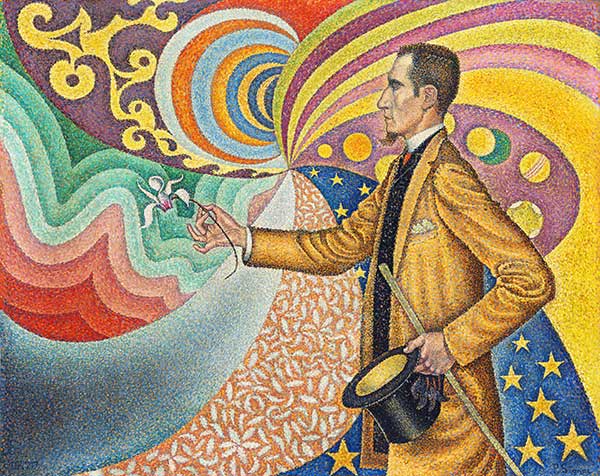
Within this atmosphere, French avant garde figures such as Stéphane Mallarmé, Alfred Jarry, Guillaume Apollinaire, and later Tristan Tzara and André Breton absorbed a spirit of defiance that extended beyond aesthetics. Jarry’s play Ubu Roi mocked authority with grotesque exaggeration, portraying power as ridiculous, greedy, and childish. Apollinaire dismantled poetic order, combining fragments of speech and image in ways that mirrored the unsettled experience of modern life. In the visual arts, painters like Georges Seurat and Paul Signac showed sympathy for anarchist ideas, often depicting workers, gatherings, and shared labour rather than glorified rulers.
Printed material played an important role in this environment. Anarchist newspapers and journals frequently relied on artists to produce illustrations, typography, and striking layouts. Posters appeared on walls throughout the city, designed to communicate quickly and directly. Theatre also changed character. Instead of distant performance for passive audiences, some productions sought participation and confrontation. Actors addressed spectators openly, dissolving the usual distance between art and everyday experience. These experiments helped shape the later idea that art could become a collective activity rather than a finished object.
Russia provides one of the most intense and complicated moments in this wider story. Anarchist writers and organisers such as Bakunin, Kropotkin, Lev Chernyi, and later Nestor Makhno inspired generations who were searching for radical social change. Before rigid state control took hold, cities like Moscow and Petrograd were alive with argument, artistic experiment, and political expectation. Anarchist clubs, publishing circles, and improvised cultural spaces appeared across the urban landscape.
Among Russian avant garde writers, figures such as Velimir Khlebnikov, Vladimir Mayakovsky, and Aleksei Kruchenykh began attacking the very structure of language. They suspected that grammar and logical order carried the habits of obedience embedded within them. By inventing strange sounds, fractured syntax, and entirely new words, they tried to release thought from inherited discipline. Painters including Kazimir Malevich, El Lissitzky, Natalia Goncharova, and Wassily Kandinsky pursued similar ambitions in visual form. They reduced painting to colour, line, and spatial tension, abandoning narrative and hierarchy in favour of direct perception.
Reactions among anarchists were mixed. Some celebrated these experiments as necessary steps toward freeing the imagination. Others worried that art might drift too far from the concerns of labour and survival. Yet for a brief moment artists and anarchists shared common ground in workshops, cafés, and informal gatherings where politics, poetry, and daily life blended together. When authoritarian power later tightened its grip, anarchists were violently suppressed and many artists were pushed into official aesthetic programmes. Nevertheless, memories of that earlier freedom continued to circulate quietly among later dissidents and underground cultural movements.
In Germany after the First World War, the devastation of defeat and economic collapse created another volatile environment for artistic and political rebellion. Anarchists such as Gustav Landauer, Erich Mühsam, and Rudolf Rocker believed cultural transformation was inseparable from social change. Landauer argued that genuine revolution begins in relationships and everyday behaviour rather than in the capture of institutions. Mühsam combined poetry, satire, and direct political resistance in his work and activism.
Avant garde artists including Hannah Höch, Raoul Hausmann, George Grosz, and John Heartfield responded to the fractured atmosphere of the time with techniques such as collage and photomontage. By cutting apart newspapers and official imagery, they exposed contradictions within the language of power. Political leaders appeared as mechanical figures, distorted faces, or lifeless bodies assembled from fragments. This visual strategy echoed the anarchist suspicion that official narratives conceal domination beneath a surface of order. With the rise of Nazism, anarchists were among the earliest targets. Mühsam was murdered in a concentration camp, Rocker escaped into exile, and many others survived only through silence or secrecy. Art persisted in coded forms, private notebooks, and quiet acts of refusal.
Britain presents a quieter but still influential strand of this shared history. William Godwin had already laid early philosophical foundations for anarchist thought, and later writers such as Herbert Read, Alex Comfort, and Colin Ward explored the connections between anarchism, education, creativity, and everyday life. Read in particular played a crucial role as both an anarchist thinker and a respected art critic. He argued that modern art revealed a fundamental human desire for balance and freedom that cannot flourish under rigid authority.
British avant garde figures such as Wyndham Lewis, David Bomberg, Mina Loy, and various experimental poets associated with small magazines challenged established expectations tied to class, empire, and cultural hierarchy. Independent presses became important spaces where unconventional work could appear without institutional approval. Poems, essays, drawings, and manifestos circulated in modest publications that reached readers far beyond official cultural centres. In this environment, technical polish mattered less than sincerity and experiment. The idea that anyone might participate in cultural creation echoed anarchist hopes for a society organised through shared responsibility rather than control.
In the United States the connection between anarchism and avant garde culture developed under different conditions shaped by migration, labour conflict, and enormous economic disparity. American anarchism attracted workers, intellectuals, and organisers who saw cultural freedom as inseparable from social struggle. Figures such as Emma Goldman, Alexander Berkman, Voltairine de Cleyre, and Lucy Parsons insisted that political liberation must include freedom of expression, sexual autonomy, and creative experiment. Goldman in particular defended theatre, literature, and modern art when critics dismissed them as immoral or incomprehensible. She believed that art should unsettle complacency and expose hidden obedience.
Avant garde activity in the United States grew through small magazines, experimental theatre groups, and loosely connected artistic communities. Artists such as Marcel Duchamp during his New York years, Man Ray, Mina Loy, and later performers working across different media challenged established definitions of form and meaning. Theatre sometimes dissolved the barrier between audience and performer. Poetry explored rhythm, repetition, and fractured narrative. Visual artists turned their attention to machinery, crowds, and alienation in rapidly expanding cities. In dance and music, improvisation and chance increasingly replaced strict choreographic order.
Across these varied places and movements, a recurring idea appears again and again: freedom cannot simply be granted by authority, it must be practised. Anarchist thinkers including Godwin, Proudhon, Bakunin, Kropotkin, Goldman, Rocker, Landauer, and Ward provided artists with ways of thinking about responsibility, cooperation, and power. At the same time, avant garde figures such as Jarry, Apollinaire, Malevich, Khlebnikov, Höch, Duchamp, and Herbert Read offered anarchists imaginative visions of freedom that extended beyond political slogans or programmes.
The connection between anarchists and the avant garde does not conclude with any single movement or historical episode. Its deeper significance lies in an attitude that returns whenever people begin to resist control and imagine new ways of living together. What appears at first as artistic rebellion often reflects a broader refusal to accept authority as inevitable. In this sense the tradition is less about chaos than about mutual care without command, creativity without permission, and trust in human judgement without rulers.
This history offers no final doctrine and no tidy lesson. Instead it leaves behind a set of possibilities: refusal, experiment, cooperation, and faith in human capacity. Wherever individuals continue to create without asking approval, to organise without rigid hierarchy, and to speak without fear of authority, the quiet alliance between anarchist thought and the avant garde continues, unfinished and quietly defiant.
.