
for the
South Bank 75th anniversary, London, Friday 27 March 2026
A peaceful future starts with human rights for all
If the aim of the Great Exhibition of 1851 was to show off the brilliance of Victorian inventors, its centenary with the Festival of Britain in 1951 sought to raise spirits after the war. Many still lived in temporary housing, rehabilitating from injury and loss; they were coping with rations, young men were still being called up to National Service.
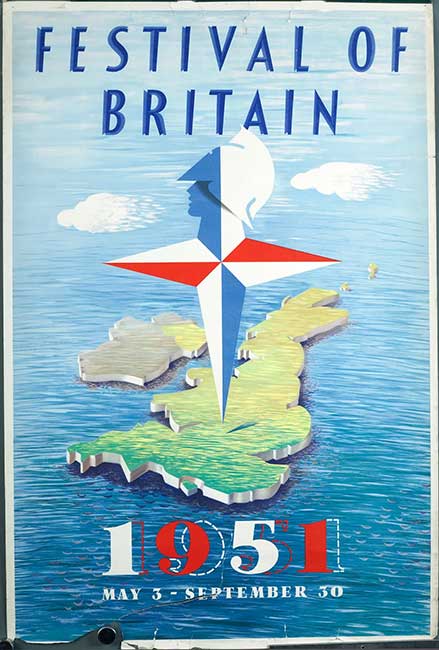
The Festival posters were designed in the favourite new sci-fi genre. A Flying Saucer inspired spaceship the size of a stadium had landed on marshland across from Parliament. A steel tower, the Skylon, stood 350 ft (95m) tall to track space objects travelling at supersonic speed, as in The Day the Earth Stood Still. Festival goers were familiar with HG Wells’ books, although still a few years too early to watch the War Of The Worlds and Time Machine. The only strange detail was the colour of flowers in the Festival gardens, not expected by an audience of black and white films. It would be another 6 years before Laika circled the Earth in a Sputnik, but outer space travel was already believed to be imminent. The posters promised innovation and amazement to a public keen to be transported to a different place and time.
The Festival programme showed an avantgarde Boadicea, draped in end-of-war celebratory bunting. How many working class people could afford the 2/6 (25p) cost of the programme, on top of the entrance ticket, if that was the same as half a day’s work? The time off work, neighbours and relatives to look after the children? While some considered the Festival a waste of money the country did not have, 8.5 million people visited the South Bank for the Festival, half from outside London.
Futuristic music was expected. None of the pieces submitted by leading composers of the time featured in the Festival, not even by Benjamin Britten following his recent success with Peter Grimes. The mainly US composers of film scores from that time do not seem to have been invited.
Young composers wrote music for performances by both the Ballet Rambert and the Sadler’s Wells Ballet. By 1951, London had four great ballet companies – Rambert, set up during World War I; the soon to become Royal Ballet resident at the newly reopened Royal Opera House, and its sister company Sadler’s Wells in Angel, both formed by Wicklow-born Ninette de Valois after she left Diaghilev’s Ballets Russes; plus a brand new London Festival Ballet named for the forthcoming Festival.
Future concert Part 1 – Voices
Let’s imagine the Festival visitors, weary from walking the Coal Cliff in the Hall of Power, the Hall of Ship Building and Railways and the Hall of the Future, were invited to take seats for a ‘glimpse into the future’ concert. Unseen projectors and coral pink light beams from high above the roof reveal a recently formed Philharmonia Orchestra, composer, conductor and choir of sopranos. The musicians are surrounded by images of the same Royal Festival Hall, only it is filled with different colours and ages of people in unusual clothing, who have been teleported back to 1951 with a concert entitled ‘Possible Futures, Friday 27 March 2026.’
Yulia Mahr introduces her husband, the composer Max Richter, and everybody in the film audience cheers and applauds. This is the British composer chosen by the South Bank to create this anniversary concert. With a bow, he takes his seat between a grand piano and a keyboard at the front of the stage, beside a lead violinist, soprano and an actress, whom the 1951 audience will not know. When quiet returns, Yulia welcomes everybody to a musical explanation of the Universal Declaration of Human Rights, adopted by the still new United Nations in 1948. She refers to post-truth politics which nobody in the 1951 audience can understand.
Waves of spoken testimony echo in a hundred languages around the Royal Festival Hall. Although only a few of the words will be understood by any one person, the pain of the survivors ripples through the audience in tremors.
Jessie Buckley takes the stage as Eleanor Roosevelt, the leading United Nations and human rights activist of their time. With accompanying choir, she recites the Preamble of the Universal Declaration of Human Rights. Then from Article 1:
“All human beings are born free and equal in dignity and rights.”
Max begins his composition Voices at the keyboard. Jessie continues:
“Everyone is entitled to all the rights and freedoms in this Declaration, without distinction of race, colour, sex, language, religion, political or other opinion, national or social origin, property, birth or other status. No distinction shall be made on the basis of the country… to which a person belongs…”
The strings accompany Max on the piano. He sways gently, hands lifting like waves. There is an acoustic power to this concert hall that is easily underestimated by its rectangular concrete shell, voices and instruments all individually clear. Soft pastel light drifts like clouds across the ‘backstage’ where rows of the film audience are sat in the 360-degree space. To the 1951 audience it would have been otherworldly.
Jessie continues with Article 3:
“Everyone has the right to life, liberty and the security of person.”
Max has moved to the enormous shiny black grand piano. The voices continue, a child’s as well. The key 4 beats of this tune are amplified by double basses.
“All are equal before the law and are entitled without any discrimination to equal protection of the law…”
The 12 sopranos of London Voices form a choir of angels now spotlit across the back.
“Everyone has the right to a nationality and to change his nationality.”
More recounted experience echoes around the hall. A songbird chirps. The whole orchestra is joining in a thunderous roll of drums and bass. Dry ice fogs the back and sides of the stage.
The solo soprano Sarah Aristidou moves to beside Max, who has been playing throughout. Her song is without words, South Asian in feel.
“All human beings are born free and equal in dignity and rights,” Jessie repeats. “No distinction of race, colour, sex, language, religion, political or other opinion, property, birth or other status.”
A gentle white beam lands on Max as he pulls at our hearts, to slow our breathing and synchronize us into the performance. Spirits fly with the light and image created. This singing would be unlike any from an opera some of the 1951 audience may have attended, rather the ethereal sound of a new planet. All the while, voices speak in different languages. The choir joins and a warm orange glow covers the orchestra.
“Everyone has the right to freedom of thought, conscience and religion,” Jessie turns to Articles 18 to 20. “To the freedom of opinion and open expression… to the freedom of peaceful assembly.”
Her soft Irish voice flows with the music of Max’s keys and the choir.
“The right to work and human dignity.”
Max plays alone.
“The right to motherhood and childhood are entitled to special care and assistance. All children, whether born in or out of wedlock, shall enjoy the same social protection.”
Sarah’s solo soprano opens this into a mother’s desperate plea for her child. The angel choir sings, dry ice clouds drift through pale blue lighting. This is heaven.
“Everyone has the right to free education… It shall promote tolerance and friendship among all nations, racial or religious groups… for the maintenance of peace.”
Cellos join Max and the solo lead violinist, Rakhi Singh, as a collective human cry. The music quietly ends. Jessie leads Max into the wings, leaving the stage empty and dark for the interval.
Speechless or excited, people greet strangers in the queues for drinks. How quickly the 1951 audience would have been drawn in by the short musical phrases repeated and building, over and over, becoming ever more familiar to the brain and heartbeat, layered with different orchestra participation in a minimalist technique not yet popular in the 1950s. Only Bolero would be known to them with its escalating repetition, perhaps a Gymnopedie or Gnossienne by Satie; there was no Philip Glass Violin Concerto or Einaudi yet.
Future concert Part 2
The future concert resumes with a woman composer (very rare to 1950s eyes) leading her piece from the grand piano. It is loud, joyful, full brass, to revive all in the mid-evening lull. The composer, Cassie Kinoshi, developed her piece at Studio Richter Mahr, especially for this evening.
The last hour is reserved for Max Richter compositions reflecting later 20th century and early 21st century events.
First, November, from Max’s debut album Memoryhouse, recalls tragedies from Kosovo to 9/11. The solo violinist plays alone in the background. Violence flashes and slams with the bass, then whole orchestra, yet still we make out the fragile violin voice. Max’s signature rhythm and phrasing starts with piano, then strings, turning to anguish, repeated pleas and a whole orchestra lament.
Two short pieces, Your Reflection and Our Reflection, follow from Max’s My Brilliant Friend, based on the Elena Ferrante novel. Carolina Cury plays at the grand piano, her hair like flames when caught in orange light. Does this scene appear Martian to the 1951 audience? It is too beautiful to be hell. The melody sways gently, like resting in a boat in the middle of a lake. Flashing blue sirens announce the story’s end.
The final two pieces are collaborations with the choreographer Wayne McGregor. If you read Virginia Woolf Watches from the 24 January 2026 edition of the International Times, you will know the brilliant partnership Max and Wayne make.
First is Infra 5, from Max’s first ever score to a Wayne McGregor ballet. For those alive in 2005, it is a choking reminder of London’s postwar bombing campaigns. The music is a memorial to those killed, hurt and terrorized in London stations on 7 July and 21 July.
The stage is dark, no colour. All is silent. White floating lights appear on wands. A technical, synthesised sound scratches to warn the audience of danger nearby. It is the tube (underground). The bass threatens and lights pulse like pain, or trains moving along a track. What is out there? When will it come?
Some of us in the 2026 audience were too close those Thursday mornings. The initial misinformation of an electrical fault closing local Piccadilly line stations, then waiting at a bus stop close to Russell Square to be told to run, as a bus had just exploded around the corner. Curling up on the floor by my settee in Clerkenwell, hugging the home phone (mobiles were disabled) waiting for a call from my husband or anybody who had heard from him, to say he had pulled away from Kings Cross before that first bomb. The night of terror for the hundreds of people trapped on a burning train deep below the next pavements between Russell Square and Kings Cross. Violent acts change us and impact us even without lasting physical injuries. All this evoked by music.
The chorus stands. A pale turquoise light shines on the lead violinist. When one of us is harmed, we all suffer. The blue violin plays as if walking away from a grave or crematorium hall, alone.
The concert closes with the Maddaddam Suite for Wayne McGregor’s ballet Maddaddam, inspired by Margaret Atwood’s archetypal dystopia.
Spires shudder like drones, while angels sing. When they fall silent, static crackles as if the ‘system’ is watching. Max’s refrain starts and the lighting shows a glorious dawn. We hear pieces called Background Radiation and My Body is Earthly Ark. The music repeats and unfolds into a choir of angels guiding us forward to an infinite light. This is how Max leaves us, eyes raised, wide to beauty. A life in the sun as one possible future.
As if hypnotised, both the present and future audiences leave calm, new human rights advocates. If they look back 75 years to the turmoil around the world, lessons from two world wars, would they refuse to accept that 75 years into the future, nothing will change? It would be decades before the first IRA bombs in London, so the relative frequency of attacks on this and other UK cities would shock a 1950s audience. Such is the 21st century world.
Big Ben strikes two bars. It is late – 10.30pm. For the Festival goers, there were 25 single-decker green sight-seeing buses London Transport had bought to ferry them there and back.
The Festival closed in October 1951. With Churchill’s return to power, the site was demolished in 1955, leaving only the Royal Festival Hall standing. Churchill is said to have called the Festival “three-dimensional Socialist propaganda”.
The Royal Festival Hall is described as brutalist, modernist, but was just postwar affordable and is now listed for posterity. The restaurant Skylon continues the name, despite not teetering like the Oxo Tower or Oblix or Aqua Shard. The South Bank now also has the Queen Elizabeth Hall, Purcell Room, Hayward Gallery, Poetry Library and BFI South Bank. A few minutes to the east under Waterloo Bridge is the National Theatre, then Tate Modern and the Globe.
True to the spirit of its construction, the Royal Festival Hall is the most inclusive and representative of London’s theatres and concert halls. Children attending my poor inner city ballet school were able to perform here in annual shows. More than 3 million people visit each year for music or dance, art exhibitions, graduation parties, literary events, seasonal celebrations.
Younger people today choose not to learn about the past or the Universal Declaration of Human Rights. Yes, they watch films and listen to music, but history and the rule of law do not generate profit on Youtube influencer sites or impress chat groups. Their world is no less desperate than the immediate postwar context of the Festival of Britain.
Any possibility of a peaceful future still depends on protection of human rights for all.
By Tracey Chippendale-Gammell
Picture from Museum of London archives
.