
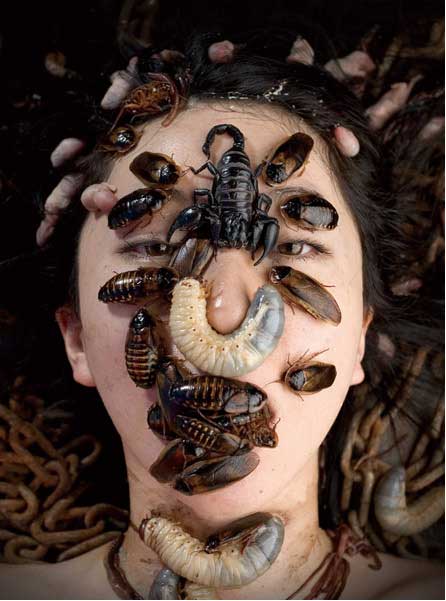
Daikichi Amano is a name that evokes curiosity, fascination, and, for some, unease. As the creator of the controversial Genki-Genki films, Amano occupies a singular and often polarising position at the intersection of Japanese experimental cinema, avant-garde art, and pornographic visual culture. His work, frequently incorporating sea creatures, insects, and other natural forms into meticulously staged compositions, challenges conventional assumptions about beauty, eroticism, and the limits of representation. Yet to reduce Amano merely to controversy would be to miss the intricacy of his practice. At heart, he is a photographer, and it is through photography that his artistic language first took shape.
Long before the films gained notoriety within extreme cinema circles, Amano was experimenting with still images. His photographic work reveals a patience that borders on the meditative. He studies surfaces, textures, and the interplay between flesh and shell, softness and carapace, fragility and resistance. There is a pronounced tactility to his images, a sense that the viewer is being invited to consider not only what is seen but how it might feel. This emphasis on materiality places him in a lineage of artists concerned less with narrative than with sensation and form.
Amano’s studio practice is deceptively simple. He often works in controlled, minimal environments, where lighting becomes the principal sculptural tool. He prefers stark contrasts, sharp illumination against deep shadow, allowing the smallest details, the curve of a claw, the translucence of a wing, to become monumental. He has spoken of light as though it were a living collaborator, noting how a slight shift can transform an image from grotesque to almost tender.
Born and raised in Japan, Amano developed an early fascination with the overlooked corners of the natural world. While many artists might turn towards landscapes or portraiture, Amano gravitated to stranger subjects. Insects clinging to female faces, fish placed strategically upon naked flesh. This method matured into an aesthetic philosophy grounded in juxtaposition. For him, the natural world is not separate from human experience but interwoven with it, capable of reflecting and amplifying vulnerability and desire.
Despite the extremity associated with the Genki-Genki films, Amano approaches his craft with deliberation and restraint. The shock that audiences often speak of is, in his view, secondary. What matters more is the creation of an image that lingers, that refuses to be easily categorised.
In a rare interview conducted in 2010, he spoke to me candidly about his process, his intentions, and the peculiar creative path he has chosen.
Ade Rowe: Your work has often been described as provocative, even confrontational. When you think about what you create, do you see it primarily as art, as pornography, or as something that deliberately resists those labels?
Daikichi Amano: I think it is both, and maybe also neither in a simple way. For me, photography and film are art first. Even if the subject includes erotic elements, I am thinking about composition, about balance, about how the image will stay in the viewer’s mind. I do not begin with the idea of pornography. I begin with the idea of creating an image that is strong and unusual. If people see it as erotic, that is part of it, but I hope they also see the craft and the imagination behind it.
His response suggests that classification is less important to him than impact. Definitions appear secondary to the endurance of the image itself.
AR: When you began the Genki-Genki series with Love by the Scalpel Dog, did you already have a long-term vision for where the work would go, or was it more experimental at that stage?
DA: At that time, it was very experimental. I was testing ideas and seeing what was possible. Working with a dog was extremely difficult. Animals do not follow instructions, and for photography you need precision. I realised that I needed subjects I could observe closely and work with more carefully. That experience pushed me to think differently. It was not a failure, but a lesson. Without that first film, I would not have found the direction that became my signature.
There is no trace of regret in his reflection. Instead, he frames the early work as a necessary stage in a process of refinement.
AR: The incorporation of sea creatures and insects has become central to your visual identity. Could you describe how that idea evolved, and what you find so compelling about these particular forms?
DA: I have always been fascinated by small creatures. When you look closely, they are incredibly detailed and sometimes very beautiful in unexpected ways. I spend time in fish markets, observing textures and colours. I watch how creatures move, how they react to light. These observations give me ideas. I think about contrast, about softness and hardness, about how natural forms can create a strong visual impact. For me, it is about curiosity. I want to look at things people normally ignore and present them in a way that makes them impossible to ignore.
He speaks repeatedly of observation. Study precedes construction. The creatures are not merely props but catalysts for visual exploration.
AR: When you are composing a photograph, what is your process like? Do you sketch ideas beforehand, or is it more instinctive once you are in the studio?
DA: It is a mixture. Sometimes I have a clear image in my mind, almost like a drawing. Other times I begin with the creature itself and see how it behaves under the light. I adjust the lighting many times. Small changes make a big difference. I am patient. I can spend hours finding the right angle. For me, photography is about waiting for the moment when everything feels balanced.
This patience is evident in the finished work. Despite the intensity of subject matter, the images rarely feel hurried. They possess the compositional discipline of still life studies, albeit reframed through an unconventional lens.
AR: Do you personally experience your own work as erotic, or do you approach it more as an aesthetic exercise intended for a particular audience?
DA: I think of the audience first. I know there are people who are interested in this category, and I create for them. But for myself, the process is more about design, about building something unique. I am thinking about how to surprise, how to create tension in the image. It is less about personal feeling and more about construction.
His distinction between construction and sensation underscores his identity as a maker rather than a participant. The work, in his mind, is engineered as much as it is imagined.
AR: You have developed a very recognisable style. Do you feel there are still unexplored possibilities within your chosen themes?
DA: Yes, absolutely. Nature is endless. Every creature is different. I can change the lighting, the composition, the mood. There are always new ideas. I do not feel finished. I am still experimenting. That is important for me, to continue discovering something new each time.
The emphasis on experimentation remains constant throughout his answers. Evolution, for Amano, does not require abandoning a theme, but deepening it.
AR: Finally, are there any artists or filmmakers who have shaped your thinking, or have you developed your approach independently?
DA: I respect many artists, but I do not follow anyone closely. I prefer to observe the world directly. My inspiration comes from nature and from my own imagination. If I try to follow someone else, I feel my work would lose its originality.
This insistence on independence is perhaps the most telling aspect of his character. Whether admired or criticised, Amano’s work is unmistakably his own.
In an era dominated by repetition and digital homogenisation, Daikichi Amano remains defiantly idiosyncratic. His photographs, in particular, reveal a discipline and attentiveness that complicate any simplistic reading of his films. They are exercises in contrast, texture, and light, studies in how the natural world can be reframed to challenge perception. Through Genki-Genki and beyond, Amano invites viewers not merely to react, but to look more closely, and perhaps to question why certain images unsettle us while others do not.
For those willing to engage with the work on its own terms, beyond the immediate shock, there lies a curious and strangely compelling artistic vision, one rooted not in imitation, but in observation, patience, and an unwavering commitment to the unconventional.
.
by Ade Rowe