
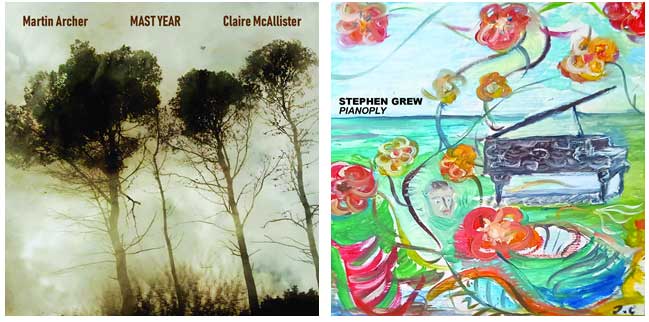
Mast Year – 207CD (2026), Martin Archer / Claire McAllister / various artists (Discus Music)
Pianoply 209CD (2026), Stephen Grew (Discus Music)
For those who don’t know, ‘mast’ is a word not just for those things that stick up on boats and hilltops, but for the fruit of forest trees and shrubs (acorns, other nuts, raspberries, etc.) A ‘mast year’ is one in which a forest produces an abundance of mast. It’s an evolutionary tactic: mast is a critical food source for many animals and so, every few years, the trees and shrubs in a forest massively overproduce it in order to ensure that some seeds remain uneaten and germinate. It’s the sort of natural process that draws attention to the fact there’s a lot more going on in the silent, slow-growing plant world than meets the eye.
I’ve listened to the album Mast Year a few times now and am still trying to get my head round it: it has the feeling of a dense forest in which you’ll make discoveries each time you wander through it (from the album notes, it’s clear it’s creators are aware of its forest-like qualities, too). Deep sounds evoke shadows and lingering electronic textures (the work, I’m guessing of Jan Todd) create an impression of imperceptible growth, while restless instrumental activity creates the impression of life in the forest going on, out of sight but in earshot. It’s not a difficult impression to create, but here it’s done particularly well. And the music has originality and substance, absorbing and co-opting a range of influences. Genre-fluidity is often a hallmark of projects Martin Archer gets involved in: ‘Stripped’ (a track I particularly liked) inhabits a world that has its roots in modern jazz but which owes an equal debt to modern classical. At other times, one might be reminded of Tangerine Dream (Berlin School music gets a mention in the album notes). Add to this the precise yet poetic, jazz-rooted musical world of Archer’s collaborator, vocalist and composer Claire McAllister, and finding a label for the wide-ranging eclecticism of the music you’re listening to no longer seems to matter! (Discus provide the option of buying McAllister’s 2018 release, Caminos, as half of a two-CD bundle with Mast Year). It was McAllister who, as well as contributing music, wrote the words and, as is usual when listening to words set to music, sometimes you can make them out and sometimes you can’t; however, they do their job well, clearly feeding and following the emotional contour of the musical narrative. Trying to figure them out further, I decided, was a needless distraction. And I love Archer’s choral writing, which was one of the high points on the album for me.
At the end of the album notes, Archer says ‘In this world of thousands of new recordings each year, I hope I’ve realised my aim of creating something a little different, and which will give some lasting enjoyment. What else is there?’ He makes an interesting point. With digital streaming the danger is that the best can get lost in the static and, even when it stands out, can get quickly forgotten in the never-ending stream of new releases. You could think of it as an on-going ‘mast year’ for recorded music if you like and, yes, Mast Year – the album – is definitely one of the juicier nuts on the forest floor, one to squirrel away in one’s digital download – or CD – collection. Enjoy!
Pianoply is the fourth solo album pianist Stephen Grew has made for Discus Music. Grew has been touring as an improvising musician since 1996 and has worked with many other musicians active in the improvised music scene, including Evan Parker, Keith Tippett, Graham Clark, Pat Thomas and Howard Riley. For the past decade, though, he’s been concentrating on solo playing, creating ‘large[r] musical shapes, … [that] inhabit a longer time frame than the shorter phrases and musical gestures ordinarily associated with free improvisation.’
In the notes to the album, Grew, characteristically, focusses on the piano he’s playing and the surroundings he’s working in (as he says: ‘I enjoyed being in the middle of the countryside, surrounded by trees’. Those trees again). This, paradoxically, tells us a lot about his work: it directs us towards a realisation that there is very little to say, as the music speaks for itself and, as Wittgenstein famously put it, ‘whereof one cannot speak, of that one must remain silent’. Better to talk about the trees, the studio, the piano itself. What he creates comes over as very much absolute music: it seems to – and probably does – exist in a world of its own. I know this could be said of a lot of music, but one is very much aware of it when listening to Grew. And he’s right about the larger musical shapes. This is music that embraces both thoughtful atonal ruminations and energetic passages of high velocity that always retain a sense of direction. The need to create structures that develop seems to be encoded in his creative DNA. That’s not to say that the music is unemotional – indeed, the title of the first track is ‘Play what you feel, feel what you play’ – only that, as well as the emotional energy that he puts into the music, one is aware of a structural mind forever shaping it into the language of his almost hermetically sealed, atonal musical world. The results are captivating and addictive.
.
Dominic Rivron
LINKS
Mast Year – 207CD (2026): https://discusmusic.bandcamp.com/album/mast-year-207cd-2026
Pianoply 209CD (2026): https://discusmusic.bandcamp.com/album/pianoply-209cd-2026
Thank you Dominic for the lovely review.
Comment by Stephen Grew on 11 April, 2026 at 12:15 pmAll the musical best.
Stephen Grew.🎹🙂
You’re welcome!
Comment by Dominic Rivron on 12 April, 2026 at 7:46 pm