
by Ade Rowe
The death mask of Tutankhamun holds a peculiar place within cultural memory. It is one of the few artefacts from the ancient world that has escaped the confines of archaeology and entered something closer to mythology. Reproduced endlessly in documentaries, museum catalogues, textbooks, and popular media, the mask has become almost detached from the young king whose face it represents. Yet when examined carefully, beyond the familiarity created by modern reproduction, the object remains deeply arresting. It possesses an unusual stillness, an unnerving composure that feels strangely alive despite its obvious connection with death. Few surviving works from antiquity communicate such a powerful combination of splendour, grief, political authority, and spiritual anxiety.
When Howard Carter first looked into the burial chamber in November 1922, he could not immediately see the mask itself. What confronted him initially was overwhelming visual confusion, a dense accumulation of ceremonial furniture, shrines, chariots, gilded statues, caskets, and ritual objects pressed together within the confined architecture of the tomb. Layer upon layer of funerary equipment had been arranged with deliberate ceremonial logic, each enclosure protecting another sacred space within it. Wooden shrines covered in gold leaf enclosed massive coffins, and within those coffins rested further layers of protection surrounding the king’s body. The mask emerged only later, after painstaking excavation and documentation. By the time it appeared, resting upon the mummy of the dead king, it had already acquired an atmosphere of near supernatural anticipation. Carter himself struggled to describe the emotional impact of the discovery. Even through the detached language of archaeology, there is a sense that he understood he was witnessing something far beyond ordinary excavation.
Part of the mask’s fascination lies in the fact that it does not appear mournful. Modern funerary art often emphasises loss, sorrow, or the fragility of life, but the Egyptian conception of death differed profoundly. The mask was not intended to commemorate tragedy. Instead, it functioned as an instrument of transformation. To the ancient Egyptians, death represented a dangerous transition rather than a final conclusion. The deceased ruler required protection, guidance, and ritual reinforcement in order to survive the journey into the afterlife. The mask therefore acted as both shield and substitute body, preserving the king’s identity while simultaneously presenting him in divine form. The different symbolic elements fused together into a single theological statement. Kingship, divinity, rebirth, and protection were not treated as separate ideas, but woven into one unified object intended to secure eternal survival.
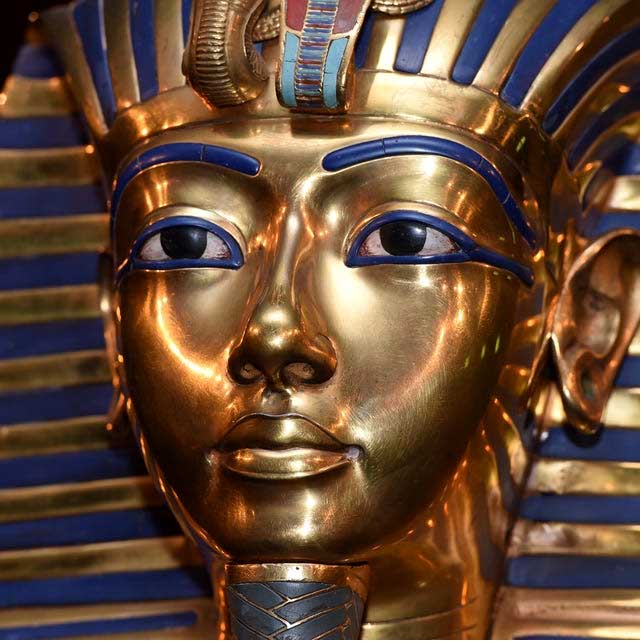
The face itself is idealised with remarkable discipline. The symmetry is so carefully controlled that it almost resists emotional interpretation. The cheeks are smooth and youthful, the mouth restrained, the eyes detached yet strangely alert. There is no sign of physical suffering or weakness, despite the fact that modern examinations of Tutankhamun’s remains suggest he endured considerable health problems during his short life. The mask does not portray the vulnerable adolescent who died around the age of nineteen. Instead, it presents kingship perfected and eternalised. This distinction mattered enormously within Egyptian religious thought. The pharaoh was not simply a political ruler, but an intermediary between the human and divine realms. Death therefore required not the preservation of ordinary humanity, but the refinement of identity into sacred permanence. In this sense, the image of the king became layered with divine characteristics over the course of the funerary process, transforming an individual ruler into an eternal sacred presence.
The craftsmanship involved in creating the mask remains astonishing even under modern scrutiny. It was fashioned primarily from gold of exceptionally high purity, though scientific studies have revealed subtle variations in composition across different sections. These differences were almost certainly intentional. Egyptian goldsmiths understood that slight alterations in alloy content produced changes in colour and texture. The warmer tones visible in the face contrast gently with the cooler appearance of the headdress, creating depth without disrupting visual harmony. Such details reveal artisans who possessed not only technical ability, but also a highly sophisticated understanding of aesthetics. Different sheets of metal were carefully blended together so that joins became nearly invisible beneath polishing and decorative finishing. Rather than appearing fragmented, the separate sections fused visually into a seamless whole.
Contrary to popular imagination, the mask was not poured into a mould as a single solid object. Ancient Egyptian metalworkers relied upon far more patient and intricate methods. The structure was created through hammered sheets of gold, carefully shaped and joined together with extraordinary precision. Craftsmen repeatedly heated the metal during production in order to prevent brittleness, a process known today as annealing. Without this repeated heating, the gold would eventually crack under sustained hammering. The procedure required enormous concentration because excessive force could distort the surface permanently, while insufficient shaping would prevent the sections from fitting together properly. Once individual components had been formed, they were meticulously fused through joining techniques that concealed structural boundaries beneath decorative refinement. The neck, face, headdress, and ornamental sections gradually became part of one coherent sculptural surface through repeated shaping, reheating, smoothing, and polishing.
One can easily underestimate the physical demands involved in such work. Gold is soft compared with many metals, but softness alone does not simplify craftsmanship. Maintaining symmetry across a large ceremonial object demanded constant adjustment and refinement. The artisans worked without electric tools, precision lasers, or industrial measuring systems. Their achievements depended upon trained eyesight, accumulated experience, and astonishing manual control. Every curve of the face had to remain balanced because even minor irregularities would become visible once the polished surface reflected light. The final harmony of the mask emerged gradually through countless stages of correction, where separate decorative and structural layers were refined until no individual element overwhelmed another.
The eyes of the mask are among its most compelling features. Formed from quartz and obsidian, they create the unsettling impression of consciousness. Many observers describe the sensation that the mask appears to watch rather than merely exist. This effect was intentional. Egyptian religious belief associated the eyes with divine awareness, solar rebirth, and spiritual vitality. The decorative lines extending outward from the eyes imitate cosmetic markings worn by both royalty and deities. These markings were not merely fashionable embellishments. They symbolised protection and sacred authority, linking the king visually with gods such as Horus and Ra. The contrast between the dark obsidian pupils, pale quartz, and surrounding gold created visual depth that gave the features a startling sense of animation, as though separate materials had fused together into something almost living.
The blue stripes of the nemes head-dress contribute another important layer of symbolism. Although many people assume the blue material is solid lapis lazuli, much of it is actually coloured glass crafted to imitate precious stone. Egyptian glassmaking had advanced significantly by the late Eighteenth Dynasty, allowing artisans to reproduce the appearance of rare imported minerals with remarkable accuracy. This choice reveals something interesting about Egyptian royal workshops. Wealth alone was not the determining factor in artistic production. Practicality, symbolism, visual coherence, and availability all influenced material decisions. The luminous blue carried celestial associations, suggesting the heavens and the eternal cycle of cosmic order. The alternating bands of blue and gold also created a rhythmic visual structure in which colour and metal merged into a unified symbolic surface representing both earthly kingship and divine cosmic authority.
At the centre of the forehead stand two sacred creatures, the cobra and the vulture. Together they represented the unification of Upper and Lower Egypt. The cobra symbolised Wadjet, protector of Lower Egypt, while the vulture represented Nekhbet, guardian of Upper Egypt. Their placement upon the brow transformed the mask into a declaration of legitimate sovereignty. Yet these figures also served a protective role. Egyptian funerary imagery frequently combined political and spiritual meanings because the king’s authority was believed to extend beyond earthly existence. Even in death, the pharaoh required divine guardianship against hostile supernatural forces. Here again, political symbolism and religious belief fused together so completely that separating one from the other becomes almost impossible.
Perhaps the most extraordinary quality of the mask is its surface finish. Gold reflects light differently from most metals, producing a softer and warmer luminosity. Egyptian craftsmen exploited this property with exceptional skill. Through repeated polishing using fine abrasives, they achieved a radiance that still survives after more than three thousand years. During this process, microscopic imperfections across different sections of metal were gradually smoothed until the entire surface reflected light with remarkable consistency. Inside the dim burial chamber, illuminated only by flickering lamplight during funerary rituals, the effect must have been overwhelming. The face would not simply have gleamed. It would have appeared animated, emerging from darkness with an almost spectral presence.
The craftsmen who created the mask remain unknown to history. Ancient Egyptian society rarely celebrated artists as individuals in the manner later European traditions would. Their anonymity reflects broader cultural attitudes regarding creation and sacred labour. Artistic production within royal workshops was understood less as personal expression and more as participation in maintaining divine order. To fashion an object intended for a king’s eternal existence carried profound religious significance. These artisans were not merely decorators producing luxury goods. They were contributing directly to the metaphysical survival of the ruler. Different specialists almost certainly worked together within these workshops, combining metalworking, stone carving, glass production, engraving, and polishing into a collaborative process where many layers of craftsmanship ultimately became inseparable.
Much discussion has surrounded the possibility that the mask may originally have been created for someone other than Tutankhamun. Certain inscriptions appear altered, and some scholars believe parts of the funerary equipment were adapted hurriedly following the king’s unexpected death. This theory gains credibility when considered alongside the political instability of the period. Tutankhamun ruled during the aftermath of the religious revolution initiated by Akhenaten, who attempted to replace traditional Egyptian polytheism with the exclusive worship of the Aten. The consequences were socially and politically disruptive. Temples lost influence, religious traditions fractured, and royal authority became entangled in theological conflict.
Tutankhamun’s reign attempted to restore older religious practices, but his early death created uncertainty once again. Under such circumstances, it is entirely plausible that workshop artisans modified pre existing royal equipment in order to complete the burial within the required ceremonial timeframe. If true, this possibility adds another layer of complexity to the mask. Altered inscriptions, adapted components, and revised iconography may have been integrated into the finished object so carefully that the modifications fused almost invisibly into the final design. Rather than representing a perfectly planned commission, it may embody the improvisation and political tension of a fragile historical moment.
The mask cannot be separated from the wider funerary rituals surrounding it. Egyptian burial ceremonies were highly elaborate performances involving priests, incense, recitations, offerings, and symbolic gestures intended to reactivate the senses of the deceased. Through rites such as the Opening of the Mouth ceremony, the dead ruler was believed to recover speech, sight, breath, and awareness. The mask formed part of this transformative process. It acted not as passive decoration, but as a sacred mechanism through which identity could endure. The physical object became fused with ritual performance itself, gaining meaning through repeated ceremonial interaction rather than existing independently.
Modern audiences often focus heavily upon the wealth represented by the object, particularly the sheer quantity of gold involved. While this reaction is understandable, it can obscure the deeper conceptual purpose of the material itself. Gold mattered to the Egyptians not simply because it was rare, but because it appeared incorruptible. Unlike iron or copper, gold does not tarnish easily. Its resistance to decay made it an ideal symbol for eternity. Egyptian religious thought constantly grappled with the problem of impermanence, seeking ways to preserve order against the destructive forces of chaos and time. The use of gold therefore carried philosophical and theological significance far beyond material luxury. Material meaning and spiritual symbolism became inseparable within the object, each reinforcing the other.
There is also something profoundly poignant about the fact that Tutankhamun himself was a relatively minor ruler. Had his tomb been plundered thoroughly in antiquity, as happened to many royal burials, he would probably remain obscure outside specialist scholarship. Instead, the accidental survival of his funerary assemblage transformed him into the most recognisable figure of ancient Egypt. In a strange historical irony, the king achieved the immortality his civilisation desired, though in a form entirely unimaginable to those who buried him.
The modern display of the mask within museums has inevitably altered how it is experienced. Originally, it existed within darkness, enclosed inside multiple shrines and coffins, hidden from human sight. Today it is illuminated by controlled lighting, surrounded by glass barriers, observed by crowds carrying cameras and mobile phones. The shift is enormous. Yet despite this displacement from its original sacred environment, the object has not lost its power. If anything, the contrast between ancient intention and modern spectatorship intensifies its fascination. Layers of meaning continue to accumulate around it even now, as archaeology, tourism, media representation, and public imagination become fused with the ancient object itself.
People often speak about the mask as though its importance lies entirely in beauty, but beauty alone cannot explain its enduring effect. Many ancient objects are beautiful without becoming culturally iconic. The death mask of Tutankhamun continues to resonate because it condenses so many aspects of human experience into a single object. It embodies fear of death, longing for permanence, political authority, religious conviction, artistic discipline, and extraordinary technical intelligence. These ideas do not merely exist beside one another. They interlock and merge throughout the object until spiritual belief, artistic mastery, and royal propaganda become impossible to separate. It represents a civilisation attempting to negotiate with mortality itself.
Even now, centuries after the collapse of the pharaonic world, the mask retains an unusual emotional force. Looking at it for any length of time produces a curious sensation, somewhere between admiration and unease. The face appears calm, but not peaceful. It seems distant, almost inaccessible, as though suspended outside ordinary human time. Perhaps that is precisely what its makers intended. They were not trying to preserve a memory in the modern sense. They were attempting to construct eternity.
The artisans succeeded beyond anything they could possibly have anticipated. Dynasties vanished, temples crumbled, languages changed, religions disappeared, and entire empires rose and fell, yet the golden face survived beneath the desert for more than three thousand years. The many layers of metal, symbolism, ritual meaning, political identity, and divine imagery remained fused together across millennia with astonishing resilience. When modern viewers stand before it now, they encounter not merely an archaeological treasure, but the surviving expression of one of humanity’s oldest ambitions, the refusal to accept oblivion quietly.
(for Petal)
.