
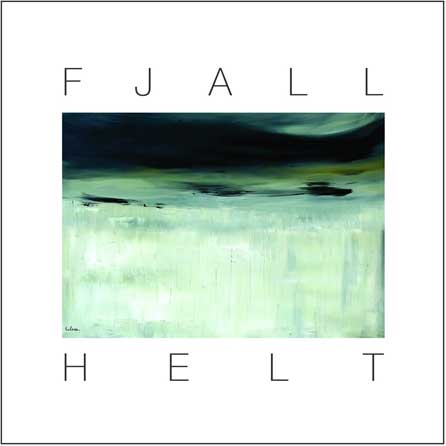
Helt, Fjall (Discus Music)
Tony Oxley – Combination, Hundred Years Gallery, London
The quartet Fjall came together in 2022 with the intention of making improvised music that deliberately avoids the dense activity that is so often associated with the genre. Instead, they set out to make music that, as they put it, ‘tends more towards ritual or even contemporary classical music’. They have described themselves as having ‘shades of AMM meeting The Third Ear Band maybe’. The sound-world they create together is made all the more interesting by the fact that half the quartet – Fran Comyn and Richard Jackson – are percussionists. Martin Archer (who plays mainly reeds, but also diversifies what he does in all sorts of interesting ways) and Jan Todd (who plays an electric Harp-E, but, like Archer, expands what they do outwards in all sorts of intriguing directions) make up the other half. The end result is a music which is, indeed, hard to pin down, but which has a kinship with other projects, all tending to draw on the same wide pool of musicians, including ones I’ve written about here (Inclusion Principle and Theta, for example). As such, it’s part of a growing body of work which, if you’re unfamiliar with it, is well worth exploring.
‘Fjall’ is an old Norse word meaning ‘rough hill’ and their first album, which came out in 2023, is indeed called From the Rough Hill. The title of this latest album, Helt, meaning ‘hero’, is another foray into old Norse. The track titles are minimal, elemental evocations of landscape, although, unless you find it useful to have a ‘handle’ on the music you’re listening to, I wouldn’t pay too much attention to them, the reason being that the music here is so much more than merely descriptive of one thing. I listened to the first track, ‘Stone’, for example, before I’d read any information about the album and it invoked for me the very deepest parts of the sea.
That said, the start of the second track, ‘Edge’, is, I think, almost Oldfieldesque – definitely, for a while, more Third Ear Band than AMM – and does evoke , for me, the sense of openness one might experience on a hilltop although, as it develops it certainly moves on into more abstract territory. At the risk of sounding over-subjective, I’d say Fjall makes music that seeks to penetrate the essence of things. And, of course, when one does this, what you take as a starting point (stone, wood, etc.) ceases to have significance, as the deeper you go, the less easy it becomes to distinguish that starting point from everything else. You might think that sounds a bit woo-woo, but it does describe a process which music can – and often does – fulfil. You can take a melodic fragment that has all kinds of extramusical associations, or a field recording of something familiar and, by developing and responding to them musically, create from them a sound-world that’s quite abstract.
There are four tracks in all – all of them the length of a respectable, one-track album. Fjall have evolved an eclectic way of making music which contains points of reference which could draw in listeners from more mainstream genres and open people’s ears to the wider possibilities of music, which has to be a good thing. However, that’s just a by-product, if you like, of what they do, which is make interesting improvised music which stretches one’s expectations of what improvised music can be.
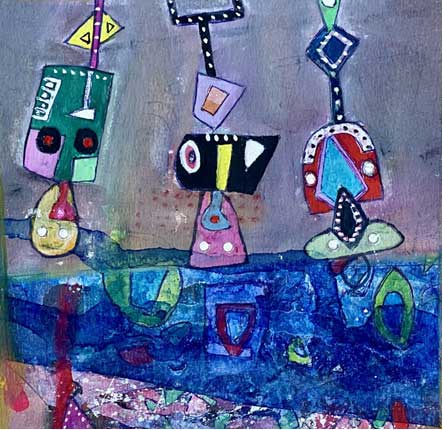
As most readers probably know, percussionist Tony Oxley, who passed away in 2023, was a key figure in the development of improvised music in the UK. A member, with Derek Bailey and Gavin Bryars, of the seminal improv group Joseph Holbrook, he went on to work on all kinds of projects in the improvised music world while, at the same time, occupying the prestigious – though more mainstream – role of house drummer at Ronnie Scott’s (beginning in 1969, readers of Melody Maker voted him Best British Jazz Drummer three years running). As if that wasn’t enough, encouraged by painter-musician Alan Davie, he began painting in the 1970s, going on to produce a body of work which spans five decades. (Oxley and Davey also made an album together, The Tony Oxley / Alan Davie Duo and a number of further recordings they made were released on Confront Recordings in 2021 under the title Elaboration of Particulars).
Having lived and worked in Britain through the 1960s and most of the 70s, Oxley moved to Germany, as he felt it provided a more receptive environment for avant-garde music. He sometimes mounted exhibitions in his own home and provided art for dozens of album covers, but, album covers aside, this exhibition at the Hundred Years Gallery will be the first time his work has been seen in the UK. And it promises to be interesting. As the gallery blurb puts it, ‘Tony… [worked] his way through many different styles, stages and approaches. Much like his music, complex textures, spontaneous gestures, and a sense of continually-flowing structure, are evident in Tony’s work.’ Sadly, the exhibition only runs from the thirteenth of June to the twenty-first, so blink and you’ll miss it, which, of course, you wouldn’t want to do as all the work on show is for sale, meaning this could be the last chance to see it all gathered in one place.
.
Dominic Rivron
LINKS
Helt: https://discusmusic.bandcamp.com/album/helt-210cd-2026
Tony Oxley – Combination: http://hundredyearsgallery.co.uk/exhibition-tony-oxley-combination/
Elaboration of Particulars: https://confrontrecordings.bandcamp.com/album/elaboration-of-particulars
Thanks for flagging up the Oxley exhibition Dominic, much appreciated. The show has now been extended until 28th June.
Comment by Mark Wastell on 22 June, 2026 at 7:15 pm