
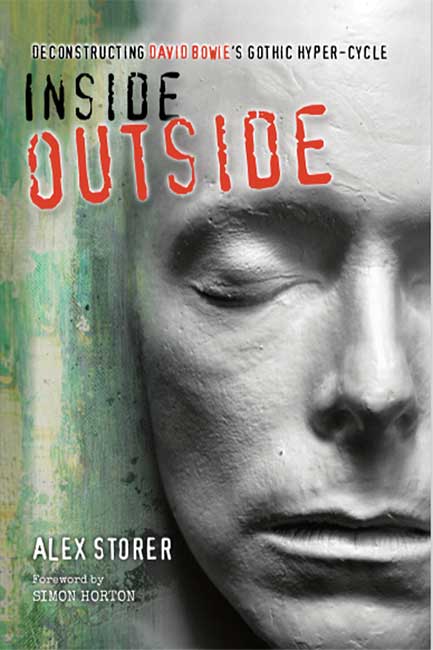
Inside Outside: Deconstructing David Bowie’s Gothic Hyper-Cycle, Alex Storer
It’s always interesting finding out who likes what in David Bowie’s discography, as well as information about how his albums were put together, conceptually and musically. Here, in this new self-published book, Alex Storer explores the album 1. Outside. Well, what he actually does is offer a much wider, chronologically and critically panoramic view of the album, only focussing on the making of the album and the official and unofficial releases arising from it, for part of the book.
To be honest, much of the contextual and background stuff here is too well known to need retelling here. What is interesting, however, is Bowie & Eno’s interest in Naive or Outsider Art which seems to have informed their initial concept for a new album. Their research included a visit to the Gugging Clinic, a psychiatric clinic which had a whole wing for patients who wished to work in the visual arts. Bowie spoke to several of the artists/patients working here and valued the way work could be used for both diagnostic and therapeutic ends, as well as being interesting in its own right.
Around the same time, Bowie was wanting to get in on the short-lived CD-Rom boom. As a painter and musician he was interested in the possibilities of visual and musical combinations and juxtapositions, as of course was Brian Eno. Storer’s chapter here is called ‘Derangement as Design’, suggesting that the influence of Outside Art, Eno’s Oblique Strategies cards and Bowie’s continuing use of cut-ups to construct lyrics created a way to create surprise and originality. In fact, Bowie co-created a computer cut-up programme that responded to keyed-in words and phrases.
Bowie and Eno created a space in the studio for improvisation and exploration, with musicians such as Reeves Gabrels and Mike Garsons, resulting in (according to who you believe) 22-35 hours of what was regarded as usable material. (Bowie and Eno were apparently quite strict about what was saved.) Much of the music was informed by character cards handed out to the musicians and engineers by Eno, and by a diaristic detective story Bowie had written, full of strange characters and elusive narration, which some say was influenced by David Lynch’s Twin Peaks.
They set to work editing and mixing the material, producing – some say – five ‘suites’ of music: 20 minute tracks with rambling overlays of spoken word (with Bowie assuming many roles and accents), samples, rhythms, snippets of song, and lots of keyboards and guitars. You can find three of these quite easily online as The Leon Tapes bootleg. The other two suites, if they ever existed, have evaporated, as did the idea of a four or five album series. Mostly, it seems, because no record company would release the first album.
Bowie and Eno set to, deconstructing and reassambling the material into brief songs and narrative snippets, along with resurrecting a couple of older songs, to produce what many, myself included, regard as a snoozefest of an album. For something that got reviewed as weird and experimental, it’s amazingly ordinary, mostly chugging blues-based motifs and Bowie-esque mannersisms that seem like the man parodying himself.
Perhaps he was? By the time he had the album finished, and reworked some songs from it for a tour, he was pretty much done with the whole thing. The energy, vitality and fun had been taken out of the project, and reviewers were not interested or supportive. The 22+ hours of material were filed away, although not, apparently, before someone had made copies of some brief snippets of tracks in progress, which were released as Something Really Fishy (Outside Outtakes) and also what becamse The Leon Tapes, originally also regarded as outtakes but actually the predecessor to the official Outside album.
I always say if a book about music or musicians tells me new things and makes me listen again to its subject then it is a success. By these criteria Storer’s beautifully designed book, which includes new images by the author as well as photographs from a number of sources, is an absolute success. I spent the morning relistening to Outside and then The Leon Tapes but the book hasn’t made me change my mind. Outside is dull through and through, and The Leon Tapes, although a big step up musically, feels like what it is, an edited-down version of studio jams by people not very used to improvising and mostly unaware of contemporary experimental music, be that classical, jazz or rock.
I take full responsibility for my response, however, and my preference for Bowie albums such as Low, “Heroes” and Blackstar. Storer has done a great job of research in an attempt to persuade the likes of doubters like me, and to furnish those already fans of the album with as much new and detailed information as possible. He deserves full marks for his critical, authorial and persuasive powers, and for getting this fascinating and intelligent volume published.
.
Rupert Loydell
Inside Outside can be ordered here.
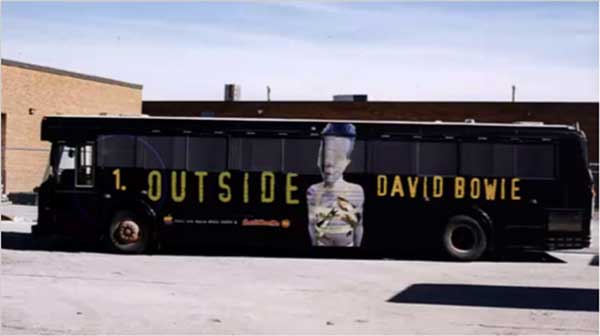
Tour bus photo by Davide De Angelis
.