Steve Aylett interview introduction by Malcolm Paul
Steve Aylett is the author of absurdist satires including Lint,The Book Lovers, Slaughtermatic, Rebel at the End of Time etc, and comics such as Hyperthick and The Caterer. Alan Moore describes The Book Lovers as “utterly astonishing”.
Aylett lives in Scotland and is also responsible for the film adaptation of his own book Lint.
Steve Aylett is the third in a series of interviews that I have conducted over the Summer of 2026.
The previous two were the author/anthologist and publisher Tony White as well as the author/musician and words & music artist Darren Francis.
I’m now happy to say that I can present my third interview. This one is with Steve Ayelett the author/filmmaker and comic creator.
All three interviews have been very different experiences in many ways.
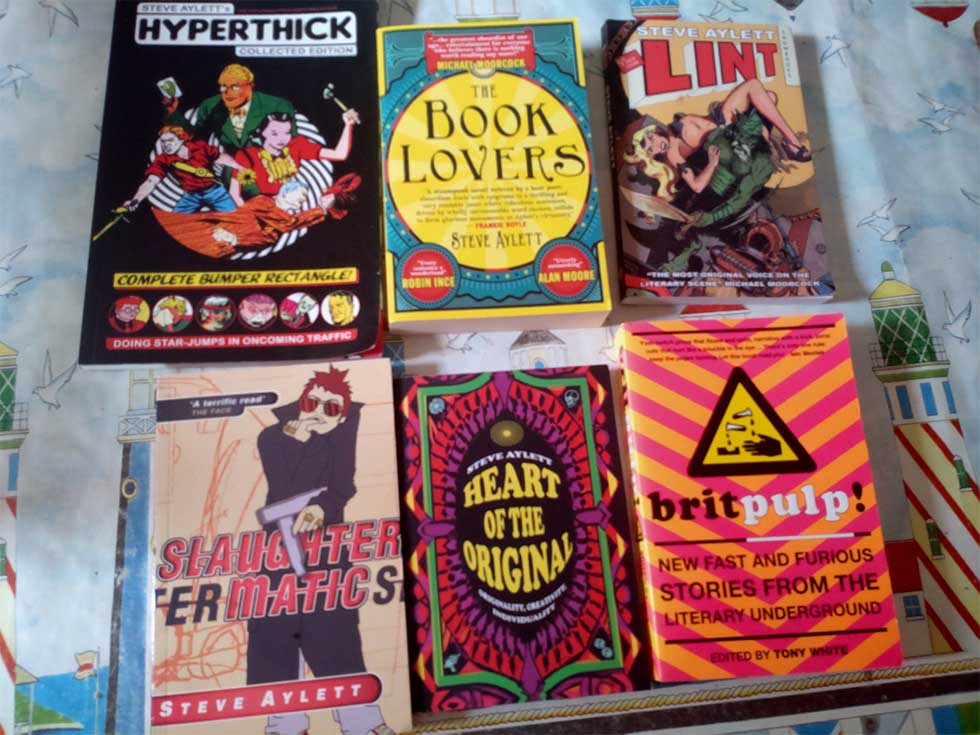
But the one thing they all had in common was that they were with the writers who all had contributed written pieces to the 1999 anthology ‘brit pulp ‘.
(Edited by Tony White) ‘brit pulp’ was an iconoclastic era defining collection of new fiction featuring 22 different authors.
As I was to discover as I put the three interviews together, there was plenty of room in the ‘brit pulp’ tent for so many like-minded authors, who were inclined to experiment and push literary boundaries when it came to writing , ‘chop shopping’ genres, SF and Punk, etc. and in Tony White’s case the detective genre.
‘brit pulp’ authors were as much a collective as they were original stand alone talents.
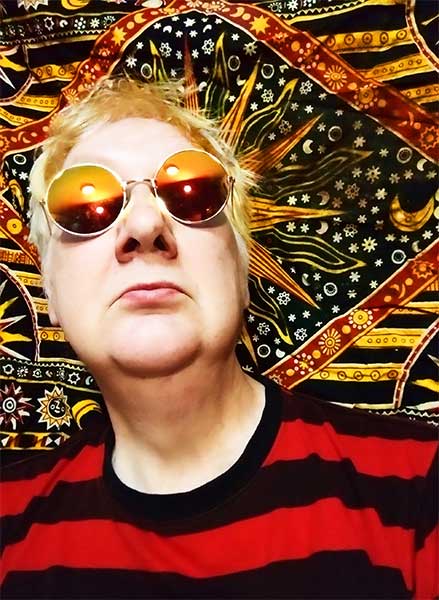
Steve Aylett is a magician/illusionist/conjurer when it comes to using language.
If you don’t watch closely, Steve will have your mind darting in all directions, and missing the slight of hand have you running through a hall of fairground mirrors- overturning Comte de Lautreamont’s* vision “as beautiful as a chance encounter between an umbrella and a sewing machine on an operating table” while the Lint non sequiturs take on an almost Kabbalistic/cryptic meaning and Steve’s unfettered imagination is a joy to take a trip with as he subverts language/plots and reasoning and lets the absurd triumph on the page.
So I’m warning you – All who enter here…
Think Steppenwolf’s Magic Doorway and read on.
*Isidore Ducasse
MP) Steve, you were born in Bromley, Kent. (Is it still in Kent?)
I suspect you have relocated a few times in your life! You were, I’ve just been reading, living in Brighton when you wrote the Accomplice series. So, there was a detour. Now you are in Scotland – Outer Hebrides?
SA) Actually I’m in the Highlands.
MP) If you stood up right now and walked to the window and looked out, what would your view look like and what would be the first thought going through your mind?
SA) Outside is a porch where I grow flowers and vegetables, and beyond it is gorse, a road, pine trees, the Highlands. In summer I feel grateful and in winter I realise I’m stranded in an Arctic outpost.
MP) (Being born in Bromley) I believe there is a whole book about David Bowie’s early life in 1953 in Bickley/Bromley Common. Do you think you might get a plaque and a book one day?
SA) No.
MP) I don’t think I’m going to be able to talk to you about a lot of subjects without being aware that you are a person/artist who has the quite uncommon condition known as synesthesia and as an adult you were diagnosed with being on Autistic spectrum. It is difficult to view a lot of the way you create/created your art and have lived your life without having those twin facts in the back of my mind.
“Scientists believe synesthesia happens because of extra brain connections. We are all likely born with these extra wires. As we grow up, our brain “trims” them to separate our senses. People with synesthesia—called synesthetes—keep many of these connections. It often runs in families and has a genetic link.”
It’s neatly bundled up in a few lines in Wikipedia under the heading of your personal life.
(Malcolm: I am a 69 year-old adult with officially undiagnosed Autism.I have worked most of my life with people who are clinically diagnosed with autism and were either living in institutions or Care in the Community. That’s 35 years working as a professional. I also have a family member, who was diagnosed with autism.
So, because of my professional and personal background I was aware of my own situation in later life and made a self-diagnosis. I have, despite being ‘odd’ and having all the traits, been able to live a pretty normal life with people who know and understand why I am the way I am.)
“A synesthete, Aylett claims to have books appear in his brain in one visual “glob” that looks like a piece of gum.
Aylett also has Asperger syndrome.”
Wikipedia
It begs the question: Does your personal life appear in any particular shape or colour?
I’d love to know.
I’m screwing up my face trying to imagine what my personal life would be like if I imagined it as a person with synesthesia. Nothing as eye-catching as say a painting by Wassily Kandinsky, who, a friend informed me, was an artist with synesthesia.
My personal life I think would have the painterly aspect, say a Hodgkin or a more likely a de Kooning for the off days.
What would imagining my personal life smell like? Lilies or roast beef? After sex?
How do you view your personal life as a synthetase?
SA) I see ideas and situations as shapes and colours, structures. At the moment my life looks like a tangle of twisted wreckage and I’m a very insubstantial drift of ghostlike stuff that can’t touch or affect anything. So things are pretty grim.
MP) Do you think all artists are a bit that way inclined anyway?
SA) I think most people are synesthetic, they just don’t necessarily realise it. People are told that they think in sentences but I suspect most people don’t. I can’t imagine how thin and impoverished things would be for someone who thinks like a bit of tickertape twitching across their vision. I have to do loads of translation to get things to words, but I’ve got good at it I think.
MP) Is it different, as if the paint box went nuts, and all the colours took over your imaginings?
SA) A juicy idea is a rolling multicolored chiming structure with mechanisms buzzing and fluorescing it. It’s easy to see visually whether it works or not. It’s right there to see, so ‘critical thinking’ is very easy.
MP) In the 1970s I used to take a fair amount of Acid. Have you ever taken LSD?
SA) No. Even mild drugs affect me badly. According to brain scans, for what it’s worth I’ve already got a ‘joined-up’ brain, with the different parts all communicating with each other. The corpus callosum bridge is overdeveloped. Alan Moore told me once that in my case, taking real drugs would be ‘gilding the lily’.
MP) It must be hard to sometimes keep a lid on all that activity going on in your head.
I heard you say you carry a notepad around with you and jot down ideas as you are doing what? Wandering around?
SA) I write, sleep, cycle, see friends, grow veg and flowers.
MP) You said somewhere, that you were never short of ideas and it was more a question of discarding ideas than scratching your head trying to think of something to write. Do you ever experience writer’s block?
SA) No.
MP) Is the landscape and the view part of the reason you moved to Scotland?
SA) It started decades ago visiting the Findhorn community, which is an intentional community with an ecovillage. If you’ve seen My Dinner With Andre you can see Andre talking about it. Then more recently I became a lot more involved and lived there for a few years. But because of Brexit and other stuff they panicked and sold my favourite part of it for almost nothing – Cluny Hill House, where I lived for five years – and it broke my heart. I still love Findhorn but when an organisation grows beyond a certain size, a disconnect happens and bad decisions are made.
MP) My paternal grandparents were from Glasgow. They grew up in the Gorbals, not the most scenic place. Scotland is a very visual place, especially where you live I imagine?
Is the environment important to you?
SA) I like being out in the country. Cities aren’t really made for humans to live in, but for those humans’ energy to be fed from.
MP) I don’t think I was the first potential interviewer to recognise how visual your writing has been over the years. I have read the books in the Beerlight series and the Complete Accomplice Quartet books, which for me confirmed my observations.
Lots of critics/reviewers seem to be wrestling with ways to describe your style of writing and your own particular method of plotting/subverting genres and ‘slipstreaming’ behind a rocket to Jupiter – Deep into Space.
Do you find all that analysis frustrating?
I mean they weren’t being horrible to you or your writing, quite the opposite.
There seem to be a lot of labels and associations – even jumping the pond – and linking you to the ‘Bizzaro’ movement in America and that got pasted onto your particular style of writing.
SA) At this point I don’t know what the category would be. I just like to make things as rich as possible so that it delivers ideas and color all the time. It’s meant to be an intense antidote to the vacuum. Some people find it ‘too much’.
MP) Perhaps they could start a degree course on your collected works. Almost Joycean!
Do you fancy that idea?
SA) I’d probably disagree with the teachers.
MP) I would imagine a lot of people reading this will be thinking that Steve Aylett has – despite everything – done well for himself. Turned things around where there might have been perceived as a disadvantage.
(I mean the twin conditions of Synesthesia and Autism).
Written loads of critically acclaimed books that have been lauded by the likes of Alan Moore and Michael Moorcock. Plus, you also said at one point, that you have struggled to write in a ‘formulaic’? Using a ‘conceptualisation’ with some sort of control over the flow of ideas and it just didn’t work.
I was once accused by another author of not “marshalling my ideas”, you seem to prefer not to instead be free associating?
Where it almost sounds like Surrealist ‘automatic’ writing. You had to revert back to your normal way of writing. If I remember, you said you wanted to write the kind of books YOU wanted to read.
Have you succeeded?
SA) Yes I have written the sort of books I want to read. The few times I’ve toyed with writing something straight it just felt absurd and unnatural, to deliberately not have interesting ideas being expressed, to tamp things down and kill the light. The deliberate powering-down feels crazy and sad. There’s plenty of people out there writing dead stuff, I don’t need to add to it.
MP) (Surrealist automatic writing is a technique where you write as fast as you can without thinking. The goal is to bypass your conscious mind to let your hidden, unconscious thoughts flow directly onto the page. You do not edit, plan, or correct your work)
Can you relate to that form of ‘stream of consciousness’?
SA) I don’t do it as a deliberate practice but I often end up there anyway. But there’s usually some storyline for people who need it. It’s not just all craziness (except The Inflatable Volunteer, which was all craziness). Usually it’s a balance which is very precise like poetry. There are some things which can’t be expressed in a normal way or pointed to directly.
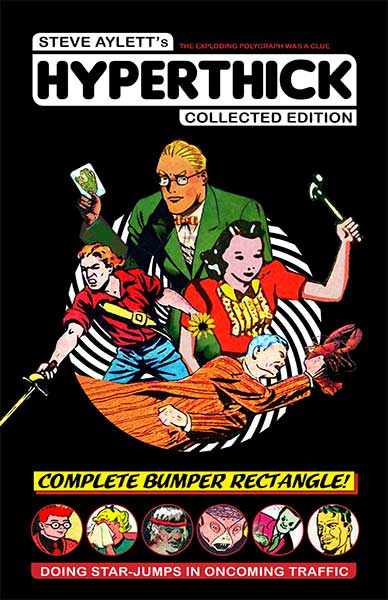
MP) In HYPERTHICK you seem to be almost playing ‘exquisite corpse’ with yourself.
Can you comment?
SA) There may seem to be jumps from the end of one sentence to the beginning of the next, as though I’ve jumped rails, but there is always a connection. I just don’t spell out every atom of the connective tissue. There’s a feeling and a meaning in that jump.
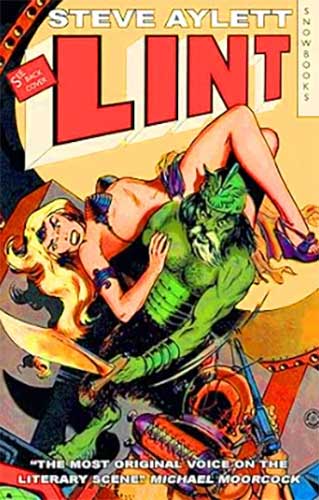
MP) I’m coming to Lint. I’ve re- read Lint a second time. I really enjoyed it.
I just keep thinking that after all your early novels like Beerlight (I loved) and Complete Accomplice (Liked a lot) you wanted some wider recognition? Is that true?
Is this a fair comment to compare Lint to an alter ego?
SA) Lint is a kind of alter ego, but if you look closely he isn’t a huge commercial success either. It’s a way of having a sense of humor and perspective about all that. Also just a perfect structure for accelerating hundreds of ideas into the page.
MP) I looked up Freud on the alter ego. The good news is that Freud wrote that the alter ego was a double edged sword. It could be a positive thing (I’m simplifying here).
“An alter ego is this “other self” stepping into the spotlight”.
An alter ego lets you step out of your comfort zone and act “bigger” than you normally
Stress Shield: You can project a confident persona to handle high-stress situations. This protects your real self from harsh criticism or failure.
It can be a means of running away.
Or it can be a positive driving force
If you agree that Lint is an alter ego then do you see him as a positive manifestation of your inner self – or a ‘shield’ in the way Freud describes?
SA) It’s definitely a healthy humorous expression. Elsewhere in my life I’ve tried what you refer to, creating a more extrovert version of me so I can step into certain situations, and it really left me bruised. I did stand-up for a short while and had to emulate or model a more outward me. Though it could be high for a short while, it was like doing violence to myself. The experience does mean I can now stand up and speak in front of hundreds of people, but I do it as myself, not as a character. I don’t perform. In the book I’m currently finishing, the outward-facing and inward-facing energies are expressed through two characters, twin brother and sister.
MP) Are you still in love with Lint?
SA) Yes, I love Lint. It’s fizzy and has no filler. Hyperthick is like that too. It’s good to find a form that allows me to put in as many ideas as a page can hold. The thing I’m working on now also has that, it’s lush.
MP) Steve, I once asked the Dutch writer Bert Plantenga this question:
MP) Bart do you think you should be famous?
BP) Long ago I dreamed of being rich and how thrilling it would be to personally donate my wealth to good causes & deserving artists. I don’t understand the new Dickensian billionaires & their joyless lives. Bill Gates’ ex shows how it should/could be done. If we just taxed these criminals properly we wouldn’t have to be grateful for the crumbs they’ve strewn under our noses.
As far as fame – Hmm. I’d settle for renowned or well-regarded… I think it would be nice to float on a certain amount of acclaim or recognition that would precede me like the renown would erase my shyness like a red carpet of presumption so that what has been reported can lay the groundwork. Like having a bar where they know your name, your drink of choice… But beyond not much…
If not famous, better known and appreciated?
Appreciation would be fine. I have simple psychic needs. Just once in a while someone might say “O I know you’ or ‘O yea, I read that book, so yr the guy that…’ I am too shy, wish I was more Dali or Johnny Rotten or Gore Vidal extroverted – like the world’s your stage. But I now find myself attracted to the shy/reclusive style – absence as a kind of intriguing presence: Pynchon, Salinger, Burial, Banksy, B.Tra.I think Bart – who I know very well and to be honest a writer whose style isn’t too dissimilar to yours obviously gave my question a lot of thought….
If I asked you the same question Steve, what would your answers be?
SA) I used to want to be famous, yes. I let it go when it clearly wasn’t going to happen. Also it turns out I’m rubbish at it, even at the level of micro-celebrity. It baffles me really. I think there’ll be more chance of fame when I’m neatly dead and out of the way. I can be re-packaged.
MP) In the 2025 Quietus interview with Aug Stone he wrote:
“But large scale popularity continues to elude Aylett, despite his having written some of the most interesting, inventive, and funniest books of recent years.”
How does it feel to read something like that?
My question is a kind of extension of the question I asked the author Bart Plantenga.
I mean would you like to be popular and be on a book carousal at all the major airports alongside the bestsellers? (I’ve pulled the pin out on that question.)
SA) I’ve heard the surprised phrase ‘Why haven’t I ever heard of this writer?’ for about thirty years now. I never get any more well known. Famous people have talked about my stuff but it’s never game-changing and never moves the needle. The lack of impact is downright supernatural. Defies the laws of physics. Look honestly, people don’t have much appetite for stuff they haven’t encountered before. They really do want more of the same, comfort food, and I can understand that. I just can’t provide it.
MP) Dodgem Logic came later and was a collaboration with Alan Moore.
It ran for eight issues. I would like to ask what it was like working with Alan Moore (who you already knew) and why didn’t Dodgem Logic run longer?
(I’m sitting here with some back issues the author Michel Faber lent me. An entertaining read.)
SA) Alan allows a free hand, he doesn’t interfere. Though if something’s crap he doesn’t use it. I don’t know why Dodgem Logic didn’t last longer. I suspect it cost a lot to produce, it was very high quality and there was a lot of colour.
MP) Grant Morrison gave you some advice. He suggested you write comics. All you had to do was to write a few words and you got paid a lot (that is why he went off to America where that’s actually true). I don’t think you took up Grant’s advice – if you didn’t why not?
SA) In real life, as regards money and so on, I’m basically an idiot.
MP) You’ve probably been asked this question a few times but not everyone has seen the answer. So my question is why Hyperthick and what’s so special about it?
It’s almost as if Dada had escaped the Cabaret Voltaire (you write Voltairean satire apparently!) and ended up roaming through the comic worlds of the 1940/50s version of Tin Pan Alley, just ready for you to come along like Tristan Tzara and put all kinds of craziness in their speech bubbles.
So did you dislocate your common sense and put all kinds of absurd/fantastical non sequiturs into a bunch of hijacked character’s mouths?
Can you explain what was going through your head and spare us to put electrodes on the side of your head? What makes HYPERTHICK a jewel in the crown? One of your personal favourites?
SA) It’s quite a traditional form popularised by the French Situationists – they’d get American cowboy comics and slap political slogans over the speech bubbles. I wanted to do it more long-form and have stories continuing over three issues, all in really high colour. And almost every character is a trickster archetype, so there’s no filler and no small-talk. Everything is always getting to the crucial point in every panel. It’s intense. I like that it just doesn’t waste any time.
MP) Steve, there are some questions I asked Tony White about the 1999 anthology ‘brit pulp’, in which you contributed the short story ‘shifa’ alongside an array of other writers who were debatably writing in a similar style.
My question is adjusted. Steve, how would you describe the significance of the anthologies you were involved in?
SA) I was usually a bad fit but was crowbarred in by a kind person who was into my stuff.
MP) ‘brit pulp’ was a huge influence on emerging writers such as myself. A generation who found it liberating.
I am now completing a Trilogy of interviews which I started with two other writers who appeared in the ‘brit pulp’ anthology Tony White and Darren Francis and now your goodself.
For me it will identify not just a possible overlap but also show the originality of the authors finding a mutual home between the covers of the ‘brit pulp’ anthology.
How do you feel about that idea as a project?
SA) I don’t think there’s much overlap except maybe the motive of being bored with what was already out there.
MP) Do you think critics of ‘avant pulp’/‘slipstream’ are a pretty humourless bunch?
Perhaps lacking the faculty to ‘disconnect‘ their imagination from the mainstream Literature!
Plug into something more challenging but in equal measure exciting.
SA) I always have the sneaking suspicion that they’re only pretending not to understand. I may be wrong sometimes, but there are times when people pretend to be dumber than they are, to fit in or toe a particular line. It’s horrible to see, and it’s tragic in the true sense of that word. I think there’s more of it in these very conservative days.
MP) How do you react to an accusation I’ve heard that genres like avant pulp and the slipstream lack emotional depth?
Can it be quite shallow and that the characters are devoid of warmth, personality and humanity?
Could these characteristics be a casualty of experimentation?
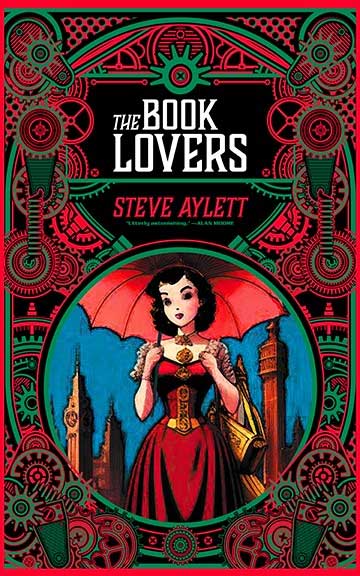
SA) Yeah, that can happen. Though in The Book Lovers and the new book I’m just finishing now, there’s all sorts of love being expressed. Some people may still have trouble with the noise-to-signal situation because there are still idea-explosions going off all the time. But, well, these are intense characters. There are hearts and angels and explosions.
MP) Do you think the art of experimentation in writing is waning – or perhaps is lost?
Any comments on the present time?
SA) Most people don’t seem to know there is an option other than imitation, so things are getting diluted and re-diluted. I don’t know where that will end.
MP) What does the future look like in terms of your writing/creative projects?
SA) I’m finishing a big book now (well, big by my standards – about the same length as The Book Lovers) and it’s the best thing I’ve done. It may even be understandable by normal people – though I’ve thought that before about other stuff I’ve written and then people come back saying it’s yet another psychedelic sleigh-ride. Generally in future I hope to use my powers of sarcasm for good.
MP) How as a synesthete might you visualise/smell and hear the word ‘future’? How does it appear to you?
SA) Morality will be defined by the ability to find drinkable water.
MP) If I was walking into your room now what music might you be listening to?
SA) Cocteau Twins, BJM, Cigarettes After Sex, Aurora, My Bloody Valentine, The Mummers.
MP) Thank you for answering my questions. I appreciate the time you have given.