
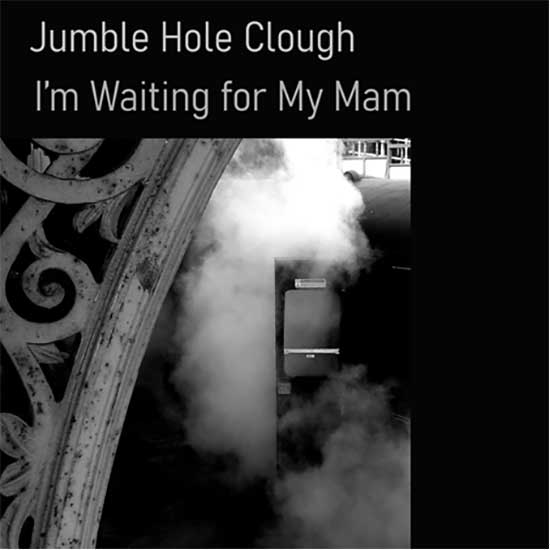
I’m Waiting For My Mam, Jumble Hole Clough (Jumble Hole Clough)
People allude to various musicians when trying to pin down what Jumble Hole Clough sounds like. Colin Robinson, the musician behind it, name-checked ‘Faust, The Residents, Eno, T-Rex, Van der Graaf Generator, Gong [and] The Fall’ in a recent attempt. Any such attempt, though, tends to prompt a ‘yes, but…’ response. I’d also say that, whatever you come up with, you have to add, ‘with a whiff – only a whiff, mind – of Ivor Cutler’. To look at it another way, you could perhaps say that Robinson tends to use the last sixty years of musical history as a dressing-up box, pulling out of it whatever stylistic inflections he wants at any given moment. Yes, but… JHC is no pastiche. Whatever Robinson pulls out he puts to his own, highly original use. And – forget the dressing-up box – what he does is, quite simply, original.
I’m well aware that I’m struggling to express myself and, if you want to know what I’m trying to say, the best thing you can do is have a listen to the latest JHC album, I’m Waiting For My Mam. The first track, ‘I Just About Remember The Revolution’, was, for me, like a confused dream recalling the school discos I went to, too many decades ago. It’s about a revolution, shaving one’s head and a purple (I think) hat. JHC is nothing if not a breeding ground for mondegreens, which is as it should be. In the second track, ‘I am Still Listening’, Robinson tells us he’s no longer looking, but he is still listening. However, given the inventive aptness of the photos that go with the tracks on this album, I wouldn’t take this too literally. This is vintage JHC at its best: as inventive as it is explosive, the music makes great use of the stereo space, sounds ricocheting from one side to the other. The next, ‘Tower of Mabel’, takes us to Penistone Hill, near Howarth which is, of course, just up the road from Hebden Bridge. You don’t have to dig very deep into this one to uncover its origins: Hartcliff Folly, know to locals as the Tower of Babel, stands nearby. Take what you have, change a letter, add a bit of Morse code, humans feeding penguins in Patagonia…
The music of JHC is essentially aural psychogeography, usually emanating from the landscape and atmosphere of Hebden Bridge and the Calder Valley, and anyone familiar with the area (watch out for the penguins) will find themselves transported there – if they haven’t been already – when they get to the track ‘We’ll Run away to Rawtenstall’, with its damp hills and absurd, dry humour. This is another side of the bestness of JHC:
Take your partner by the hand
lead them through this wasted land:
one side is mud
and the other side is snow,
don’t turn your back on me,
mind how you go.
Do you know where we’re from?
We’re from Bacup.
This is followed by ‘Twenty Colden Grates’, a homage to the late Mick West, a local avant-garde musician. The title comes from a sadly-unrealised project of his, which involved photographing drain covers in Colden, a village a short drive east from Hebden Bridge, through Heptonstall and up Slack Bottom. The next track, ‘Every Bloody Day’ is an edgy parody of a certain sort of terrible song. It’s far more fun to listen to, though, than any of its targets. ‘Death is the Poor Man’s Doctor’ combines gruesome lyrics with trademark JHC oddity in a skeletal, Caribbean-flavoured marimba totentanz. (Who first associated skeletons with xylophones and, by extension, marimbas? Saint Saens, probably).The breviloquent avant-gardism of ‘Manchester Melody’ is, for some reason I can’t quite put my finger on – and I say this having lived there – quintessentially Mancunian. ‘Friday 13th Part 16 (Cottage Hospital)’, is a study in eerie nostalgia with a suggestion of urbex which matches the artwork that goes with it: an unsettlingly anonymous, empty-looking bungalow. The title of the next track, ‘Prelude to a Down-Payment on a Gas Cooker’ is the sort of thing Erik Satie, another maverick musician with Dadaist tendencies, might’ve come up with. The title track, with it’s allusion to Lou Reed, brings the album to an end. A song about loss, by turns domestic and quirky, it hits a nerve. It quotes Hughes Mearns’ famously eerie poem about absence: ‘Yesterday, upon the stair, / I met a man who wasn’t there’. Listening to it, it struck me how JHC can be thought of as a brave, whimsical response to the human condition. You get the impression – and I’m sure the same could be said of many artists across many disciplines – that Robinson writes songs the way Scheherazade kept coming up with stories, only his nemesis isn’t a homicidal despot but the human condition itself: the sun will rise every bloody day, until it doesn’t, there’s nowhere to run to (not even Rawtenstall), who cares if you come from Bacup – certainly not the universe – and death is the poor man’s doctor. And whenever I contemplate the parameters of the aforesaid condition myself, I’m amazed so many of us – often with the help of the arts – manage to hold everything together as well as we do.
I’m Waiting For My Mam is the latest iteration of the instantly recognisable idiosyncratic weirdness of JHC. It’s the fifty-second, I think, and – as well as winning it new fans – I suspect it’s already made it onto the A-list of JHC albums fans find themselves coming back to.
.
Dominic Rivron
LINK
I’m Waiting For My Mam: https://jumbleholeclough.bandcamp.com/album/im-waiting-for-my-mam
.