
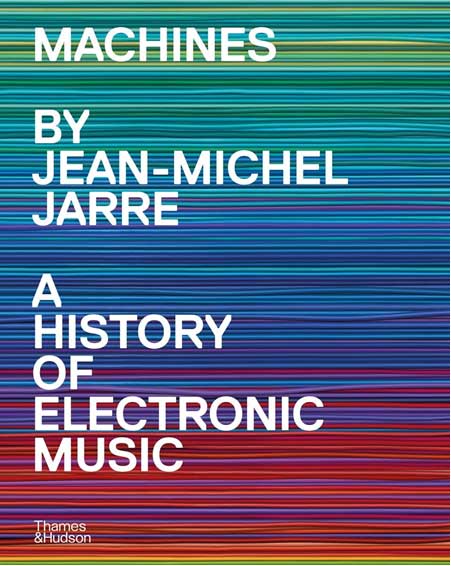
Machines: A History of Electronic Music, Jean Michel Jarre (Thames & Hudson)
This isn’t quite the book I thought it would be. There is no way this qualifies as anything other than a brief and incomplete history of electronic music, instead it is a chronological display of electronic instruments (mostly keyboard based; mostly synthesizers) with some brief technical information about them, alongside Jarre’s opinion and details of when & where (occasionally why) he used them.
There is, of course, an argument to be made that technology has driven music, or certainly facilitated key changes. The microphone allowed vocalists to sing in front of orchestras or bands; multi track recording equipment allowed for experiment, layering and ambitious arrangements and production; the mp3 and internet allowed sharing and downloading to occur. But in the end that is only part of the story, electronic instruments, however complex, are only tools for making music with, just as guitars, drums and woodwind instruments are. Early computer & synthesizer systems allowed for new and impossible sounds which musique concrète made use of, but it still required creativity – along with scissors and tape, not to mention loops – to turn those sounds into music, however strange or weird it might be.
Personally I think Brian Eno had, and probably still has, it right: it’s better to get to know one or two instruments as well as you can rather than constantly update and have to start again. Limitations, foibles and peculiarities can all be worked around or put to good use; innovation and ‘progress’ are not good things in themselves.
I suspect Jarre would disagree. The pictures of his concerts suggests he is of the more-is-better progrock school, with equipment piled high and lazers and screens providing visual spectacle to accompany his electronic anthems. This is in stark contrast to contemporary laptop musicians who coax sounds from their machines, mixing it live with sound recordings, loops and rhythms to create their improvised ambient work. Even as a fan of some progrock, it seems like the mass of keyboards that players such as Rick Wakeman gather onstage is mostly either showing-off or to avoid reprogramming or changing presets between tracks.
So, who is this book for? Certainly not for anyone seriously interested in the evolution and offshoots of electronic music; nor I should think for fans of Jean Michel Jarre unless they are an absolute technical geek, although it probably won’t sate any desire for detailed lists. No, it’s for equipment fetishists, who can sigh and stroke the glossy hi-res photos of so many synthesizers and other machines, who can get excited over the number of octaves, knobs, oscillators, effects, keys and possible interfaces, and ooh and aaah at the moment when monophony became polyphony, the size of the early Moogs, the groovy design of instruments in the Sixties, the keyboards they used to own and should have kept, and the arrival of iconic machines. Oh, and hopefully laugh like I did at all the keytars designed so that keyboard players could strut their stuff at the front of the stage alongside their fellow guitarists.
To be honest, I wish I’d trusted my initial reaction to seeing who the author of this book was (I’m not a fan of M.O.R. synthesizer music). Jarre is clearly on another plane to mere mortals like me… There’s no sign of Electronic Dream Plant’s budget Wasp synthesizer either, which – along with a tiny Casio that had something like a 3-second sampler on – are the only keyboards I have ever owned. (And, yes, I wish I hadn’t sold the former, they’re very collectable now.) If you like glossy photos of keyboards and shallow generalisations of how they were used or how much Jean Michel Jarre liked them, then this book is for you. In fact, you can have my copy.
.
Rupert Loydell
.