
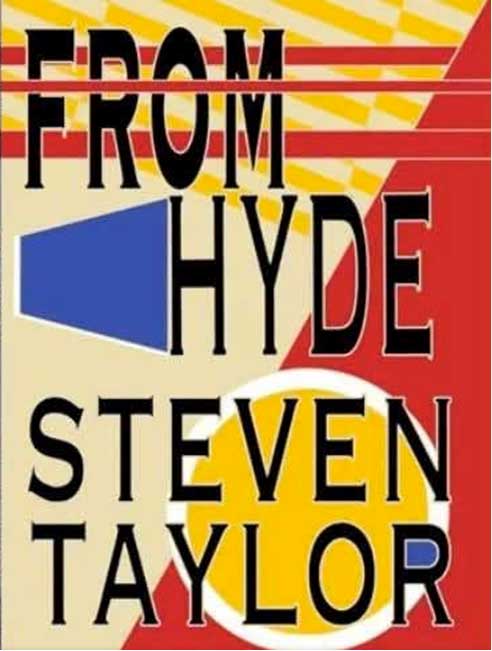
From Hyde, Steven Taylor, 120pp, £10.00 (erbacce press)
In the Acknowledgements to From Hyde, Taylor credits his parents and tells us how his father’s profession (he was a textile cutter) suggested to him the refrain that runs through this book-length poem:
each length measured for a purpose,
marked, and cut accordingly
Sometimes, it stands for the brutal impersonality of a system that shapes people to its own purposes and how the people it sucks up might come to process events subconsciously: the methodical, repetitive processes of their jobs carrying over, perhaps, into how they think and feel in their lives outside work. In the latter part of the poem, it is even added as a humorous qualifier to Hyde’s motto, ‘Onward, Onward.’ Also, you could say it encapsulates the method behind the poem itself, describing, as it does, the way the content we get between the appearances of the refrain is selected and organised, although the way Taylor marks and cuts his material is very different to that of those who might present a less politically conscious narrative. He has an eye for the absurd, too. For example, the poem begins by juxtaposing two disparate facts about Hyde – its Edwardian electric tramway and its prowess at water polo, which constitute, as the poem puts it:
A peculiar convergence of circumstances
obviously
In another example, local farms that existed before the canal was built find themselves up alongside teddy boys drinking hot Vimto in an ice-cream parlour. Throughout, it’s as if information converges on the poem, is measured up and cut to size.
The tramway, water polo, farmers, teddy boys and so on – it may all be converging, but what is it converging on? One is left very much with a sense of Hyde as an organic centre: people shape the place (by building the canal, etc.) according to the demands of capitalism. In thrall to the system, the people are, in turn, shaped by the place they’ve created. The people shape each other, too, and it becomes difficult to separate the people from the place. William Carlos Williams claimed the theme of his long poem, Paterson – another poem that focuses on the relationship between people and place – to be ‘the resemblance of the mind of modern man and the city’:
The city
the man, the identity –
it can’t be otherwise – an
interpenetration, both ways.
– William Carlos Williams, Paterson
Although something similar can be said to be happening here, the method is very different. Williams improvises over a riff which presents the city itself a man and the natural world as a multiplicity of women (and yes, some critics have flagged up the poet’s questionable approach to gender in that poem. There’s none of that here). Taylor’s approach is less fanciful, but no less poetic and, one might argue, more politically astute. He documents how capitalism has measured, marked and cut Hyde and the people who lived – and still live – there for its own purposes, so much so, that the people doing the measuring, marking and cutting can find themselves believing they’re acting entirely according to their own free wills.
The poem got me thinking, too, not just of Williams but of other possible poetic antecedents. Taylor has said the poet he’s read most is probably Wallace Stevens and there is something in his voice and the ease with which the poetry absorbs philosophy that’s reminiscent of that poet. The music of his lines and the timing of his story-telling owe more though, I’d say, to another poet he favours, Guillaume Apollinaire. And the way he imports chunks of history is reminiscent of Pound. I immediately reached for Harrison’s V, but that poem is more personal, more rooted in the time it was written. I was, though, reminded of the Bunting of Briggflatts, not only on account of its anti-capitalism (Bunting’s turd-bakers) but also its vast historical sweep, its realisation that autobiography and history are inextricably linked and its attention to commonplace detail (the way Bunting writes about shepherds, the game of bowls, ‘tea from the can’ and so on). Take the poet’s memories of his mother and grandmother. As a small child, he finds himself
beside a woman’s skirts
the soft warm cotton
my Mother wore on washdays
printed with tiny cornflowers
while Gran favoured a version
of violets
This is a good example, too, of the range covered by this poetry: it can be both vivid, intimate and personal one moment and – as we’ll see – broad, more objective a philosophical the next, as need demands. Incidentally, both Pound and Bunting get name-checked in the text: ‘each length’ in the lettering carved by Bunting’s Briggflatts stonemason – you guessed it – gets ‘measured for a purpose, / marked, and cut accordingly’.
In this poem, Hyde becomes a microcosm of a nation. As humans, we constantly perform a balancing act at which we’re so adept we hardly notice we’re performing it. We think of the human body as a beautiful thing while at the same time shutting out, as far as we can, our awareness of what it contains; the skeleton and the viscera which, for most people most of the time, is the stuff of horror. We are brought up to apply the same trick to the body politic. When we shut out of our minds the horrific things our governments do (e.g., support and wage wars overseas, mistreat certain of their own citizens, etc.) we use the same, well-trained mental muscle. I don’t think Taylor makes this point explicitly in the poem, but he does present us with the end result. Consider what he tells us about the treatment of children in what was, supposedly, a far more explicitly Christian society than today:
The mill owners arranged for foundlings
To be delivered in batches from the south
Of England and kept them in dormitories
Warmed by their collective body heat. They
Were beaten into use and those who failed
To measure up were discarded. Children
Who became ill or vexed were put out
And commonly died under hedgerows.
Anyone who finds it hard to imagine how we might, as a society, normalise this, underestimates just how easily we can normalise just about anything. And the people of Hyde, over time, as Taylor shows us, have had plenty to process. He gives us a biblical list of the poor sods who died in a mine disaster, accounts of industrial accidents and of the insanity brought on by the use of mercury in millinery. Then there’s the war memorial. To return to the body analogy, this is poetry as autopsy. Taylor gets beneath the skin to the things we’d rather not look at and makes poetry out of it. We are spared nothing, ‘each length measured for a purpose, marked, and cut accordingly’.
And anyone reflecting on the anti-Muslim sentiment prevalent among some people in the UK right now might usefully reflect on its similarity to the prejudice – also as unreasonable and unfounded as it was cruel – meted out to British Catholics in the past. I’m not thinking here of the parts of the UK polarised by a sectarian divide, but of a ubiquitous, everyday prejudice, commonplace even at the time I was growing up. I remember, as a child, being told how you could never trust Catholics because they owed their allegiance to the pope rather than the monarch. It still exists, but nothing like to the extent that it once did, and I would suggest most people now see it as the nonsense it always was. Go back a century before my childhood, though, and the hatred you’ll find back then was visceral and violent. It rears its ugly head in From Hyde in the form of the Murphy Riots of 1868,
when William Murphy, a member
of the Protestant Evangelical Mission stirred up
hatred to such an extent that over a hundred
homes were destroyed in Ashton and Stalybridge
Taylor’s account ends with the observation that
Murphy was killed in 1782
after being set upon by Irish Miners
celebrating St Patrick’s Day.
Which, in turn, is followed by the poem’s refrain which at times – as here – has a resonance akin to Kurt Vonnegut’s Slaughterhouse-Five motif, ‘so it goes’.
Time passes. There are disasters, a royal visit, wars, anecdotes to be told, plus glimpses of Myra Hindley Ian Brady and Harold Shipman. Not that people take it all lying down – there are strikes, for example. People help each other out. Capitalism, though, sadly, still holds sway. The lives of Taylor’s ancestors are intertwined with all this converging historical material until, midway through the book, Steven Taylor himself is born. (Incidentally, for a poet to be born in the middle of their own poem in surprisingly rare. It takes some doing. Walt Whitman is one of the few others who managed it).
Taylor can be poignant, as when he says of his grandfather
I presume
he had a particular reason
for taking an axe to the piano.
Perhaps it was the death of his wife.
Not to mention darkly witty:
Michael who fell from the Orme at Llandudno
while stealing eggs from seagull nests
was presented to the rest of us at a Special
School Assembly as a lesson
and a warning of what could happen
if you went to Wales without proper supervision.
There is so much more one could tell about this encyclopedia of a poem, but I’d hate to spoil the fun for the reader. There’s everything in it from the fate of the dinosaurs had they not been wiped out, through William of Ockham and the early Wittgenstein, to the price of beer in Redfern’s social club. At one point, near the end, Taylor asks:
If I carry on drinking with the curtains
closed in darkness will I find myself or lose my bearings?
From then on I couldn’t help imagining the poem being read to me by this character. Indeed, I wondered if his hadn’t been the voice reading the poem out to me all along. It carries on freewheeling from one talking point to another, it’s cuts and measurements – at least it felt like this to me – increasingly personal, spontaneous and intuitive, as well it might, after a few bottles of Boddies: Harold Shipman, St Paul, ISIS, Lyrical Ballads, the girlfriend of a drug-dealer from Wythenshawe… Drawn in as we are, though, it all makes sense. Does the poet lose his bearings, as he feared he might? Absolutely not. However, he does appreciate how, as he tellingly quotes Charles Olson as saying in his biographical note, ‘one perception must immediately and directly lead to a further perception’. This poem is both brilliantly put together and a compelling read. Do get yourself a copy and read it, preferably out loud and, if possible, in one take.
.
Dominic Rivron
LINK
From Hyde: https://www.erbacce-press.co.uk/steven-taylor
/