
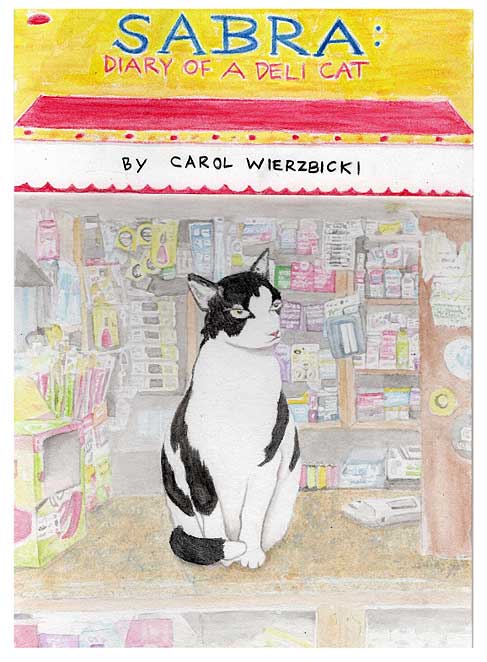
by Carol Wierzbicki
“cats are deemed smart by the extent to which they can train humans to do their bidding.”
Carol Wierzbicki, Sabra
- book review by bart plantenga
I’ve been owned by some wonderful cats. A few were life-wreckers but for the most part, when they’re in cohabitation mode they’re great and I’ve never hesitated to try to charm my way into their midst. I imagine I’m delving into their inner lives, impersonating their voices, discussing things with them – their askew heads as affirmation that they get it. It’s probably related to watching The Aristocats maybe one too many times.
Sabra is, however, a deli cat with, come to find out, a lot on his mind. His socio-quadurpedal narrative ends up as handy corollary to the standard two-dimensional Disney vision of cats by presenting the lives of his cat gang in terms of personal and class struggle. They’re victims of the system that profits from a rigged system of unpaid labor and worker precarity as a by-product of gig work and zero-hour schedules.
Competing as they must for the affection of humans by playing up the cuddly value-added angle, Sabra describes the feline attitude as distinct from, and perhaps superior to, that of dogs. Cats are less slavish and, although she’s not wholly dismissive – suspicious maybe – she and her clowder of felines remain perplexed by the canine’s embarrassing submissiveness to its human “owners.”
It’s well known that cats are proud of their ability to out-psych, out-scheme their human cohabitants, being always in control by offering humans the illusion that they’re in control of things. But alas our feline proles cannot gloat long because they soon discover that they are at the mercy of the lords of power, real estate and everything else.
Sabra’s story is a mini-epic, a 4-pawed picaresque: adopted by a deli owner, commissioned to keep an eye on the store – a cushy job in a warm, snoozy window with a short job description: maintain vigilance and catch the occasional mus urbanis [city mouse]. An easy life, really – one of simple, “basic needs… to have a purpose, a mode of employment, food and shelter, and to be left in peace.” Seems reasonable.
But it’s too much to ask because this idyll is soon upended by the encroaching cabal of greedy speculators and shady property owners. Sabra and her gang of “cats of every color, stripe, spot and size,” become just more victims of gentrification which leaves every cosy old hood unaffordable – yuppified, monetized. Sabra and his furry four-footed are evicted, left homeless, cast adrift to embark on a desperate quest for food, clothes, shelter – and purpose – Homer’s Odyssey, Steinbeck’s Grapes of Wrath, and Orwell’s Animal Farm all come to mind.
The cats strive to survive as migrants in their own city and eventually as strange cats in a strange land as they end up on a sailing ship that puts down anchor in a faraway land. They face hopelessness, lost dignity in increasingly undignifying and anxious neoliberal times, encountering many hardships, deaths, confrontations, predators, and deprivations along the way.
They settle in a shantytown on the wrong side of the tracks where many of the have-not humans also end up, aptly mirroring our current neoliberal-ordained crisis where the few haves have ever more and the have-nots have ever less. They eventually end up in the care of a compassionate human who tends to their needs.
In survival mode, the cats, eventually prove their mettle – and superiority to humans – showing admirable solidarity over sectarianism through the acceptance of one another despite being from VERY different breeds and economic backgrounds – from feral to pampered domestic. They’re also adept at adopting basic democratic principles – when their leader Nero dies and they must elect a successor, they choose Sabra without serious incident. The current state of the world demanding ever more resourcefulness.
They even draw up a non-aggression pact with their natural enemy, rats, who are eventually enlisted to chew up the speculators’ for-sale signs in an effort to do battle with ruthless real estate moguls and developers selling off their future.
I often found myself nodding “yesyes” as Sabra’s told her life story from her informed meowing maw and then – wait a minute; suddenly I’m tagging along with this felis tabernaria [neighborhood bodega cat], talking to me from over her shoulder: “As you’re walking down the street, a flicker of movement in the corner of your eye: that’s us,” as she negotiates her sly clandestine feline routes.
Carol Wierzbicki’s charming, immersive, anthropomorphic allegory about feline survival in a neoliberal wilderness is an aspiration worthy of MLK: “I dream of a world without cats in cages.”
My enthrallment was swift, effortless, enlightening. How close the lived experience of a cat is to our own.
~
Sabra: Diary of a Deli Cat
Copyright © 2025 by Carol Wierzbicki
Illustrated by Eric Wolf
ISBN 9798307810019
.