
By Ade Rowe
Japanese metalsmithing represents one of the most sophisticated and aesthetically distinctive traditions within the history of material culture. Its development cannot be understood merely as the progression of techniques used to manipulate copper, iron, silver and gold. Rather, it constitutes a complex relationship between material knowledge, artistic sensibility, cultural identity and philosophical understanding. Across successive historical periods, Japanese metalworkers transformed substances of considerable physical resistance into objects of remarkable delicacy, demonstrating an extraordinary command of metallurgy whilst developing an artistic language in which texture, colour, proportion and surface carried profound significance. The resulting tradition is distinguished not simply by technical accomplishment, but by an unusually intimate understanding of the possibilities and limitations inherent within metal itself.
The origins of Japanese metalworking extend considerably further back than the emergence of the celebrated sword making traditions with which the country is frequently associated. Archaeological evidence demonstrates that metal objects occupied an increasingly important position within Japanese society during the Yayoi period, conventionally dated from approximately 300 BCE to 300 CE. The introduction and subsequent development of bronze and iron technologies fundamentally altered the material circumstances of early Japanese communities. Bronze was employed in the manufacture of ritual objects, agricultural implements and ceremonial weapons, whilst iron gradually became indispensable to agricultural production, construction and warfare. These materials were not simply adopted as foreign technologies. Their manufacture and utilisation underwent substantial local adaptation, reflecting the environmental conditions, available resources and social structures of the communities responsible for their production.
The subsequent Kofun period, extending approximately from the third to the seventh century, witnessed further developments in the sophistication of metalworking. Iron weapons, armour, horse equipment and ornamental fittings became increasingly elaborate, reflecting the emergence of powerful political authorities and the growing importance of martial identity. The exchange of metallurgical knowledge between the Japanese archipelago and neighbouring regions of continental Asia also contributed significantly to technical development. Influences arriving through the Korean peninsula and China introduced new methods of casting, forging and decorative treatment, which Japanese craftspeople gradually assimilated into their own practices. This process of cultural transmission was neither passive nor uniform. Imported knowledge was repeatedly modified, refined and reinterpreted, eventually contributing to the distinctive character of Japanese metal craftsmanship.
One of the fundamental techniques within Japanese metalworking is tankin, the art of shaping metal through controlled hammering. This process involves gradually transforming a sheet or plate of metal into a three dimensional object through repeated blows delivered using specialised hammers and supporting tools. Depending upon the desired form, the metalworker may employ raising, sinking, planishing and repoussé techniques. Raising involves progressively drawing the edges of a flat metal disc upwards and inwards, producing a vessel with considerable structural continuity. The workpiece is repeatedly rotated and struck against an appropriate supporting surface, with the hammering sequence carefully controlled to prevent irregular deformation. Sinking, by contrast, involves driving the metal downwards into a hollow or recessed form. Repoussé produces raised decorative relief by working the metal from its reverse side, whilst chasing refines and defines the resulting shapes from the front.
These operations require an understanding of work hardening, the phenomenon through which repeated deformation increases the hardness and reduces the ductility of metal. To restore workability, the material must periodically undergo annealing, a controlled heating process followed by appropriate cooling. Annealing allows internal stresses to diminish and the metal to become sufficiently malleable for further manipulation. The relationship between hammering and annealing is fundamental to successful Japanese metal forming. Excessive deformation without appropriate softening can cause cracking, particularly in materials that have become increasingly brittle through repeated working. Consequently, the craftsperson must continuously assess the material’s condition and determine the appropriate moment for further treatment.
Another significant technique is tsuchime, which involves deliberately creating hammer marks upon the surface of metal. Rather than removing these marks through extensive polishing, the metalworker retains them as an intentional decorative feature. The resulting surface may exhibit a regular arrangement of small impressions or a more irregular composition, depending upon the shape of the hammer and the rhythm of the working process. Tsuchime demonstrates how a procedure ordinarily associated with fabrication can become an important element of visual expression. Light interacts with the numerous small indentations, producing subtle variations in reflection that give the finished object an unusual sense of depth and movement.
The development of Japanese swordsmithing represents one of the most consequential achievements within this broader history. During the Heian period, approximately 794 to 1185, the Japanese sword underwent considerable morphological and functional transformation. The emergence of the curved blade, particularly associated with the development of mounted warfare, encouraged refinements in forging and heat treatment that would become central to the country’s metallurgical identity. Japanese swordsmiths developed procedures involving repeated heating, folding and forge welding, through which different characteristics of iron and steel could be combined within a single blade.
Traditional Japanese sword manufacture is especially notable for its treatment of tamahagane, a form of steel produced through the smelting of iron bearing sand in a tatara furnace using charcoal. The resulting material contains considerable variation in carbon content and physical characteristics. Rather than treating this inconsistency as an entirely undesirable condition, the swordsmith selects and combines different portions of the steel according to their intended function. Through repeated forging, the material is consolidated and impurities are progressively expelled.
The process of folding and forge welding involves heating the steel until it reaches an appropriate working temperature, then hammering it into a flattened form. The material is folded and welded repeatedly, producing a layered structure and helping to distribute carbon throughout the steel. The number of folds varies according to the material and the smith’s chosen method. The resulting blade may incorporate different arrangements of harder and softer steel, providing a carefully considered balance between cutting performance, resilience and structural integrity. The distinctive surface grain known as hada emerges through the interaction of the steel’s composition and the forging process.
Differential hardening further illustrates the sophistication of this tradition. Before quenching, the swordsmith applies a carefully prepared insulating clay mixture to the blade. Its distribution influences the rate at which different sections cool when the heated blade is immersed in water. The cutting edge consequently develops a harder martensitic structure, whilst the spine retains a comparatively softer and more resilient composition. This transformation produces the characteristic hamon, the visible temper line that distinguishes the hardened portion of the blade from the surrounding steel. Its appearance reflects the relationship between thermal treatment, steel composition and the individual judgement of the craftsperson.
The significance of the Japanese sword nevertheless extends beyond its mechanical construction. Within the historical consciousness of Japan, the sword became an object associated with authority, social distinction, personal discipline and martial identity. Its manufacture consequently acquired a cultural significance that elevated the status of the swordsmith. The finished blade was understood as the result of both technical knowledge and concentrated human endeavour.
Whilst swordsmithing attracted considerable attention, the decorative metalworking traditions associated with Japanese sword furniture developed into an equally remarkable artistic discipline. During the Edo period, from 1603 to 1868, prolonged political stability under the Tokugawa shogunate created favourable circumstances for the refinement of specialist craftsmanship. The samurai class continued to use swords as markers of status and identity, generating substantial demand for decorative fittings. These included tsuba, the handguards of Japanese swords, alongside menuki, kozuka and kogai, which formed other components of the sword’s ornamental ensemble.
The techniques collectively associated with ch?kin, or Japanese metal chasing, became particularly important during this period. Ch?kin encompasses an extensive repertoire of engraving, carving, piercing, texturing and inlay procedures. These techniques enabled craftspeople to produce exceptionally intricate compositions upon comparatively small metallic surfaces.
Kebori is a form of fine line engraving executed using a specialised V shaped chisel known as a tagane. The tool is carefully guided across the metal to create narrow incisions that can represent delicate outlines, botanical details and intricate linear patterns. The depth and width of each incision are determined by the angle of the chisel and the pressure applied. The technique demands considerable precision because even a minor deviation can alter the character of an otherwise carefully composed design.
Keribori employs a different approach to line engraving, using a flat chisel to create a succession of small triangular impressions. These marks can be arranged to produce continuous lines with a distinctive visual character. Katakiribori, meanwhile, involves cutting with an asymmetrical chisel so that one edge of the incision is steeper than the other. This produces lines of varying depth and width, creating an effect reminiscent of brushwork in traditional Japanese painting. Its significance lies in the ability to translate the fluidity of calligraphic gestures into the comparatively resistant medium of metal.
Shishiaibori is a particularly sophisticated form of sunken relief carving. The craftsperson removes material from the surrounding surface to create recessed compositions, carefully regulating the depth of the carving to establish variations in light and shadow. Ukibori produces the opposite visual effect through the creation of raised relief. In both techniques, the final appearance depends upon the precise relationship between the untouched metal and the areas that have been cut away or raised.
Horikuzushi involves more extensive carving and modelling, allowing three dimensional forms to emerge from the metal surface. Through the selective removal of material, the craftsperson can create figures, animals, botanical subjects and ornamental details that possess a pronounced sculptural character. The process requires an intimate understanding of the relationship between depth, perspective and the physical thickness of the metal.
Another particularly distinctive technique is sukashibori, which involves cutting or piercing openings into a metal object to create openwork decoration. The designs may be produced through chiselling or the use of specialised saws. In the manufacture of sword guards, this technique allowed metalworkers to construct intricate compositions in which the relationship between solid metal and empty space became an essential element of the design. The openings were not simply decorative omissions. They formed an integral part of the composition, influencing the distribution of visual weight and the passage of light through the object.
Nanako-uchi is a surface texturing technique involving the repeated punching of extremely small, rounded indentations into metal. A specialised punch is used to create an orderly arrangement of minute impressions, producing a surface resembling fine fish roe. The technique is particularly effective on sword fittings and decorative components because it introduces a delicate texture that contrasts with smooth polished surfaces and more elaborate engraved details. The regularity of the pattern requires considerable dexterity, since inconsistent spacing or depth can compromise the visual coherence of the entire composition.
Ishime provides another method of surface texturing, producing a roughened appearance reminiscent of natural stone. Rather than creating the highly regular pattern associated with nanako-uchi, the metalworker employs specialised tools to generate irregular indentations and subtle variations in the surface. The resulting texture can create an interesting contrast with polished metal and precious metal inlay.
The tsuba became an especially important medium through which these techniques could be combined. Although its primary purpose was functional, its surface offered considerable opportunities for artistic expression. Craftspeople developed elaborate compositions incorporating landscapes, botanical forms, animals, mythological subjects and references to classical literature. A single object might incorporate fine engraving, raised relief, openwork, textured backgrounds and precious metal decoration. The successful combination of these procedures required not only technical proficiency but also a sophisticated understanding of visual composition.
Japanese metalworkers also developed exceptional inlay techniques collectively described as z?gan. These involve introducing a contrasting metal into a prepared surface, creating decorative compositions through the juxtaposition of different materials and colours. Honz?gan, often referred to as true inlay, involves cutting grooves or cavities into a harder metal substrate and inserting a softer metal, frequently gold or silver, into the prepared recesses. The sides of the cavity may be cut at an angle or undercut to provide a mechanical foundation for the inlay. The inserted material is hammered into position, allowing it to spread and become securely embedded within the surrounding metal.
Several variations of z?gan exist. Senz?gan involves the insertion of metal into narrow lines or channels, making it particularly suitable for fine outlines and linear decoration. Hiraz?gan produces relatively flat inlay, with the inserted material brought into alignment with the surrounding surface. Takaniku z?gan involves raised inlay, in which the contrasting metal projects above the principal surface to create a more pronounced relief. Togidashi z?gan is refined through polishing, which reveals the inlay and surrounding metal as a continuous surface. Itoz?gan employs narrow strips or threads of contrasting metal to create delicate linear compositions.
Nunome z?gan, frequently translated as textile inlay, is another highly specialised technique. The metal surface is first covered with a series of fine intersecting incisions, creating a crosshatched pattern resembling the weave of fabric. Thin sheets or fragments of precious metal are subsequently hammered into this prepared network. The numerous incisions provide a mechanical grip that secures the softer metal against the harder substrate. Gold and silver can therefore be applied in remarkably delicate patterns without relying exclusively upon conventional soldering. The resulting surface can exhibit the appearance of a woven metallic fabric, particularly when the inlay is used to produce intricate ornamental details.
The development of these techniques demonstrates an exceptional understanding of the mechanical relationship between different metals. Gold and silver are comparatively malleable, allowing them to be manipulated into intricate forms, whilst harder materials such as iron, copper and brass provide a more resistant foundation. The contrast between these materials is exploited not only for structural purposes but also for aesthetic effect.
The ability to produce different colours through the manipulation of alloy composition represents another particularly significant achievement. Among the most important materials is shakud?, a copper alloy containing a small proportion of gold, which acquires a distinctive deep blue black appearance through traditional patination. Its visual character is remarkable because the gold content does not produce the familiar appearance of conventional gold objects. Instead, the interaction between alloy composition and chemical treatment creates an entirely different chromatic effect.
Shibuichi is another important alloy, traditionally produced from copper and silver. Its name is commonly translated as one quarter, referring to a traditional proportion of silver within the alloy, although historical compositions were not necessarily uniform. Depending upon its precise composition and subsequent treatment, shibuichi can acquire surfaces ranging from pale grey to muted brown. Other alloys, including kuromid?, a dark copper alloy, contribute further possibilities to the traditional Japanese palette.
The wider family of coloured copper alloys is frequently described using the term irogane. Their development represents a particularly significant contribution to decorative metallurgy because it demonstrates an understanding of colour as a property that could be generated through the internal composition and subsequent transformation of a material. Japanese metalsmiths were not simply decorating an object with colour. They were manipulating the material itself to produce an appearance that emerged through chemical transformation.
The treatment responsible for these effects is known as irogane shitate, whilst the application of controlled chemical patination is generally associated with niiro. Before treatment, the metal surface must be carefully cleaned and prepared to remove grease, oxidation and other contaminants that might interfere with the chemical reaction. The object is subsequently immersed in an appropriately prepared solution, traditionally involving ingredients such as copper sulphate and verdigris, under carefully controlled conditions. The temperature, duration of immersion and composition of the alloy influence the final appearance. Once the desired colour has developed, the object is removed, rinsed and protected using a suitable finishing treatment.
The science underlying these processes is particularly fascinating. The characteristic appearance of shakud? is associated with the development of a thin cuprite rich surface layer containing finely distributed gold particles. The resulting colour is therefore not simply a superficial stain but a consequence of the interaction between the alloy and its chemically transformed surface. Such procedures reveal the empirical sophistication of traditional Japanese metalworkers, whose knowledge was developed through prolonged observation and practical experimentation.
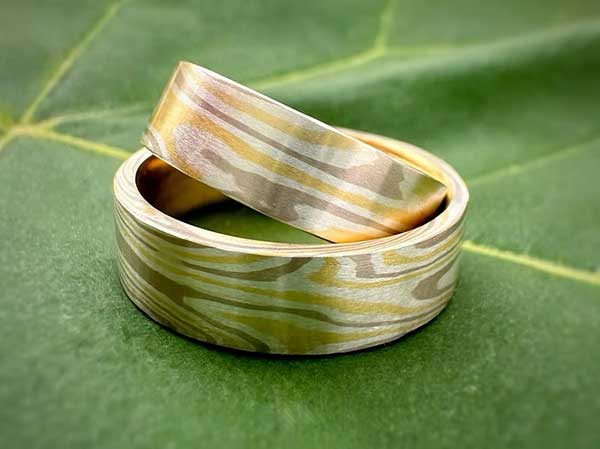
The technique of mokume gane represents another extraordinary achievement. Its name is generally translated as wood grain metal and refers to a method of creating intricate patterns through the combination of contrasting metal layers. The process involves preparing thin sheets of different metals, which are carefully cleaned and arranged into a laminated stack. Copper, silver, gold, shakud? and shibuichi are among the materials that may be employed.
The individual layers are brought together under carefully controlled heating conditions, allowing them to bond through diffusion and forge welding. The resulting billet must be sufficiently consolidated to prevent separation during subsequent working. Once the layers have fused, the craftsperson introduces carefully positioned cuts, grooves or depressions into the surface. The billet is then subjected to further forging, flattening and manipulation, exposing different sections of the contrasting layers.
By controlling the depth and position of the cuts, the direction of deformation and the subsequent removal of material, the metalworker can produce patterns resembling flowing timber grain, concentric formations, waves and irregular organic structures. The billet may also be drilled or carved to reveal additional layers beneath the surface. Once the desired pattern has emerged, the material can be flattened into sheet form or shaped into vessels and jewellery through further hammering and forming.
The technical difficulty of mokume gane lies in achieving a secure bond between dissimilar metals without allowing excessive oxidation, separation or unwanted deformation. Differences in melting behaviour and mechanical properties must be considered throughout the process. Each operation influences the final arrangement of the layers, meaning that the resulting pattern depends upon a sequence of carefully calculated interventions. Although the craftsperson exercises substantial control, the internal structure of the material creates opportunities for variation and unexpected visual effects.
The artistic significance of mokume gane extends particularly strongly into contemporary jewellery making. Its laminated construction provides an exceptional opportunity to create wearable objects in which the decorative pattern is integral to the structure of the metal. Rings, pendants, earrings, bracelets and brooches can all be produced using this technique. The resulting objects possess a distinctive appearance because their patterns emerge through the manipulation of contrasting metallic layers rather than through the application of surface decoration.
In ring making, for example, a laminated billet is first forged and reduced to an appropriate thickness. The metal is then cut into a strip of calculated length, shaped around a mandrel and carefully joined to create a circular band. The edges must be accurately aligned to preserve the continuity of the pattern. Once the joint has been secured, the ring is adjusted to the required dimensions and its surface refined through filing, abrasion and polishing. The final finishing process reveals the contrasting layers, creating an intricate arrangement of flowing lines and organic formations. Each ring possesses individual characteristics determined by the original layering, the direction of deformation and the subsequent shaping process.
The manufacture of Japanese jewellery more broadly represents a significant dimension of the country’s artistic heritage. Japanese jewellery encompasses objects of personal adornment, ceremonial accessories, decorative hair ornaments and contemporary wearable sculpture. Although historical Japanese conventions of personal adornment differed in several respects from those of European societies, Japan cultivated an extensive repertoire of techniques through which precious metals, coloured alloys, gemstones and other materials could be transformed into objects of considerable aesthetic and cultural significance.
Traditional hair ornaments known as kanzashi provide an especially interesting connection between metalsmithing and personal adornment. These ornamental hairpins and accessories have historically been produced from materials including silver, gold, copper, tortoiseshell, lacquered wood and other decorative substances. Metal examples frequently incorporate delicate engraving, repoussé, chasing, openwork and decorative inlay. Their compositions commonly feature botanical motifs, seasonal flowers, birds and other subjects drawn from the natural world. Their manufacture requires considerable attention to weight distribution and structural stability because the object must remain sufficiently lightweight and comfortable whilst retaining its decorative complexity. Kanzashi therefore demonstrate how technical considerations and aesthetic requirements intersect within the production of wearable objects.
The production of jewellery begins with the careful selection of suitable materials. Gold, silver and copper are particularly important because of their malleability and their capacity to be worked into complex forms. Alloys are selected according to the desired colour, hardness, durability and response to subsequent processes. Metal may be obtained in sheet, wire or ingot form, with the latter requiring casting and subsequent reduction through rolling or hammering.
Sheet metal fabrication involves cutting, shaping and manipulating metal to produce the principal components of an object. A jeweller’s piercing saw is used to cut precise outlines and internal openings, whilst files and abrasive materials refine the edges. The resulting components can be shaped through hammering, bending and forming, depending upon the intended design. The process requires considerable precision because even small irregularities become visually apparent in finished jewellery, particularly when several components must fit together accurately.
Annealing is especially important in jewellery manufacture because repeated hammering and bending gradually harden metal through work hardening. Heating the material to an appropriate temperature restores its malleability, allowing the craftsperson to continue shaping it without causing fractures. The temperature and cooling procedure depend upon the particular alloy being worked. The metalworker must therefore possess a sound understanding of material behaviour rather than relying upon a universal treatment for every metal.
Soldering is another essential process through which separate components are joined to create structurally coherent jewellery. The surfaces to be joined must be cleaned and fitted accurately, after which an appropriate solder is introduced and heated until it flows into the joint through capillary action. The workpiece is subsequently allowed to cool, cleaned and refined. Different solder grades may be selected according to their melting temperatures, allowing several components to be joined in sequence without remelting earlier connections. The placement of the solder is particularly important because excessive material can leave visible seams or interfere with subsequent decorative operations. Skilled jewellery makers therefore seek to produce joints that are both mechanically secure and visually unobtrusive.
The construction of rings demonstrates the relationship between forming, joining and finishing particularly clearly. A strip of metal is cut to the required length, shaped around a mandrel and brought into alignment before its ends are soldered together. The resulting circular form is adjusted using specialised forming tools to achieve the desired dimensions and profile. Depending upon the design, the ring may subsequently undergo forging, engraving, texturing, stone setting or the addition of decorative components.
Earrings, pendants and bracelets require similarly careful consideration of structural design. Earrings must be appropriately balanced to avoid unnecessary strain, whilst bracelets require sufficient strength and flexibility to accommodate movement. Pendants may incorporate suspension loops, hinges or connecting elements that must remain secure despite repeated handling. The finished object must therefore reconcile visual sophistication with comfort, durability and practical functionality.
Gemstone setting introduces another specialised dimension to Japanese jewellery making. Prong setting involves forming small projections of metal around a gemstone and carefully bending them over its edges to retain it securely. Bezel setting requires a surrounding metal enclosure into which the stone is fitted, with the upper edge subsequently pushed or burnished over its perimeter. Flush setting involves preparing a cavity within the metal itself, allowing the gemstone to sit approximately level with the surrounding surface. Each method demands accurate measurement and an understanding of the relationship between the hardness of the gemstone, the thickness of the metal and the pressure required to secure the setting.
Japanese jewellery makers may combine gemstone settings with engraved backgrounds, textured surfaces and contrasting alloys. A gemstone can therefore become part of a broader decorative composition rather than functioning merely as an isolated ornamental feature. Pearls, jade, coral and other materials have also occupied important positions within Japanese personal adornment, although the choice of materials and their symbolic significance have varied considerably across historical periods.
Granulation represents another significant technique within the wider history of jewellery making. It involves the production and attachment of minute metallic spheres to a supporting surface. Small particles of gold or silver are prepared and arranged into carefully considered patterns before being joined to the underlying metal. The placement and attachment of each granule demand considerable precision because the scale of the individual elements makes inconsistencies immediately apparent. Granulation is found in various historical jewellery traditions, and its use in Japanese work reflects the broader international history of decorative metalworking rather than an exclusively Japanese invention.
Filigree work, involving the arrangement of fine metal wires into intricate ornamental patterns, provides another method of creating delicate jewellery. Thin wires are twisted, curved and arranged into spiralling or interlacing compositions before being joined at selected points. The technique is particularly suitable for earrings, pendants and decorative components because it produces visually complex structures with relatively little material. Its successful execution depends upon controlling wire thickness, curvature and tension whilst ensuring that the finished structure remains sufficiently robust for everyday use. Japanese practitioners have incorporated delicate wirework into various forms of ornamental craftsmanship, adapting its possibilities to their own aesthetic preferences.
The surface treatment of jewellery is equally significant. Polishing is not simply the final stage of production but an important artistic decision that determines how the finished object interacts with light. A highly reflective surface can emphasise the purity and smoothness of a precious metal, whereas a brushed or satin finish creates a softer appearance. Hammered finishes introduce irregular reflections, whilst patinated surfaces create subdued tonal effects. Migaki, referring broadly to polishing and surface refinement, is employed to establish the final character of the metal. The choice of finish can fundamentally alter the perception of an object, even when its overall form remains unchanged.
Contemporary Japanese jewellery has increasingly moved beyond conventional expectations of preciousness and ornament. Many artists explore the expressive potential of oxidised metals, unconventional alloys, recycled materials and combinations of metal with wood, ceramics, textiles and lacquer. Some create jewellery that approaches the character of miniature sculpture, using asymmetrical forms, irregular surfaces and deliberately restrained compositions. Others reinterpret traditional techniques such as mokume gane, z?gan and shakud? patination within distinctly contemporary visual languages.
Casting also occupies an important position within Japanese metalworking. The traditional lost wax method, known as r?gata, involves producing a model from wax, covering it with a suitable refractory material and subsequently removing the wax through heating. The resulting cavity is filled with molten metal, which assumes the form of the original model. Once the casting has cooled, the mould is broken away and the object undergoes finishing, including the removal of excess material, filing, polishing and decorative treatment.
Other casting methods involve the use of prepared moulds into which molten metal is poured. The technique allows complex shapes and sculptural forms to be produced that would be difficult to achieve through hammering alone. Japanese metalworkers also developed more specialised procedures for combining different alloys within a single casting. Fukiwake, for example, involves introducing different molten alloys into a mould at carefully calculated intervals, producing distinctive transitions between the materials. Igurumi is another process in which a different metal is incorporated into the mould so that it partially melts and interacts with the principal casting material, creating distinctive patterns.
The joining of different metals is equally important in the production of vessels and decorative objects. Hagiawase involves bringing separate pieces of metal together through joining and subsequent hammering. The joints must be prepared carefully to ensure a secure bond without excessive distortion. Rozuke refers to the use of soldering materials to join metal components, with the selection of the joining alloy depending upon the composition and working requirements of the principal materials.
Japanese metalsmiths also developed sophisticated gilding procedures. Tokin, sometimes referred to as amalgam gilding, historically involved the application of a gold or silver amalgam to a prepared metallic surface, followed by heating to evaporate the mercury and leave a precious metal coating. Although historically significant, mercury based gilding presents substantial health and environmental hazards and is not an appropriate procedure for casual contemporary practice.
The artistic significance of these methods reveals an important characteristic of Japanese aesthetic thought. The relationship between surface and substance is rarely treated as incidental. The colour of an alloy, the impression left by a hammer, the subtle variation of a patinated surface and the intricate arrangement of an inlay all contribute to the identity of the finished object. A material’s physical characteristics are not obstacles to be concealed, but qualities that can be explored and transformed through technical understanding.
The historical development of Japanese metalworking also involved the refinement of specialist tools. The tagane, or metalworking chisel, exists in numerous forms designed for particular engraving and carving procedures. Its cutting edge may be V shaped, flat, asymmetrical or specially modified according to the desired result. Hammers of different weights and profiles are used for shaping, raising and texturing. Stakes, anvils and supporting forms provide the necessary resistance during hammering, whilst files, scrapers and abrasive stones are employed to refine the surface. Jewellery makers additionally employ piercing saws, mandrels, pliers, burnishers, setting tools, rolling mills and specialised soldering equipment. The selection and maintenance of these instruments are integral to the quality of the finished work.
The relationship between tools and technique also illustrates the importance of apprenticeship within traditional Japanese workshops. Technical knowledge was frequently transmitted through observation, repetition and direct instruction. An apprentice had to learn not only how to operate tools, but also how to recognise the behaviour of different metals, judge temperatures, interpret surface conditions and anticipate the consequences of particular interventions. The sound produced when metal is struck, the resistance encountered beneath a hammer and the appearance of a developing surface all provide information that cannot be reduced entirely to written instructions. The experienced metalsmith learns to interpret these signals and incorporate them into practical decision making.
The artistic and technical achievements of Japanese metalworkers became particularly visible during the Edo period. Prolonged political stability under the Tokugawa shogunate encouraged the development of specialist workshops and the refinement of decorative sword fittings. The Goto family provides an important example of this development. Beginning with Goto Y?j?, who lived from 1440 to 1512, the family became particularly influential in the production of decorative sword fittings. Its members developed distinctive approaches to the use of gold and shakud?, establishing an artistic tradition that was continued and adapted by subsequent generations.
The Meiji period, beginning in 1868, introduced profound changes to the economic circumstances of traditional craftspeople. The abolition of the feudal order and the decline of the samurai class reduced the demand for many forms of sword furniture. The prohibition on the ordinary wearing of swords introduced in 1876 accelerated this transformation, forcing numerous specialist metalworkers to reconsider their professional activities.
Rather than disappearing, however, Japanese metalsmithing adapted to the new circumstances. Craftspeople redirected their expertise towards the production of decorative objects, domestic articles, ornaments, vessels and works intended for international exhibitions. The Japanese government also encouraged the development of export oriented industries, recognising that traditional craftsmanship could contribute to the country’s international reputation and economic modernisation.
The international reception of Japanese metalwork during the nineteenth century contributed to the development of new artistic relationships. Japanese decorative objects attracted considerable attention in Europe and North America, where collectors and designers became increasingly interested in their materials, compositions and technical characteristics. This interest formed part of the wider phenomenon known as Japonisme, through which Japanese artistic principles influenced various aspects of Western visual culture.
The twentieth century introduced further challenges. Industrialisation, changing patterns of consumption and the increasing availability of mass produced goods altered the economic position of traditional workshops. Certain techniques became less commercially viable, whilst others were increasingly valued as examples of cultural heritage. The designation of individual craftspeople as Holders of Important Intangible Cultural Properties became one means through which particularly significant skills and traditions could receive institutional recognition and support.
Contemporary Japanese metalsmithing exists within a similarly complex relationship between preservation and innovation. Traditional procedures continue to be practised, yet many contemporary artists employ them in ways that extend beyond their historical applications. Mokume gane, for example, has become particularly prominent in contemporary jewellery and decorative design. Its characteristic laminated patterns offer possibilities for creating objects that retain a connection with historical Japanese craftsmanship whilst responding to modern artistic preferences.
Contemporary practitioners also engage with experimental alloys, advanced equipment and scientific approaches to material analysis. These developments do not necessarily undermine traditional craftsmanship. On the contrary, scientific investigation can provide a deeper understanding of the processes through which historical objects were produced. Research into shakud? patination, for instance, has helped clarify the relationship between alloy composition and the development of surface colour. Such findings demonstrate that traditional knowledge and contemporary materials science can operate in a mutually beneficial relationship.
An additional consideration is the conservation of historical metal objects. Japanese metalwork presents particular challenges because its aesthetic qualities often depend upon carefully developed surface characteristics. Aggressive cleaning or inappropriate chemical treatment can irreversibly alter patinas, remove delicate inlays or compromise evidence of earlier manufacturing processes. Conservation therefore requires an understanding of the original materials, their chemical behaviour and the historical significance of their surfaces. A patinated object should not automatically be regarded as damaged simply because its appearance differs from that of freshly worked metal. In many cases, its surface is an essential component of its artistic identity.
The preservation of traditional metalworking knowledge also raises questions concerning the transmission of expertise in an increasingly industrialised society. The acquisition of advanced manual skills requires sustained practice, access to appropriate materials and opportunities for close instruction. These conditions are not always easy to maintain when the commercial demand for specialised objects remains limited. Consequently, the survival of certain techniques depends upon the continued commitment of individual practitioners, educational institutions, museums and cultural organisations.
Ultimately, the significance of Japanese metalsmithing lies in its ability to unite technical precision with an unusually refined sensitivity towards material appearance. Its history reveals an enduring willingness to investigate the possibilities of metal through processes that are simultaneously practical, experimental and artistic. Whether through the differential hardening of a sword blade, the controlled development of a dark shakud? patina, the subtle tonal variations of shibuichi, the intricate patterns of mokume gane, the delicate construction of jewellery or the extraordinarily precise engraving of a sword fitting, Japanese craftspeople have repeatedly demonstrated that metal possesses a far greater expressive potential than its apparent rigidity might suggest.
Perhaps the most distinctive characteristic of this tradition is the extent to which the craftsperson works in dialogue with the material. Metal is not treated merely as a passive substance awaiting the imposition of an artistic design. Its composition, resistance, temperature, structure and chemical behaviour all participate in determining the final outcome. The metalsmith must therefore exercise authority whilst remaining attentive to the material’s particular characteristics. This relationship requires both discipline and adaptability, combining established procedures with the capacity to respond intelligently to unforeseen developments during manufacture.
Japanese metalsmithing consequently occupies an important position within the wider history of human ingenuity. It demonstrates that the development of a craft cannot be measured exclusively through the efficiency of its tools or the complexity of its processes. Equally important are the cultural values, aesthetic principles and accumulated experiences that determine how those processes are understood and employed. Through centuries of experimentation and refinement, Japanese metalworkers created a tradition in which technical accomplishment became inseparable from artistic expression.
Their achievements continue to challenge conventional distinctions between engineering and art, utility and ornament, permanence and transformation. A small sword fitting, a carefully patinated copper object, a delicately constructed silver pendant or a contemporary mokume gane ring may contain an extraordinary accumulation of knowledge within a comparatively modest physical form. Each reveals the consequences of innumerable decisions concerning composition, temperature, pressure, proportion and surface. In this respect, Japanese metalsmithing is not simply a record of humanity’s ability to shape metal. It is a testament to the intellectual and creative possibilities that emerge when technical mastery is accompanied by patience, observation and an enduring respect for the material world.
Ade Rowe