
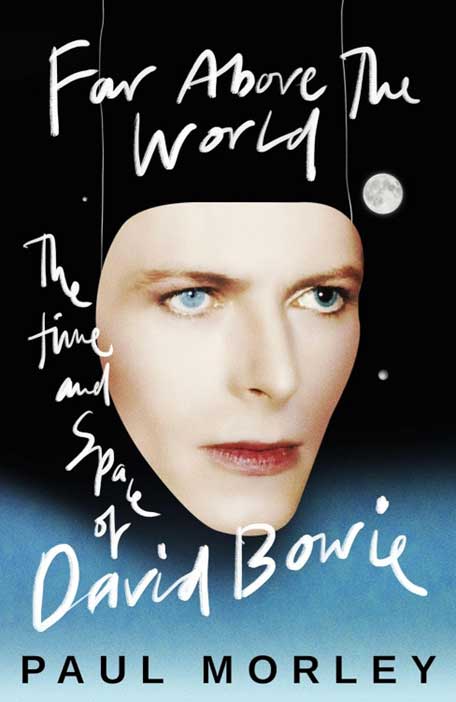
Far Above the World: the Time and Space of David Bowie, Paul Morley (Headline)
Paul Morley’s second book about Bowie is a disco ball of brief chapters that not only sparkle but reflect and illuminate both its subject and its author. It is, like all of Morley’s books, wide-ranging, informed, erudite, opinionated, obsessive and ridiculous, with long lists of comparisons and similes, metaphorical flights of fancy, unsubstantiated conjecture and multiple moments of wonderful insight.
Morley can riff and speculate on a subject with the best of them, and each chapter here is one such riff, quickly concluded within a few pages before he runs out of inspiration, energy or breath. Each section takes off from the one before but often at a tangent, picking up on an obscure reference or aside, often weaving in puns and song titles as the reader is left to collage together a version of Bowie for themselves, each chapter causing a re-evaluation and recontextualisation of his career – music, influences, critical reception – and the very notion of music, fame and culture itself.
And, of course, how Bowie fitted in to that, and changed it, slowly moving from aspiring mime artist, painter and musician to national treasure, despite his chameleon tendencies and periods of musical failure and/or absence. ‘Why are we still talking about Bowie so long after his death?’ is one of this book’s subtexts. Others include ‘What is fame?’, ‘What is love?’, ‘What is popular music?’ and ‘How on earth can anyone write about the late great David Bowie?’ (Perhaps with the sub-subtext ‘Am I worthy?’)
This book is a kind of analogue hypertext. I have only read it through as printed but I think it could be read in any order, its hopping, skipping and jumping narrative enhanced even further by acts of random selection. Not to suggest, of course, that Morley hasn’t worked hard in his arrangement. The jumpcuts and diversions always loop back to some kind of chronology and discography; Morley remains one of the finest music writers known to humankind.
He considers Bowie’s music by looking elsewhere and not talking about it, preferring to consider the influence of others, what the producer is doing, who Bowie is working with this time round, what – perhaps – he is thinking. Spirituality, longing, occult forces, heightened awareness (OK, drugs), love, desire, madness and, of course, illness and death, feature here. Somehow in Morley’s hands biography, both real and plausibly imagined, transcends the mundane and irrelevant and becomes musical and cultural criticism.
Blackstars are where matter collapses in on itself, an undoing of creation itself, and wormholes theoretically allow travel between galaxies and co-existent other times. Morley is an intrepid and fearless musical cosmonaut, just as Bowie once was. Far Above the World should not work but it does. It is a multiverse of possible and alternative David Bowies, artfully conjured up by Morley’s literary sleights of hand.
.
Rupert Loydell
.