
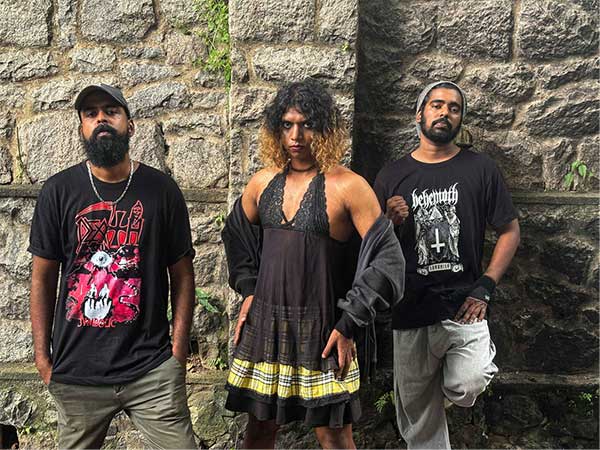
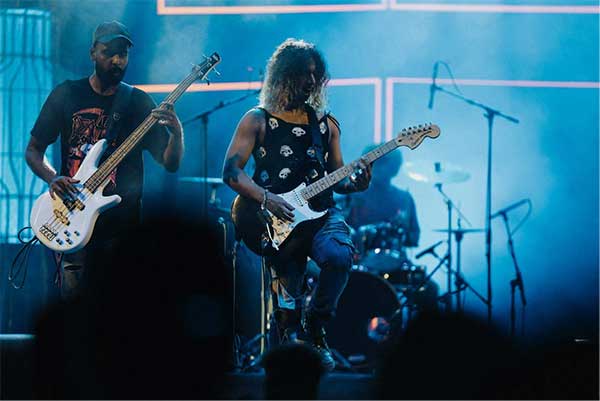
DIY DISRUPTION is a prominent, queer-fronted punk rock band from Thiruvananthapuram, Kerala, known for their fierce, socially conscious music tackling anti-fascism, anti-casteism, LGBTQ+ rights, and anti-oppression themes, bringing a raw, authentic voice back to India’s underground scene with electrifying shows and impactful tracks like “Who Killed Ra(h)ul??”. They are considered Kerala’s only active punk band, creating a significant impact by challenging norms and advocating for marginalized communities through their rebellious sound.
When I googled ‘Punk in India’ I didn’t know what to expect. As I later told AJ I had a very disappointing time in Vietnam trying to find a Punk/ Goth/ Heavy Metal band to interview when I was in that country in January 2025. Politics most likely was making it difficult for youth to speak freely about the music scene, the type of music they were playing and the inspiration for their songs.
Speaking freely to Western journalists wasn’t a wise move apparently. Especially if you were being asked about counterculture genres in contemporary music, that might involve discussing protest in a country that is an authoritarian state such as Vietnam – that is not a good idea.
So actually to find there were Punk bands in India was great news, and to further discover there was a Punk band called DIY Disruption based in Thivandrum where I was going to be staying for three weeks was a welcome surprise.
Of course, I didn’t know how DIY Disruption would react to a request for an interview so I emailed them with an open mind.
Well, when AJ contacted me and was keen to meet up and join me for a meal and drinks at the beach resort where I was staying I thought this was going to be a really interesting experience and as I didn’t want to spend the whole afternoon firing questions at AJ on a warm Sunday afternoon, I thought I’d write up the meeting as an introduction and email AJ the questions afterwards. This was the way I was going to do the interview.
So, when AJ made the short journey from the city of Trivandrum, where AJ and Maaja lived to the holiday accommodation where I was staying in Kovalam, it was a great opportunity to catch up.
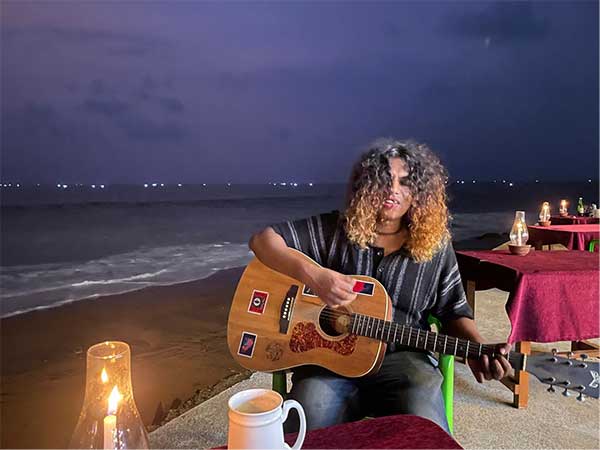
AJ had brought along his acoustic guitar and as we watched the powerful waves of the Arabian Sea pound the sands of the beach and couples dared to run into the sea, AJ went through a songbook that included Bob Marley, Paul Simon, The Clash… Guns and Roses… etc.
Finally I got a beautiful rendition of AJ’s favourite Beatle’s track Strawberry Fields Forever. It closed the evening and ended a really enjoyable afternoon/evening.
Now back home in the UK, my head full of all we talked about that day, I felt confident that my questions would be the ones that covered a lot of what we talked about and would give AJ a chance to set the record straight on who AJ is and what DIY Disruption/AJ have to say.
So here are those questions and AJ’s answers.
1) AJ, could you say a bit about how DIY Disruption got started and whose idea it was to become a Punk band as opposed to a Heavy Metal, Reggae or Ska band?
I know having spent time with you in Kerala that you are an accomplished musician on guitar/ vocals and are able to play music from all kinds of musical genres.
Punk? Was it a joint decision with the other people in the band? Rhoopak and Ajay.
Did it have anything to do with the type of music you were listening to when you were coming of age musically?
DIY disruption started out of a fire reignited. Heartbreaks can be quite a thing and when there is that gaping hole, you start to look for the things that really gave you life, which filled you with joy and passion.
Music was my best self expression and my solace and I came to find that this is where I can best be myself. When Ajay and I got to jamming on a whim at my rented home, we tried to look for something we had in common and that just happened to be Black Sabbbath’s Paranoid.
Although I did listen to metal, I wasn’t a big fan; that being said I wasn’t much of a punk aficionado either, but it did feel like it was the perfect vehicle for me to express my music without any constraints – to be authentic.
Green Day, Nirvana, Ramones, The Pistols were my immediate reference and Ajay did have more or less the same idea with punk, albeit he was more knowledgeable in the hardcore department.
When I was young Punk represented fun and chaos. It was a driving and a fun genre but I hadn’t delved deeper into it to be honest, but it always commanded my respect because of its values.
We felt the freedom that comes with punk, and the history of its rebellion against the system will inspire us to write songs while being true to ourselves.
2) AJ, Punk is regarded in the West (I use that term for convenience sake) as a musical/lyrical/vocal vehicle for angry protest, a means to speak out against Fascism, Racism, Gender issues and the Establishment.
Did you see it that way when you were starting out? Was it a perfect genre for your own and fellow band musicians to get across your views? To express your feelings about the country/ society you live in?
Yes, I definitely did see it like that. Like I had mentioned, punk to me is about authenticity and rebellion, and it is the best genre to express these views of mine in the medium of music.
3) Could you outline some of the issues that confront you in Modern India now?
Issues that you feel compelled to speak out against, if you feel free to do so.
In modern India, there are a plethora of issues that need to be addressed, and honestly I don’t think it can be completely stated in the length of a response here. However, in short, I can say what really infuriates me is:
Casteism – an ancient system of hierarchical social order based on birth, where the lowest positions in this hierarchy are deeply oppressed by those at the top.
Gender oppression – Even though in India, there are historical third gender persons, they have been quite marginalised from the very beginning and are not really integrated into the Indian society with dignity. Not to mention now we are enlightened about gender identities that exists outside of these traditions, but the systems of oppression still persist even here.
Currently, a Bill is going to be passed which strips Trans people of their right (The Transgender Person (Protection of Rights) Amendment BIll) to identify with the gender that they experience, which is profoundly worrying.
Misogyny – The inherent prejudice that Indian society instills on its population against women is quite horrifying. They are expected to be confined to the household, to the role of just submissive wives and even though in modern India, there is a liberated woman, misogyny still exists quite decisively in their lives.
4) I think it’s very significant that as a Punk band you can write songs about the caste system in India. A system that people in the West probably think has disappeared or is gradually vanishing due to the advent of social media and the levelling of differences in a world with Globalization.
Yet when we spoke you made it seem frighteningly real and a real challenge to equal relationships and equality.
Could you say something about that for readers?
Casteism in our country, is one that is deeply rooted in an ideology of supremacy. The kind that the western world could see with the KKK, the Zionists, the Nazis. However, what makes the caste system different is its deep tether to religion, to Hinduism initially, and by poisonous infection to Christianity and Islam as well.
It is ubiquitous as the air we breathe, but is very good at hiding itself in plain sight, at least in the case of urban India. The horrible atrocities that are quite the daily occurrence in rural India run from gatekeeping access to basic resources and services to straight up lynching and murder for transgressing the rules of caste supremacy.
However, it is in the context of Urban India that I want to talk about. It is in this context that I had written Who Killed Rahul?? In urban India, the upper castes who have prospered significantly because of generational wealth and labour of the lower castes have institutional power – across academia, corporates, government chambers etc.
Though many upper castes have denounced this inhumane practice, many still carry on the tradition albeit in a more insidious manner. In the contemporary world, these forces continue to harass anyone trying to call them out for their silent complicity of casteist traditions. Anyone who challenges this system will be targeted by the defenders – we can call them the Brahminical forces – and these can be normal everyday people who have been brought up with prejudices and cry out with rage when their power is challenged (husbands, wives, uncles, aunts, grandparents, the shopkeeper, the CEO, the teacher, the temple priest, the politician) – all they have to be to be identifiable as oppressors is that they believe their tradition is something sacred and not to be challenged.
5) When some would argue Punk/or Post Punk was either living in the past or had run out of issues to protest about, you still celebrate it as a force to be reckoned with?
Or is it existing under the heading Punk is Dead? How would you react to that idea?
I’m not saying that’s completely true because I know in Europe there are bands e.g. in Germany or the Netherlands, etc. tackling Environmental issues, Immigration and the Far Right political upsurge in Europe, Gender discrimination/identification.
All of these issues are still relevant in the context of the sub-continent, along with caste atrocities, communalism, and the patriarchy. Punk hasn’t run its course in my opinion, and there is still life in it to voice our resentment and as an artistic medium in the fight against injustice. Though, it still hasn’t broken into the mainstream of the music scene – which is still dominated by native language rap, Bollywood songs, and fusion bands; there is still a powerful underground scene. And honestly, punk will never die as long as there is injustice in the world, because there is no better way to articulate rage and frustrations than this genre.
6) So do you think Punk bands like DIY Disruption could be part of a drive to revitalise Punk as a means of protest in countries like India? Or across S.E Asia and the Indian Sub Continent?
As if you were a second breath of air – a new angry committed voice?
Bands such as ours and many others you might not have heard about – Exit Wound and Inshallah Babes – carry on this fight, with rage and righteousness to disrupt the status quo and bring about radical change. I feel these are our real contemporaries, and the fact is that they were formed in the last one year or so. Another fact being that they are both queer punk bands. I feel proud to call them my peers, and I truly believe we are the breath of fresh air that the rock scene here in India needs.
7) This is what an author friend of mine said when I asked him why people seemed surprised when I say I met a musician from a Punk band and that there was a a Punk scene in India – say compared to Japan where there is an active well documented Punk scene, India doesn’t get the same consideration/coverage and surprise is often coupled with bewilderment when Punk is mentioned:
Question for Michel Faber
When I mention that I interviewed a Punk musician living and playing in India it gets a mixed reaction. Which is hard to interpret. What is it? Surprise? Irony? Disbelief? Ridicule?
It’s hard to tell and of course it could be more than one… All unified I guess by surprise.
It’s Transatlantic/European – even Japanese so what’s with the Indian Sub Continent? Is it all part of the Yoga Fascism – Spiritual India Myth – so why not Punk?
Interesting 🤔 Any thoughts. As I mentioned Japanese Punk has no problem with cult following – India is never going to get a Julian Cope book. I want to tackle all this in my interview with AJ see what he says….
“I think people’s knowledge/opinions are always a mix of things they have some personal experience of and things they’ve read somewhere or that somebody else has told them, and I think often people get confused about the dividing line between those two. If you mention, for example, that there exist Japanese punk bands or Japanese psychedelic bands, most people will never have heard these bands themselves but if they’re interested in culture they’ve probably read some journalist talking about this stuff at some stage. So the concept won’t take them by surprise; they will imagine they know something about it even though they don’t. Whereas the media has been completely uninterested in taking note of Indian punk, so most people when you mention the Indian music scene can only think of Ravi Shankar et al.”
Michel Faber*
8) AJ do you think Michel has a point as to why Punk may be recognised as a cultural force in Japan but not the case in India?
I understand when someone thinks about the Indian music scene, their mind just goes to Ravi Shankar, after all, his influence on the western music scene via The Beatles is quite well documented. In the world that is around us now, I feel if you were to ask a westerner about Indian music – they would not mention Ravi but Punjabi Singers like Diljith Dosanj who has played in famous festivals and venues like Coachella and Madison Square Garden and across the western world. You would also hear about Bloodywood – a metal band that uses traditional Indian instruments in their songs and performance.
Punk in India does not have this cultural power, not just to bring the music to the global stage but even to compete with the bigger metal bands who sometimes go on tour in Europe. Punk in India is as underground as it can come, there are only a few bands, and most of them hardcore bands who are sometimes indistinguishable from metal bands, so DIY Disruption is not here to be part of a movement, we are trying to start a movement from the root up. It would be a while before we become a cultural force to be reckoned with, but I believe there are many passionate individuals who would want to see that happen.
9) Do you fear censorship or personal violence against yourself or the band members for what you are singing about and the powerful message in your lyrics?
I do fear censorship once I get my songs out more in the mainstream, and once they become more recognised. There has been a history of the Right Wing nationalist government deleting songs off of Spotify and other online platforms, and if our incendiary songs get more traction, that might just happen, although there are still laws in place for the songs to be put back.
I have had friends who have faced violence, albeit not directly from the fascist forces themselves, but seemingly urban class men – those who have sympathies towards the fascist regime.
10) Have you been threatened with violence either on or off stage?
I believe you said Kerala was a more liberal State than other States in India, and you felt
safer performing in Kerala than say in the North of India where Punk bands face violence when they play.
Could you talk a little bit about that – how the inter State reaction works?
Yes, I can talk about that. In Kerala, the communist government is quite strong and they believe in the traditional leftist values of anti-oppression and anti-imperialism. Although, they are not a communist government in the original sense, more of a socialist government that allows capitalism to function. Their values, for me, protect the vulnerable, the marginalised from the rising forces of fascism and the saffron right-wing movement.
In the north, well actually, middle of India – Mumbai, where most of the active punk bands perform, there is a city full of people listening, and to whom their music resonates really well. So far, there has been no eye-catching incidents of violence towards punk bands in particular, a part of that reason being that punk is still extremely niche, although I suspect if it were to grow, it would get into more conflict.
11) AJ when I read about your song ‘Who Killed Ra(h)ul’? I was eager to learn more about how the song came about.
How did you identify with it? Did you manage to capture all the anger in one great song
in say the same way as the Specials did in Ghost Town, the Clash London Calling, or Steel Pulse Ku Klux Klan.
That’s a great achievement if you can pull it off. Do you feel you achieved that with Who Killed Ra(h)ul’?
For me it confirms the Internationalism of musical genres and the ability to wipe away borders and drill to the core of issues facing the individual as well as society.
The world is bigger than just the Transatlantic connections.
Actually, I feel one song wouldn’t be enough, I feel like I need a whole oeuvre of songs to even begin to capture that rage, resentment and revolution. Who Killed Rahul is a story about caste oppression and how it can have devastating, generational consequences, and a celebration of our courage to resist. It is just a beginning of what I have in mind; time will only tell how this song gets received, but I plan to keep on writing more to really articulate all that I feel and hopefully it will resonate with the masses.
12) I realise I am asking a lot of questions so I will try to wind up now.
In the Wikipedia introduction it refers to DIY Disruption as “a queer fronted” band.
How do you feel about being designated in any way by your sexual identity?
I feel proud of the fact that I am being identified as queer, because unlike the queer revolutions that have happened in the west, over here the stigma, and the opportunities for a queer person to become someone of worth, of being able to tell their stories is not so great. I want to inspire more queer people to come out and be able to be true to themselves without worrying about being harmed, I want them to take up positions of power and influence in India like how I’m striving to be. Especially queer people in South India.
13) How important is your gender identity to you? And how other people might react to how you live your life?
My gender identity is quite important to me. Before I had come out, I was always feeling like I was not being true to who I was, it was always a male identity that I was performing just because I was born with a penis and was raised as a man. The other aspect of my being was shelved for the sake of conforming to society’s binary standards of gender. So, right now, I am a liberated person, who can finally live out my life with pride. This is very important to me.
14) Do you encounter a lot of resistance/hostility towards yourself personally both in your everyday life/work and especially when you are performing before an audience?
To be honest Mal, while performing on stage or being at a concert venue, I haven’t encountered hostility or resistance, except perhaps at one venue where a group of kids might have snickered at me, but even then, that was a one off exception. All the places I have been to have all been super accepting and the people over there made me feel welcome. In places like Bangalore and Pune, there were others who were themselves queer, and have added me into social media groups, to be part of the community, it feels good.
The resistance I feel most is when I talk to my mother, she is still not able to accept my true queer self. We often have quite frustrating arguments over this and I think it’s going to take a miracle to change her mind, but it doesn’t bother me that much though, it is what it is; I believe this is the case for most of our previous generations. I am here to change the future, if they are adamant to be stuck in the past, let them be. I just don’t want them screwing up my life.
15) Is it a difficult subject to talk and write about in India nowadays? Whatever thoughts you want to share feel free to do so.
But your personal life is private so feel free to skip these questions. I would understand.
I don’t particularly feel it is a difficult subject to talk/write about. The environment here is quite receptive to queer rights and topics; several organisations have been formed to voice out queer concerns and voices. Just right now, the right-wing nationalist government is rolling out amendments to a Bill which deletes the right to self-determine gender and to further restrict the definition of queer and transgender people and the right that entails. In opposition to this, there have been many people spreading awareness of this draconian Bill, and marches have been planned to protest this. The community here is strong and that gives us all strength and hope.
16) Lastly when I asked you which song you liked above all others you said ‘Strawberry Fields Forever‘ the Beatles 1967 hit record.
What is it that you find so appealing about this particular track?
Strawberry Fields Forever for me is a song that captures the experience of the subjective nature of being, the life of a person who may not understand what truly is real because they are always seeing things through a filter of the society’s conditioning. It’s about shaping yourself to be the truest version of yourself in spite of the fact that it is often quite an impossible task but it’s alright because you are trying. You may not be able to understand others nor will others be able to tune in to your mind but that’s not something to worry about. For me the song’s personal and intimate nature is a solace. And it’s philosophical confusion about what is and what is not has always been profoundly resonating – it’s the existential mess that an individual can be; and even though going through life like this can be frustrating and mad, the song sings about the place where you once found joy and can always come back when the world beats you down, it’s where you can be free and have nothing to be hung about.
17) Lastly, if I walked in now and you were relaxing at home, what music would you be listening to?
If you were to walk in on me right now, you would catch me listening to Sleater Kinney’s ‘Dig Me Out’. Lately, it’s all about 90s Riot Grrrl movements and female punk bands for me, discovering them has been a pleasure and privilege and incredibly inspirational.
Thank you for taking the time to read and answer my questions.
.
Malcolm Paul
*Many thanks to my dear friend Michel Faber for his comments.
Who Killed Rahul
Haha, we’re back baby
And boy oh boy do we have a story to tell
You might have heard this before
It’s happening everywhere of course
And It goes
something like this
Raul went to school to break the rules
He was the kinda boy who you know wouldn’t take shit from fools
Studied well and hard, so he can be the shining star
But that’s when the chaddis thought, “man, we won’t let him get too far”
This is the story of Raul who would never ever give it up
When he spoke the truth to word,
they could never ever shut him up
All throughout his time, man, he would try his best to lift us up
He was the only one who knew how to really push the level up
For what is right
He”ll take the fight!
Shoot on sight?
He’ll Never lie!
Go outside
See him try!
Can’t be blind
See the light?
But who killed Rahul?
The chaddi boys?
Who killed Rahul?
The chaddi boys!!
These chaddis always got something up their buttholes
Rahul went to school and had just too much to lose
But you can’t deny
That it was worth a try
To change these goddamn rules
I play my guitar to reveal his scars
This song is for him and all those who couldn’t get too far
This is the story of Rahul, who would never ever give it up
This is the story of our people, who never ever gave it up
In every time, and in every life, we try our best to step it up
We shall march on ahead and we all shall lift him up
To the light
That’s divine
His sacrifice
Gave us rights
You can’t deny
This our fight
We may die
Justice I find
But who killed Rahul?
The chaddi boys?
Who killed Rahul?
The chaddi boys!!
Rahul will get his revenge
The chaddi boys can go to hell!”
.