
Rosie Jolly goes ringside for Redruth’s rejuvenation
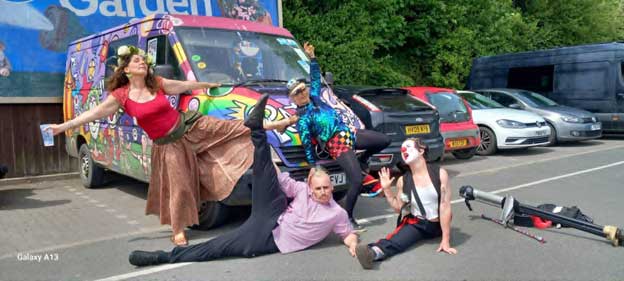
From fire prancing at raves to sitting on the Parish Council, Rosi Jolly’s journey into local politics has been anything but conventional. As well as working for various third sector organizations, Rosie helps run the charity, Cirk-Hes, which uses circus skills as a means for community empowerment and social mobility, though leading such a movement was not as straightforward as maybe assumed.
Willo Kendall chats to her to see what it’s all about.
Sitting on a crashmat, nursing her morning brew, Rosi Jolly tells me how it all started out. Originally from the North East, where she worked as extra in productions for television, Rosi Jolly moved to Cornwall in the mid 90s when she was 21, quickly occupying a space of theatrical performance. Though not formally trained in circus traditions, choosing instead to pick up skills along the way, she found that by dressing up and playing with fire she could ‘blag’ free access to local festivals. ‘As it is’ she declares, ‘I’m quite resilient and quite resourceful’. Rosi comes from a background that upholds a strong tradition of performance, or ‘being a tit’ as she coins it. No clown school needed it would seem. It was only natural that when she became a mother her children would practice such abilities as well. Rosi spotted the confidence ‘clowning around’ gave them in other areas of life. An idea was sparked in the swinging chains of the fire poi.
We meet at the premises of Cirk-Hes, a charity that uses circus skills as a means of activism and empowerment, teaching children and young adults’ dexterous talents that not only are a lot of fun but have a multitude of beneficial side effects. Body positivity, mindfulness and social integration are all byproducts of the process of, say, learning to juggle or practicing the tightrope.
Cirk-Hes’s origins predate Rosi’s involvement, originally called Cirq du Ciel, the rebranding happened after the founder retired due to ill health. The project lay dormant for some time before combining with another organization, Air Fish, run by Nome, a bit of a legend in her own right. They moved around a couple of different premises before settling at an Industrial estate in Helston. The neon mis-en-scene is a striking backdrop to our conversation, festive paraphernalia, performance props, stunt stilts and unicycled gateways to growth.
A wide demographic of clients utilise Cerk Hes’s upskilling services, people who have ‘really been bitten by the circus bug’. No matter the different walks of life, clowning, acrobatics, physical comedy and storytelling all facilitate development in other areas. Studies have shown that performance gives autonomy to the dispossessed, that it “enables societies in crisis to continue to define themselves” (as shown in studies such as Performing for Survival. Theatre, Crises, Extremity. Edited by Patrick Duggan and Lisa Peschel).
Rosi has utilized her anarchic spirit as a vehicle for unilateral growth, community empowerment and, perhaps most importantly, building confidence in young adults who don’t fit the one size for all mould that is institutional education.
One group Rosi Works with are those with additional learning needs, who get assigned a budget by Cornwall Council to access activities outside of the mainstream institutions. Dealing with the ebbs and flows of party politics, at both a local and national level and the effects on her clients who were ‘doing really well’ until budget criteria’s are shifted, as well as the incredible disparity between the household incomes of the home educated community, the charity has found a solution, being simultaneously inclusive and sustainable. Cirk Hes’s business model operates on a sliding scale, using more affluent clientele to subsidies kids and teens that may not have otherwise been able to access such vital services. With some extra funding coming from Cornwall Council themselves, some privately paid workshops, as well as grant revenue funding.
I first met Rosi Jolly when our lives overlapped at a community kitchen in the post-industrial town of Redruth, Cornwall. The town itself is undergoing a sort of artistic gentrification, yet, as is often the case with these things, still accommodates swathes of poverty. Away from the lottery funded regeneration happening in the town centre, marginalized families suffer from food poverty and all the associated hardships. Sixteen percent of Redruth’s population have additional physical and educational needs, one of the highest ratios in the country.
Rosi led with a solution-based approach to many of the day-to-day tribulations that come with culinary activism and third sector bureaucracy. Though, as I was to learn, Rosi was toying with the decision to run for Redruth Parish Council, which she did, and dually got elected.
Her presence portrays a dignified rebelliousness; she is a motivator who gets things done without the need for a posturing ego (she has other areas of her life for that outlet). She has a polite frankness and a moral code that leans toward the politics of care.
Having worked in the third sector for over five years myself I have seen the effects of administrative stagnation, of bureaucratic indifference, of small-time career politicians clearly in the game for themselves. I’m sure there must have been tensions upon her admission to the board, and I’m curious how the more conservative members have received her can do attitude to solving problems that they may have overlooked.
“We are pushing all the time for things to change, which is difficult, working with older, middleclass, often conservative men who obviously have differing standpoints. Sometimes people roll their eyes.”
Yet this has not deterred Rosi from instigating change and calling out institutional bias and bigotry where she sees it. Ever the pragmatist, ignoring petti intimidations, Rosi has moved forward with giving voice and autonomy to Redruthians who have complex needs, a group one of her outmoded colleagues referred to as ‘Poor Unfortunates’. Taking umbridge at such patronising labels she has suggested a change of tone, yet fragile egos abound on the boards of the Parish.
“They see us as saying ‘we could do something differently’ as an insult. Just because we want to do something differently, we are not saying you are rubbish at your job.”
One vehicle for the integration of this demographic has been a grass roots movement to enhance the local festivities. Events such as Murdoch Day, the International Mining and Pasty Festival and of course St Piran’s day are all allocated budgets from the parish purse. Despite this they seem to lack the panache of other towns celebrations, with nearby Penzance’s legendary Golowan festival and neighbouring Trevithick day operating on much larger scales. Rosi took it upon herself to inject some much-needed flamboyance into Redruth’s festive Calander, using workshops with locals as a means to an end. Redruth does also have its unique artistic communities to rival those of St Ives and West Penwith: Krowji is an ever-evolving creative collective, The Buttermarket has added fresh retail outlets and gallery space, yet the indigenous families often get overlooked. running accessible workshops is one way to combat this segregation. And the end goal of such workshops is to have a good old-fashioned knees up, and who could possibly be averse to that? The proof of the pudding is in the eating as they say.
Redruth is certainly on the up and there is no doubt that is down to people such as Rosi pushing the boundaries of the status quo, whilst ensuing the less able are given their due place in such rejuvenations.
.