
Collage art arises from a deeply human impulse to gather fragments of the world and bind them together into meaning. Long before it was named or recognised as a formal artistic practice, collage existed as a way of thinking, a method of understanding reality through accumulation, interruption and reassembly. Human experience is rarely seamless. It is composed of memories, objects, symbols and images encountered at different moments and in different contexts. Collage mirrors this condition, making visible the fractured nature of perception rather than concealing it behind illusion. Its history therefore unfolds not as a linear progression of style, but as a recurring response to moments of cultural, political and technological change.
In ancient civilisations, collage logic was embedded in ritual and symbolic practices. Egyptian funerary objects assembled hieroglyphs, painted imagery, carved relief and precious materials into composite structures designed to operate across physical and spiritual realms. Meaning emerged through accumulation rather than visual unity. Each fragment carried a specific symbolic charge, and together they formed a layered language of belief. In early Chinese paper traditions, cutting and assembling transformed a single surface into complex patterns of presence and absence, demonstrating that removal could be as expressive as addition. Japanese torn paper imagery valued irregularity, texture and chance, anticipating later artistic ideas that embraced imperfection as an aesthetic strength rather than a flaw.
During the medieval period in Europe, collage principles flourished within religious culture. Illuminated manuscripts combined ink, pigment, gold leaf and parchment into dense visual fields that demanded slow, attentive engagement. Marginal imagery often disrupted the central text, creating multiple layers of meaning that resisted straightforward reading. Reliquaries gathered physical fragments within elaborate structures, reinforcing the idea that broken or partial objects could possess heightened power when assembled. These works did not aim for visual coherence but for symbolic intensity, revealing an early understanding of collage as a form of spiritual and intellectual assembly.
As Western art moved through the Renaissance and Baroque periods, priorities shifted toward illusion, perspective and technical mastery. Painting increasingly sought to erase evidence of its own making, creating smooth and unified representations of reality. Collage, with its visible joins and interruptions, conflicted with this ideal and gradually retreated from high art contexts. Yet it persisted in informal and domestic forms. Scrapbooks became widespread during the eighteenth and nineteenth centuries, particularly within middle class households. These albums combined newspaper clippings, illustrations, handwritten reflections, pressed flowers and personal memorabilia. Often created by women, scrapbooks functioned as visual diaries and intellectual spaces where meaning emerged through association. Although rarely acknowledged within traditional art history, they demonstrate a sophisticated understanding of composition and narrative through juxtaposition.
The emergence of modern collage was inseparable from the upheavals of industrialisation. Cities became saturated with printed matter, advertisements, posters and newspapers. Photography transformed ideas of truth and representation, while mass media accelerated the circulation of images. Artists associated with the Avant Garde recognised that traditional painting could no longer adequately describe this new reality. Cubism marked a decisive rupture. When Pablo Picasso and Georges Braque incorporated fragments of newspaper, wallpaper and commercial labels into their works, they fundamentally altered the nature of the artwork. These materials were not representations of the world, they were pieces of it.
This gesture challenged long held assumptions about art. It questioned originality, since the fragments were already printed and designed. It disrupted hierarchies of material, placing cheap and disposable paper alongside paint. It collapsed boundaries between art and everyday life. Within the Avant Garde, collage became both a method and a philosophy, asserting that reality itself was constructed and could therefore be deconstructed and rearranged.
The political potential of collage reached extraordinary clarity during the Dada movement in the aftermath of the First World War. Dada artists rejected nationalism, rationality and aesthetic refinement, viewing them as forces that had enabled mass destruction. Photomontage became a central strategy, particularly in Germany. John Heartfield transformed collage into a tool of direct political confrontation. Working with photographs drawn from newspapers and magazines, Heartfield created images of striking clarity and devastating irony. His collages exposed the mechanics of propaganda, depicting political leaders as grotesque, mechanical or corrupt figures stripped of authority. He understood the visual language of advertising and mass persuasion and deliberately mimicked its clarity in order to undermine it from within.
Heartfield’s work was designed for wide circulation rather than elite spaces. Appearing on magazine covers and posters, his images functioned as visual arguments, compressing complex political critique into instantly legible form. He demonstrated that images were not neutral carriers of information but active agents in shaping belief. Through collage, he showed that cutting and reassembling images could expose hidden structures of power.
Alongside Heartfield, Hannah Höch expanded collage into critiques of gender, identity and social roles. Höch fragmented bodies and recombined them into unstable forms, reflecting the shifting position of women in post war society. Raoul Hausmann explored themes of mechanisation and alienation, while Kurt Schwitters extended collage into three dimensional space through his Merz constructions. Schwitters treated everyday debris as legitimate artistic material, insisting that nothing was too trivial or discarded to be transformed into art. Together, these artists established collage as both an aesthetic strategy and a political act.
Surrealism introduced a more psychological dimension to collage. Surrealist artists used unexpected juxtapositions to access the unconscious, creating dreamlike encounters between unrelated images. Max Ernst’s collages, assembled from nineteenth century engravings, transformed familiar imagery into unsettling scenes where logic dissolved. In this context, collage became a tool for revealing hidden desires and anxieties, suggesting that fragmentation was not only social or political but deeply internal.
By the mid twentieth century, collage was firmly embedded within modern art practice. Post war artists expanded it into assemblage, incorporating found objects and three dimensional materials. Robert Rauschenberg’s combines absorbed fragments of contemporary life, photographs, fabric, signage and paint, reflecting a world saturated with images and information. These works rejected clear boundaries between art and environment, insisting that meaning emerged from accumulation rather than isolation.
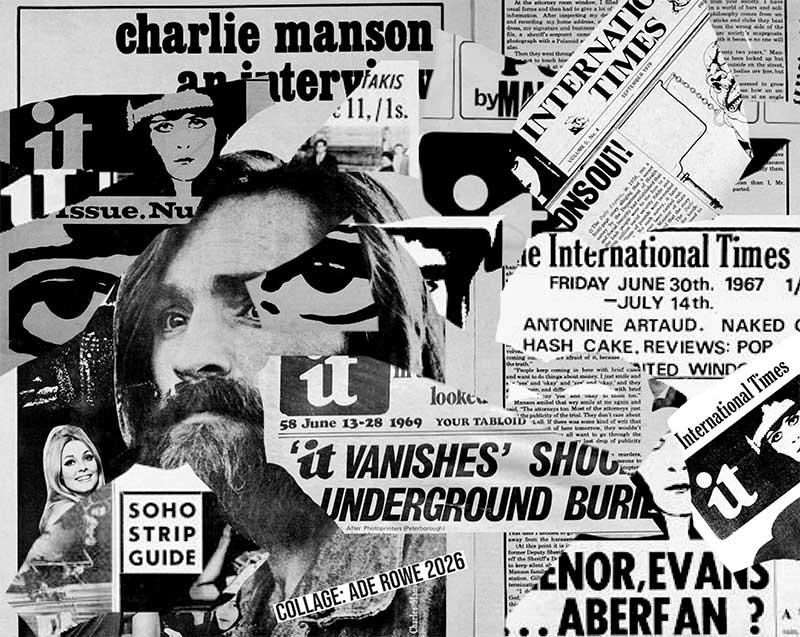
The nineteen sixties marked a crucial expansion of collage as both aesthetic strategy and cultural force, driven by the rise of countercultural movements that challenged authority on multiple fronts. As civil rights struggles, anti war protests, feminist activism and youth movements reshaped social life, collage emerged as a natural visual language for dissent. The counterculture rejected linear narratives of progress and stability, favouring experimentation, multiplicity and altered states of perception. Collage mirrored these values precisely. Its fragmented structure echoed a refusal of singular truths, while its reliance on found imagery aligned with a broader rejection of consumer conformity and institutional control.
Underground presses were central to this transformation. Alternative newspapers, posters and pamphlets circulated widely in cities such as London, San Francisco and New York. These publications relied heavily on collage to communicate ideas quickly and forcefully. Photographs from mainstream media were cut apart and reassembled alongside hand drawn lettering, psychedelic patterns and political slogans. By visibly dismantling official imagery, collage revealed how dominant narratives were constructed and maintained. It became a means of visual sabotage, redirecting the language of power toward protest and resistance.
The psychedelic movement further expanded collage aesthetics through sensory overload and visual intensity. Album covers, concert posters and light show designs layered photographic fragments, ornate typography, spiritual symbolism and scientific imagery. Eastern philosophy, pop culture and cosmic references coexisted within the same visual field. Collage offered a way to visualise non linear experience, mirroring the effects of music, communal living and altered consciousness on perception itself.
Anti war activism also relied heavily on collage. Protest imagery opposing the Vietnam War used stark juxtapositions, placing images of military violence alongside domestic scenes or symbols of consumer comfort. These contrasts exposed the moral dissonance between political rhetoric and lived reality. Collage functioned as visual argument, compressing complex critique into instantly readable form. The reuse of press photographs reinforced the idea that the truth was already visible, but obscured by framing and repetition.
Feminist and civil rights movements embraced collage as a tool for reclaiming representation. Women artists cut apart advertising imagery to reveal how bodies and identities were constructed for consumption. Black artists used collage to confront racist visual histories, combining archival photographs, political symbols and contemporary references to assert presence within a media landscape that had long excluded them. Collage enabled marginalised voices to speak visually without waiting for institutional permission.
The collective nature of the counterculture further reinforced collage’s importance. Many works were produced collaboratively in workshops, communes and shared studios. Images were passed from hand to hand, altered and reused. Authorship became secondary to message. This approach echoed earlier Avant Garde ideals while embedding them in everyday practice. Collage was no longer confined to galleries or manifestos, it became a tool of daily resistance and communication.
These strategies fed directly into the emergence of punk collage in the nineteen seventies. Punk did not invent collage as dissent, it intensified it. The idealism of the counterculture gave way to anger, urgency and confrontation. Punk collage stripped away remaining ornament and sharpened its aggression. Torn paper, ransom note lettering and photocopy distortion became weapons rather than experiments.
Jamie Reid’s work for the Sex Pistols epitomised this shift. His collages vandalised symbols of British authority, combining images of the monarchy with disruptive typography and graphic violence. Drawing directly from Dada and John Heartfield, Reid reactivated Avant Garde strategies under new social conditions. His work collapsed the distance between art and political action.
Gee Vaucher, working with the anarcho punk collective Crass, developed a stark and morally uncompromising approach. Her collages juxtaposed war imagery with domestic scenes and surveillance, exposing the contradictions of everyday life under systems of power. Rejecting humour and spectacle, Vaucher confronted viewers with uncomfortable truths, extending punk collage beyond immediacy into sustained ethical critique.
Linder Sterling dismantled representations of gender and sexuality through confrontational collage. By combining fashion imagery with pornography and domestic objects, she exposed the fragmentation and commodification of the female body. Her work denied visual comfort and forced awareness of how images construct identity.
In the United States, Winston Smith’s work with Dead Kennedys embraced density and chaos. His collages layered political satire, corporate logos, religious imagery and grotesque caricature, reflecting media saturation and deep mistrust of authority. Unlike Heartfield’s precision, Smith embraced excess as truth, suggesting meaning was buried beneath noise.
Beyond named figures, punk collage flourished in zines, flyers and underground publications. Often anonymous and ephemeral, these works relied on photocopiers, scissors and glue. Distortion and repetition became aesthetic choices. Punk collage reaffirmed that art required neither permission nor polish, only urgency and intent.
The influence of collage continues to resonate in contemporary culture. Digital technologies have intensified image saturation and fragmentation, conditions collage has always addressed. Images circulate endlessly, detached from origin and intention. Collage offers a way to interrupt this flow, to slow it down and restore critical awareness. Even digital collage often retains the roughness of punk aesthetics as resistance to corporate smoothness.
The enduring story of collage art is therefore not simply one of stylistic evolution, but of a persistent way of thinking about the world. Collage reappears whenever inherited forms fail to speak truthfully about lived experience. It refuses false coherence and embraces contradiction as reality. To cut an image apart is to question its authority. To reassemble fragments is to assert agency.
Collage occupies a uniquely democratic position within art history. Its materials are cheap, discarded or mass produced, and its processes accessible. From scrapbooks to countercultural posters to punk zines, collage has allowed marginal voices to claim visual space. Punk collage reaffirmed that sincerity mattered more than polish and that visual language could carry anger, dissent and solidarity with immediate force.
The history of collage art reveals a continuous refusal to accept the world as it is presented. From ancient ritual assemblages to Avant Garde rupture, from John Heartfield’s political photomontages to the counterculture’s visual rebellion and the raw defiance of punk artists such as Jamie Reid, Gee Vaucher, Linder Sterling and Winston Smith, collage has remained a language of resistance, reflection and reinvention. Meaning is not discovered whole, but assembled deliberately from fragments, contradictions and reimagined connections. By making its seams visible, collage reminds us that understanding is always constructed, always provisional, and always open to change.
,
.
Ade Rowe
.