
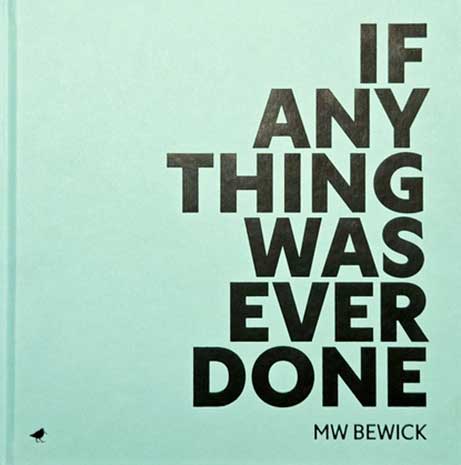
If Anything Was Ever Done, MW Bewick (144pp, £20, hardback, Dunlin Press)
As MW Bewick says, near the beginning of his new book, ‘Past a certain age and it’s a blizzard of things.’ He’s not wrong, and this book is about navigating that blizzard. It might be a long poem in three sections, it might be autobiographical, it might be a journal in poetic form, it might be a book about creativity, the self, the world, in fact everything that exists or might exist.
Whatever If Anything Was Ever Done is, it is also a beautiful hardback book, with exquisite endpapers showing details of abstract paintings by Ella Johnston, as well as a sprinkling of oblique monochrome photographs by the same artist, whilst the text also includes two interviews with musicians about creativity and making music.
Bewick, or his narrator, is in a tangle. He is unsure about what he is doing, about words, language, creativity and poetry:
I forgot to say what I meant to say, that
poetry is full of the wrong people the
wrong readers the wrong words.
He is not wrong here, either, and sometimes considers whether poetry is for everyone (or indeed anyone) or whether he should just write the stuff and worry about readers later. He worries about how poetry fits into ideas of wealth and poverty, social class systems; and how it might relate to making music. (Bewick is also a musician; hence this angle, and also the inclusion of the interviews.)
What’s great about the book is it does all this thinking whilst telling stories, in the form of possibly confessional poems, and avoids academic jargon. This writing is down-to-earth, full of comfy but worn-out armchairs, snippets of news, overheard conversations, familial history, Essex mud, favourite music, the weather, and questions.
Questions, questions, questions and thankfully only tentative answers. Those wrong people are the ones who want certainty and definitions, who take nice romantic strolls across the common with their creative berets on. Bewick, however, is down the pub, on the phone to his absent partner, or sprawled in that threadbare armchair at home.
The book might be a journey towards acceptance, about realising the answers to the questions are sometimes in the form of the question:
How do we escape such ordinary ways
of knowing, of reason, of intuition,
when it rained all day
and thought was needed
A few pages on and Bewick tells us that ‘People are understood only through unconventional means.’ There is no ordinary, there is no permanence, only the moment, the now, the transitory, and it is all strange, unconventional, exciting and surprising if we pay attention. Yet it still remains mostly unknown. ‘ It wasn’t possible to bring it all together so / let’s mess around in our freedom’, he says. No grand epiphany or finalé, no closure, just a quiet realisation, and a decision to arrange all the bits and pieces, the questions and possible answers, into a three part long poem that may or may not be an exposition of ‘mystery and silence’, or might simply be a way to document the fact that those things rarely exist in this rain-filled, confusing and creative world we find ourselves in.
This book isn’t about navigating the blizzard, or even finding a way through it or to avoid it, it is about taking a day off and making snowmen and sledging, then hunkering down in front of a fire in The Rose & Crown and watching the snow swirl above the estuary. It is about being included in Bewick’s generous and wide-ranging conversation with himself. It may only be January but this might be one of my favourite books this year.
.
Rupert Loydell
Dunlin Press’ website is here.
[This review was first published at Litter magazine]
.