
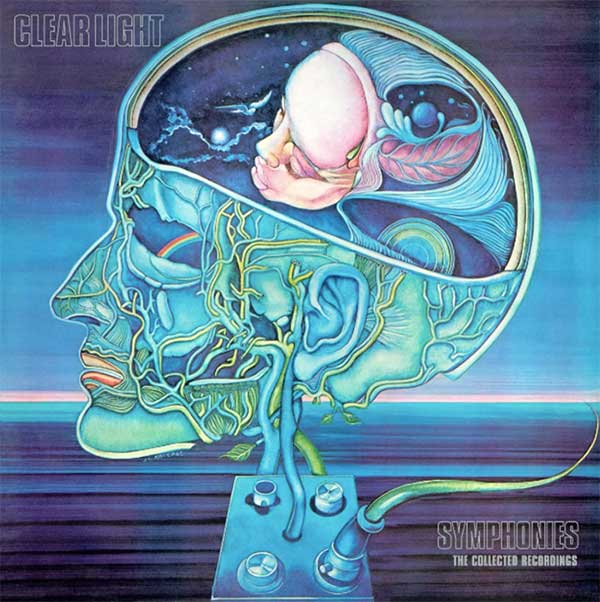
Symphonies: The Complete Recordings, Clearlight (5CD, Esoteric/Cherry Red)
Although they were singed to Virgin in the 70s, I suspect I am not alone in having never heard of Clearlight. Having said that though, they are right up there with the musical madness that was happening back then. This new clamshell collection gathers up four albums from the 1970s plus some bonus tracks and a 2014 album by the band’s main (and sometimes only) man Cyrille Verdeaux.
As the title of the reissue collection and the albums within it (Clearlight Symphony, Visions and Impressionist Symphony) suggest, Verdaeux was nothing if not ambitious. What was meant to be the 2nd Movement of Clearlight Symphony but was made side 1 by Virgin at the time, sees Verdaux’s piano, organ, mellotron and synthesized bass accompanied by the Gong boys Didier Malherbe, Tim Blake and Steve Hillage in a galactic orgy of drifting piano, variations and pulsing sonic textures. I have to confess that, unusually, I am on Richard Branson’s side as the 1st Movement, which was made at Virgin’s The Manor with different musicians brought over from France, feels much more derivative and longwinded. It hammers riffs to death and slowly builds to a noisy climax before subsiding away.
The second album, Forever Blowing Bubbles, moves away from big compositions, instead offering up an album of short and thankfully mostly instrumental music (the two vocal tracks feature abominable singing) that in the main are strangely akin to Mike Oldfield’s work, but in condensed, shorter form. ‘Jungle Bubbles’, which ends the original album is like a Jade Warrior outtake, a proto-ambient track full of burbling, sound effects and hand percussion. I like it a lot and wished CD2 had ended there as the bonus tracks have little new to offer, although a mix of ‘Without Words’ vividly brings the mellotron to the fore.
Then it is time for Les Contes Du Singe Fou, which translates as Tales of the Mad Monkey, a space rock opera. This too features some vocals, from Ian Bellamy – who I am hoping isn’t the jazzman Ian Bellamy I know – and some excruciating squeaky violin from Didier Lockwood, apparently taking leave of Magma. Again, expect lots of piano, musical exclamations and titles such as ‘Time Skater’, ‘Cosmic Crusaders’ and ‘Rivers of Time’, not to mention ‘Prelude’ which is track six! Since the original album text has not been reprinted here it’s hard to know what on earth the storyline or concept is. Perhaps that’s for the best.
Next up is Visions. Verduax had decided to keep Lockwood and his violin on, but it is somewhat made up for by the return of Malherbe and his magic saxes, as well as some stunning guitar, including ‘cosmic bottleneck’, from Christian Boule (another Gong and Steve Hillage connection). It’s a varied and entertaining album, and I especially like ‘Full Moon Raga’ and it’s brief coda as well as the closer ‘Paix Prodonde’, a more abstract track that plays with detached sounds and slowed down vocals. There are some fey wordless vocals on a couple of tracks, but nothing too dreadful. Again, the bonus tracks don’t do much for me. I’m surprised someone didn’t finally tell Verdaux that his piano arpeggios are cliché and somewhat trite and that he should get Tim Blake back on keyboards.
Which – up to a point – is what Verdaux did on 2014’s Impressionist Symphony. Steve Hillage is back too, along with Didier Malherbe. Assembled digitally from musicians recording in England, France and the USA, the eight tracks are each a tribute to a French Impressionist artist. Verdaux makes good use of synthesizer brass and string ensembles throughout and lets his musicians shine. Tim Blake’s synthesizer soars throughout ‘Pisarro King’ against Hillage’s soaring guitar, there’s a minimalist influence in ‘Degas De La Marine’ where the piano slowly mutates against a background saxophone track, whilst ‘Van Gogh’s 3rd Ear’ features stuttering synth and guitar as well as freewheeling guitar and keyboard clouds. Tracks about of for Gaugin, Lautrec and Monet offer more of the same, along with more bloody violin, but it’s a surprisingly satisfying closing disc.
As ever, it’s kind of weird to realise that whilst many of us were caught up in post-punk, new wave and more experimental musics, progrock and symphonic rock were still going strong in other parts of Europe and elsewhere. Of course, the hippy hangover lasted for a decade, and eventually hybridity, fashion and marketing ushered in an era of anything goes and everything is up for grabs. Clearlight feel like they were caught in a musical timewarp but I can also see strong links to and influences from Richard Pinhas, Lard Free, Magma, Gong, Mike Oldfield, Univers Zero and King Crimson, all bands that were around at the time.
I suspect a double best of CD would have served Clearlight better but that would have course destroyed any notions of symphonies or space rock operas. It’s a fun reissue anyway, with a nice booklet included which is full of recording details and Cyrille Verdeaux’s reminisces.
.
Rupert Loydell
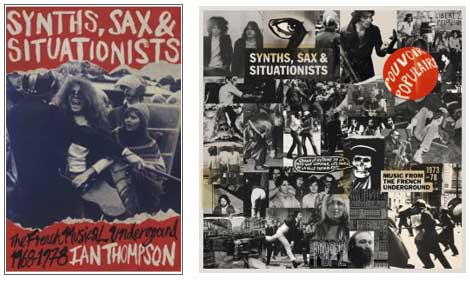
Ian Thompson’s book Synths, Sax & Situationists: The French Musical Underground 1968-1978 includes a chapter about Clearlight. I briefly reviewed it for IT here and you can read about it, samples from it, listen to some of the tracks and buy books here.
There’s also a marvellous six-track compilation of music from the book (though nothing by Clearlight) on Bandcamp here.
.