
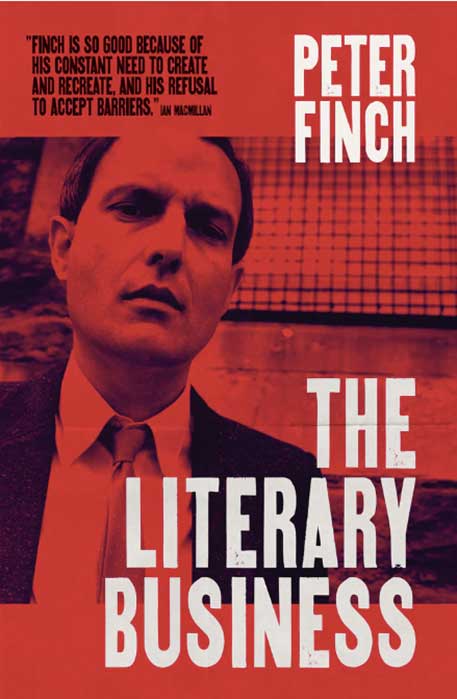
Peter Finch…
…has a new book out: The Literary Business (Parthian Books) is, it self-declares, ‘A handbook, a history, a demystification of and a ramble around the wide literary world.’ It is also extremely funny, opinionated and eclectic, moving from personal recollection to the worlds of small press magazines and publications, bookshops, grant aid, arts organizations and prizes via performances, conferences and readings; then on to cultural history, sociology and psychogeography.
…is the patron saint of small press publishing: ‘Poetry today has a stronger place than it once did in public life.’
AGNOTOLOGY
Obscure pamphlets and samizdat publications
are piled high in my sellotape church, along
with dust left behind on my way to becoming
someone else. There is a new academic subject
that studies information, deceit and ignorance;
creative writers are not featured. We all lie and
make things up, choose what to use or discard,
ignore or remember, to get what we can. In
these times of difficulty it is difficult to keep
time at bay or find our daily rhythm. Legend
has it these things are magic, stories tell us
what not to do and whose fault it is. I am
a child of light and there is music in the air.
…ran a bookshop for everyone: ‘Our customer base was considerable: Welsh speakers and Welsh learners were the largest cohort, followed by arts enthusiasts; the Anglo-Welsh; poetry persons, poetry wannabes, poetry academics, poetry fans, and poets themselves; parents who’d sent their children to Welsh medium primaries or ysgolion meithrin; new age followers of mystic spirals, UFOs, Atlantis, ley lines and standing stones; Irish speakers, via the street’s Catholic cathedral; local historians; and fans of Celtica in all its multiple guises.’
…is Wales’ secret weapon in the war of words: ‘The Welsh had had enough of being pushed around.’ ‘Twenty-five years into the new millennium and a good hundred since Welsh writing in English as a visible, distinguishable entity actually first flourished, we are still unsure of who we are.’ ‘We reside in a plural Wales. Our identity is what we declare it to be. There is room in the culture for all.’
…is the needle in poetry’s haystack: ‘Why are we doing this anyway?’
…is the point where experiment and mainstream poetry meet: ‘His poetry […] has oscillated between the avant-garde and the Anglo-Welsh literal.’
…documents the interconnectedness of poetry and alcohol (‘the haze of alcohol that most poets take as par for the course’): The Albany, the Estonian Club, the back Welsh bar of The Conway, the poetry and pints movement, the Gower Hotel, the back bar of The Park Hotel, The Three Elms, The Cow and Snuffers, The Pineapple, The Booze Stop Convenience Store, The Railway, The Plough, The Fox and Hounds on Old Church Road, The Royal Oak and then The Malsters, the Glamorgans, the Old Arcade pub in Cardiff, The White House in Earl’s Court Square, The Marchioness of Bute in nearby Frederick Street, Jude the Obscure on Walton Street, Oxford, the Captain Scott room of the Royal Cardiff Hotel, The Tredegar Arms, The City Arms, the legendary Roath Park Pub on City Road, the Four Bars Inn facing Cardiff Castle, the Blue Boar Inn, both The Ship and Pilot and The White Hart, the infamous Casablanca Club, the Carruthers Room in the depths of The Coal Exchange, upstairs at The Griffin, The Blue Anchor, The Moulders’ Arms in Union Street, The Griffin, The Three Cups in Sandland Street, Holborn, the one pub in the village. ‘Afterwards, drinks were had.’ ‘Several vodka-and-poetry filled days.’
…is a realist: ‘By the 1970s any idea that peace and love might take over the planet had been dismissed as impossible.’ ‘Poetry was not a desirable product.’
…is an optimist: ‘the future has lights in it’. ‘Verse is a whirling, cosmic reality.’
…is all knowing and all seeing: ‘there was an information gap in the poetry world.’ ‘My job, entirely self-appointed, was to list everything to do with poetry that I could get my hands on.’ ‘The books, booklets and magazines continued to arrive.’
...is Cardiff’s best sales rep: ‘Work, Sex and Rugby—those were Welsh obsessions. A book about them ought to sell well.’ ‘Cardiff became a place to be travelled to.’
…is seriously funny: ‘How do you mix poetry and lawn mowers?’
…is honest about his mistakes: ‘Meetings with idols […] usually fail. Reality can be an uncompromising master.’
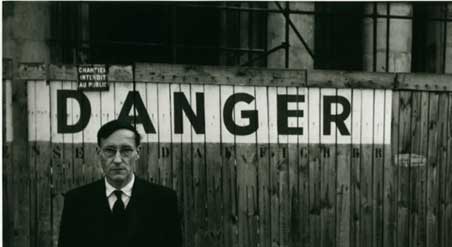
…knew everyone back in the day: Geoff, Alan, George, Steve, David, Geraint, Phil, Roger, Meg, Andrew, Will, Bernard, John, William, Cyril, Gerard, JT, Bob, Meic, Roland, John, Sam, Harvey, Heinz, Leslie, Alison, Bryn, Pamela, Jean, Gwyneth, Gavin, Kovacs, Anthony, Harri, Brian, Ogiz, Richard, Ifor, Tôpher, Gerald, Nigel, Mick, Eric, George, Lawrence, Bob, Bill, Jeff, Allen, Martin, Lee, Roy, Barry, Ken, Edwi, Tom, Bill, Maggie, Geraldine, Ken, Clive, Dom, Iain, Pete, Ivor, Ed, Aonghas, Charles, Raymond, Peter, Isabel, Terry, Allan, Harvey, David, Glynn, Menna, Peruda, Kevin, Pete, Eric, Eric, Brenda, Iwan, Brendan, Charles, Evan, Felicity, Barrie, Richard, Jack, Jenny, John, Harry, Clyde, Sarah, JD, Shani, Alfred, Allen, Mary, Peter, John, Michael, Terry, Tony, Ernest, Kyffin, Emyr, Clive, Ian, Stan, Jac, Roy, Keith, Driff, Mair, Tony, Sally, Ned, Dan, Dave, Antur, Menna, Wynford, Gillian, Robert, Tony, Sheenagh, Christopher, Twm, Peredur, Micheline, Jiri, Chris, Robin, Hywel, Phil, Elisabeth, Barry, Elian, Olwen, Dic, Islwyn, Lionel, Patricia, Thelma, Jackie, Eugene, Jean, Cerys, Dorcas, Gill, Carol, Kerry, Henry, Freya, Lloyd, Bryn, Jonathan, Gwyneth, Natasha, Amy, Kate, Nic, Zoë, Damian, Durre, Rhys, Dai.
…knows all about sound poetry: ‘Text-sound compositions with their roots in dada, jazz improvisation, scat-singing, recording-tape manipulation and speaking in tongues are often hard for new listeners to grapple with.’ ‘Sounds echo and re-echo. The air is electric.’
…is an expert on Surrealism: ‘there’s no record of its re-emergence’, ‘Although it might be in someone’s house now, I suppose, sitting on the mantlepiece.’
A POET NEEDS A BICYCLE
LIKE A MAN NEEDS A FISH
for Martin Stannard
‘and anyway, who dat man wid de fish?’
– John Ashbery, ‘Flow Chart’
Who’s that man with the fish?
(I assume that’s what you meant).
I’ve no idea, perhaps the final
unravelling of the fishing industry
or popular sport? Perhaps a last
ditch attempt to start a business
or feed oneself? A brave stand for
freedom, maybe a poetic metaphor
for all we no longer know, worlds
long gone, where you knew who
you were and which fish was which.
If you teach a man to fish he will
have a skill for life, if he catches
something he will have food upon
his table, if he decides to one day
to put a fish on his head you can
introduce him to surrealism. Either
way, he will have an annoying sport
addiction and a need for catch net,
rubber waders and several different
rods. He will probably make visits
to secret locations, and take over
the table to make plans, flies and
floats, or maybe hide in the shed.
If he has a shed. Anyway, I hope
this answers the question and will
make some kind of sense, although
it feels I’m writing poetry to order.
…trusts chance operations: ‘The endless permutational stream rolls towards infinity.’
…finds it hard to remember: ‘This is what happens when you mess with time.’
…reviews a 1916 Hugo Ball poetry reading he did not attend: ‘He launched into the text. His voice rose stentoriously and rippled through the crayoned vowels, led on by flashing consonants. His chant soared despite the howls of amazement, protest, derision, and then bafflement from his large and conservative Zurich audience.’
…doesn’t know or care what it means: ‘On the wall is a quote from Marcel Proust’s unfinished novel Jean Santeuil: “Abstract poetry is always infinitely superior to poetry which sets out to mean something.”‘
…enjoys the kudos: ‘There should be a plaque, she said.’ ‘The crowd around Ashton’s Fish stall gave me a round of applause.’ ‘as inventive and as indispensable as he has been consistently undervalued and ignored…’.
…is full of shit: ‘fellow litteratuers will want to check if they get a mention.’ Well, I don’t get a mention and neither I nor the small press I ran for decades are in the index. It’s not on, not on at all. I thought we were friends. I mean, I published Finch’s Antibodies collection, didn’t I? (‘Writers’ egos are fragile things.’)
…is a survivor: ‘Aspiration was everything. To shine. To cause wonder. To be outstanding.’
…is in the literary business: ‘What was a book?’ ‘We were going to publish one.’ ‘You print the pages and I’ll do the covers’.
…always keeps in touch: Dear Rup, you’re bound to find something here to amuse here. For favour of a review, as they say. Peter.
…is the editor from hell: ‘1. Because you write poetry, you are not unique. 2. Do not ask for criticism.’
EDITORIAL
Can’t remember what he looks like,
but we’re still in touch by email.
Don’t even know how we first met
or corresponded, wish he would go
away. I’m sure that he means well,
but am aghast at how much energy
I’ve expended trying to be polite.
They’re not really poems, just raw
emotions, thoughts written down.
He insists readers are interested.
They aren’t, not this one anyway.
You’d think half a century might
change the way somebody thinks
but no, he’s still writing drivel,
asking everyone to empathise,
be moved, come over all poetic.
I never should have replied, not
then, not ever. I’m just too nice,
too friendly, warm; always happy
to give encouragement and then
stab would-be writers in the back.
…is a catalyst: ‘I compiled a brief how-to-submit instruction’, ‘I would write a short guide that would offer advice to proto-poets and new versifiers, offer a little demystification.’
…is an oracle: ‘a poetry of abstract phonetic-roaring like speaking in tongues’.
…breaks all the rules: ‘What I didn’t know at the time was that a whole artform had found itself created out of these qualities: derivative, plagiaristic, cut-up, fluxed, chance-identified, borrowed, stolen, restructured, filigreed, fleeced, formulated, manipulated, manufactured, mixed, muddled, moulded, remaindered and rock and rolled.’
…was Bob Cobbing’s biggest fan: ‘Bob has flailed and roared through the set, pulling the disparate elements around him into one forward-flowing drone. The evenings have been brilliant creative successes’. ‘You can hear Cobbing’s “tan din an na tan dita tan roota tan rowto tanrita” rising out there, amplified in the darkness.’
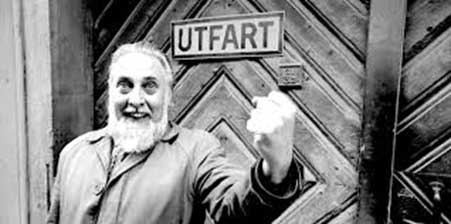
…’learned always to walk with both a notebook and a pen’: ‘ideas bounce and rush.’ ‘I made notes for a poem I might write.’
…always knew his place but preferred to stand elsewhere: ‘We made ourselves visible through stands, banners, flags and handouts everywhere.’
…has a wide-ranging set of reference points, and is a namedropper par excellence: Bob Dylan, Allen Ginsberg, Adrian Henri, Roger McGough, Adrian Mitchell, Brian Patten, Jeff Nuttall, Michael X, George Macbeth, Alexander Trocchi, Mike Horovitz, Davy Graham, Alan Jackson, Tom Pickard, Lord Byron, Charles Dickens, Gertrude Stein, William Carlos Williams, Upton Sinclair, William Burroughs, Leonard Cohen, Walt Whitman, Ezra Pound, Shakespeare, T.S. Eliot, Charles Olson, William Wordsworth, Cliff Richard, Spike Milligan, John Betjamen, Lawrence Durrell, Thomas Hardy, Philip Larkin, Dylan Thomas, R.S. Thomas, Jack Kerouac, Jacques Prevert, Arthur Rimbaud, Matsuo Basho, Louise Bourgeois, Fay Godwin, Andy Goldsworthy, Augustus John, Kurt Schwitters, David Nash, Tom Phillips, Zandra Rhodes, Charles Tunnicliffe, Bill Viola, James Callaghan, Michael Foot, Shelley, Vivian Stanshall, Mike Oldfield, Alan Stivell, John Seymour, Tangerine Dream, Duke Ellington and Johnny Hodges, Wes Montgomery, Pat Metheny, Terry Riley, The Chieftains, Clannad, Miles Davis, Iain Sinclair, Kate Adie, Jan Morris, Jackson Mac Low, Edwin Morgan, Paul Burwell, David Toop, Andrea Dworkin, Kathy Lette, Fay Weldon, Tristan Tzara, Hans Richter, Brion Gysin, David Bowie, Kathy Acker, Alan Burns, Radiohead, Clark Coolidge, Gary Snyder, Robert Creeley, John Cooper Clarke, Lawrence Ferlinghetti, Simon Armitage, Peter Reading, Carol Rumens, Wendy Cope, Jackie Kay, John Agar, Benjamin Zephaniah, Margaret Drabble, Eva Figes, J.P. Donleavy, Geoffrey Chaucer, Sylvia Plath, Twiggy, John Berryman, David Jones, Christopher Logue, Langston Hughes, Linton Kwesi Johnson, Jean Binta Breeze, Stanley Holloway, Joyce Grenfell, Liz Lochhead, Libby Houston, Lloyd George, Henri Chopin, Carol Ann Duffy, D.H. Lawrence, Edith Sitwell, Anna Kavan, Charles Causley, Seamus Heaney, Guy Debord, Charles Baudelaire, M. John Harrison, Isaac Asimov, John Updike, Barbara Cartland, B.S. Johnson, The Fat Controller.
…knows all good things must come to an end: ‘A world where I was no longer obliged to constantly read other people’s poetry was going to be a different one.’
…is not afraid: ‘I have no fear of AI overtaking me yet.’
…summed up: ‘Writers, hell, they get everywhere.’
.
Rupert Loydell
.
There was a time in the works’ composition when cuts had to be made and new adventures curtailed. The deeper proposed analysis of the British small press scene from those heady 1970s days to the harder ones of now, and which would undoubtedly have included Stride, a significant publisher, with a genuinely adventurous and important poet (Rupert Loydell) at its helm, and who did, after all, bring out my edge pushing collection Antibodies, was not taken on. I’ll right the wrongs and do this for volume two.
Comment by Peter Finch on 13 December, 2025 at 10:30 amThanks Peter. Good stuff Rupert is als0 a big contributer and editor on International Times.
Comment by Editor on 13 December, 2025 at 11:25 amVolume Two, of course, will depend on how we sell with Volume One! Stride and Rupert’s hard copy publishing operation gets good coverage in Andrew Taylor’s ‘There’s Everything To Play For – The Poetry Of Peter Finch’ which Seren brought out in early 2025.
Comment by Peter Finch on 13 December, 2025 at 12:14 pmI hope that both readers and Peter himself understood my mention of not being mentioned was a tongue in cheek response to the ‘fellow litteratuers’ quote, which is – of course – exactly what we all do upon reciving books like this.
Comment by Rupert on 13 December, 2025 at 1:34 pm