
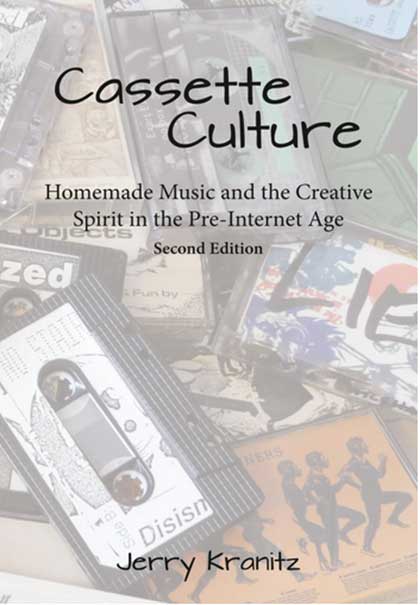
Cassette Culture, Jerry Kranitz (second edition, Monger Publications)
A wild and eclectic mix of stories, facts, details and opinions about ‘Homemade Music and the Creative Spirit in the Pre-Internet Age’, when swapping and selling lofi cassette tapes with hand-drawn or photocopied sleeves, sometimes with booklets of lyrics, images, contact details etc, was what one did if you weren’t intent on getting signed to EMI and obtaining Pop stardom.
For me, the lasting result of Punk, which was really only pub rock with attitude and provocative fashion choice, was the way it urged everyone to make and record their own music in D.I.Y. fashion. ‘Cassette Culture’ sprang up alongside zines and badges, independent record shops and new technologies: portable cassette recorders, cheap synthesizers and then 4-track tape machines.
Every band could now make their own ‘album’, albeit on tape, contribute to tape compilations, get reviewed in the badly photocopied pages of music zines around the world, and exhange their music for similarly murky-sounding songs in indistinct genres. If you were lucky John Peel would play a track, announce your call out for compilation tracks; if you were anarchist enough Crass might put you on one of their Bullshit Detector vinyl compilations.
There were thousands of labels, thousands of band, thousands of advertising leaflets and thousands of packages criss-crossing oceans and continents in padded envelopes. Bands would copy other band’s cassettes in a distribution deal, others tried to set up more formal sales and distribution networks; if your tapes were good enough or contained a ‘name’ band, Rough Trade might buy a few hundred copies, mostly for European sales.
New collaborations sprung up between musicians who had never met, punk and rock lingered on, whilst post-punk bedroom outfits drew on both the spacerock of Hawkind and the electrically deranged Chrome for inspiration. Those of us who couldn’t play made ‘industrial music’ with loops, sampled fragments, feedback, percussion and hoovers; others, more musically able, invented Plunderphonics or continued the synthesizer experiments of Tangerine Dream and other krautrockers. Current 93 recorded occult invocations then drifted into gnostic heretic folk, whilst their friends Nurse With Wound made demented, surreal soundscapes.
There was music everywhere, and Jerry Kranitz details plenty of it. Intriguingly, apart from some names you couldn’t get away from – Big City Orchestra spring to mind – most of the labels and bands are new to me, although of course, everyone had their own networks of favourites, friends and musical labels. It’s good to read about new names, and also about what happened next…
Which was, of course, the rise of digital media. Computers and burnable CDRs meant better production values, more tracks to record, ease of [re]mixing, and the ability to email sound files. Many musicians (and non-musicians like myself) grew out of cassette culture, others signed to record labels or formed their own professional and money-making cottage industries, some regarded tapes simply as promotional devices, many simply swopped the means of recording and distributing music. A few continued to make tapes, and now in the 21st Century they are regarded as a boutique object by some bands.
Was there, asks Kranitz, a cassette culture? Well, not in any organized or definable manner, no. But there was a cultural moment when the means of production was pretty much available to all, at least anyone who could borrow a tape recorder and microphone, find something to make a noise with, spend time copying cassettes, and afford the price of a stamp. It was about participation, sharing music and ideas, being part of something that was going on, in the days before everyone had online access to everything. I’m still in touch with people from the 1980s I exchanged music and letters with.
There is little ‘analysis’ here, just enthusiastic storytelling and reminscences from those Kranitz has interviewed. Musicians, radio presenters, would-be entrepeneurs, pop-up shop owners, musical shamans, poets, noise merchants, free jazzers, out-of-tune singers, synth-pop psychogeographers and electronic explorers, all have interesting things to say, and Kranitz has given them the pages to say it on. For that we should be grateful.
.
Rupert Loydell
.