
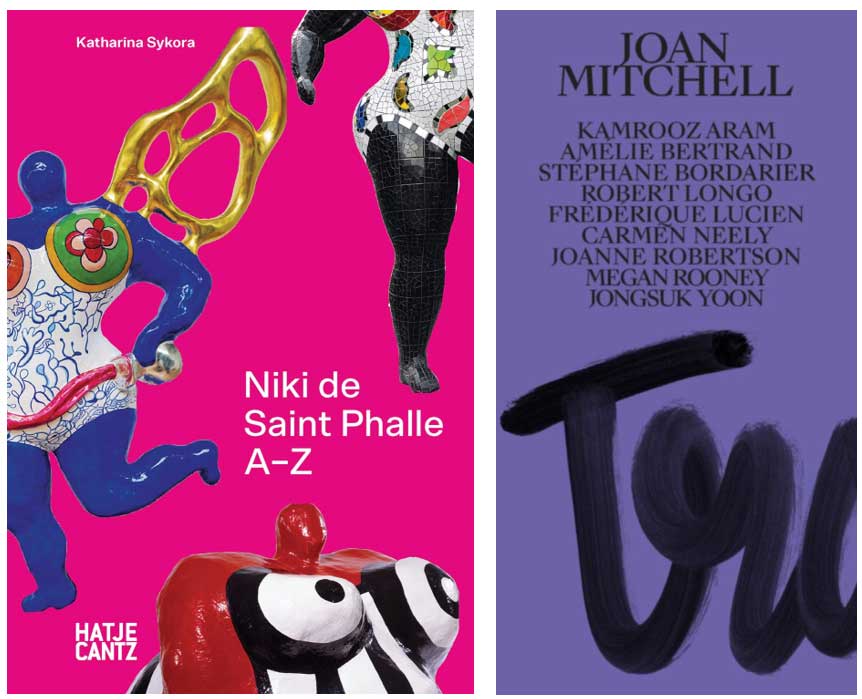
Niki de Saint Phalle A-Z, Katharina Sykora (Hatje Kantz)
Joan Mitchell, ed. Mara Hoberman (Transatlantique)
Katherine Sykora’s ABCDary of artist Niki de Saint Phalle takes a suitably oblique and sideways approach to her subject, offering a different look at the often cartoonish and highly coloured sculptures and installations she made, highlighting some common themes and occupations on the way.
So both the Parisian fountain and her Tarot Garden get a chapter, as of course do Jean Tinguely (partner, and co-creator of the fountain) and Tarot itself, with a focus on the Tarot pack de Saint Phalle made. Her series of Nana figures are considered, as are the notions of Polymorphy and the Uncanny. The early series of relief paintings and sculptures which focus on Brides – new to me – are considered, as are another sequence of Mothers.
Many of these exist alongside each other, celebrating the power of female form, subverting sexual and physical norms and expectations, playing with colour and shape. Sykora states that ‘Laughter liberates, laughter relieves fears, laughter prevents aggressions, laughter provides distance from oneself and from others. Niki de Saint Phalle loved laughter.’ Wit and play were intrinsic to her work, even when addressing a serious theme such as AIDS. This first chapter reproduces images from the 1986 no-nonsense advisory book she created, with – says Sykora – a ‘double education strategy […]: against the spread of the virus and for gender and sexual diversity.’
The work’s artistic subversion has been played down for many years, in favour of being ‘characterized as cheerful and naive’, but Sykora is keen for her readers to see otherwise. The simple act of making visitors enter a huge sculpture in her Tarot Garden via the figure’s vulva, the bright happy presence of her Zurich’s Angel – holy gold wings (physically holey as well as spiritually so), big breasts, bright blue flesh – hanging in the city’s main train station, along with the often-overlooked happenings and events earlier in the artist’s career, including ‘shooting events’ are as avant-garde as many more famous artist’s work.
There is a sense of joy and openness here, this art is open-armed and welcoming, sensual and approachable rather than mannered and pretentious. Sykora’s amply illustrated little book is a similarly welcoming and surprisingly informative overview of de Saint Phalle’s work.
American artist Joan Mitchell was an American painter who spent much of her life in France. She was considered an abstract expressionist but her work was also compared to Monet’s fields of colour drawn from the landscape. The book Mara Hoberman has put together is one of a series published by Transatlantique in bilingual editions. That is, only pages 93-173 contain the English version of the nine essays and editor’s preface here.
The preface consists of a short biography of Mitchell before a brief summary of the various texts collected here, all of which ‘approach Mitchell from different angles, which reflect unique personal connections to the artist’s work […] while also referencing the broad impact of her transatlantic experience.’ I have to be honest, the idea of these ‘personal connections’ made me suspicious although the conclusion of the preface, which argues that
All of these artists’ essays weave meaningful connections across time and
space. It is exciting to rediscover Mitchell’s between-ness through the eyes
of contemporary artists who are, each in their own way, also moving,
looking, and working with a sense of endless, but highly productive, back
and forth.
was more encouraging, offering some sense of artistic and critical relationship in addition to ‘the personal’.
It’s a mixed bag. There are several references to Big Joan and Little Joan, Mitchell’s names for her fierce artistic and gentle socialite sides; there’s a somewhat mawkish letter to the artist; a rumination on music and painting – which I mostly enjoyed because of its references to Mark Hollis of Talk Talk; a brief and considered piece by Robert Longo; and a sadly non-argumentative piece from Carmen Neely that unfortunately goes along with Mitchell’s statement against intellectual engagement: ‘The moment you put the blah blah blah on it, it destroys the whole meaning.’
This is of course naive bullshit, an excuse to simply not think about your own work. Good critical writing is not ‘blah blah’, it is clear and concise, considered, informed and informative. Unfortunately though, other contributors here are given to ‘words living like light’, ‘sublime depth’ and finding themselves, rather than dealing with the physicality and creative process of Mitchell’s art.
The anthology is at its best when it does evidence thinking about things like brushstrokes, landscape and Mitchell’s and her art’s relationship with other painters and their work. There are brief moments like this concerning Samuel Beckett’s writing, her place in the generally male Abstract Expressionist clan in New York, and Hans Hoffman’s ‘”push and pull” concept’, where ‘Painters must constantly aim to rebalance the advance and retreat of brushstrokes and swaths of colour on the canvas to avoid creating […] holes.’
Stéphane Bordarier’s ‘The Art of The Brushtroke’, the essay which mentions Hoffman, is probably the best in the book because it uses the author’s personal relationship with Mitchell to explore the paintings, not how he feels or how he emotionally responds to the work. I wish there had been more writing like this, but as it stands this is a beautifully designed and presented book about Joan Mitchell, which in the main refuses to critically engage with her art, preferring vague notions of creativity and biography to critical thought.
.
Rupert Loydell
.