
A group exercise I used regularly in the past with youth groups involves giving one person in the group one end of a ball of string, asking them to share one thing about themselves not known to the rest of the group and then throwing the ball of string to someone in the group, whilst holding onto the string, and asking them to do the same. As each person shared, a visual web of connections between the members of the group developed leading to discussion of the ways in which groups form through sharing and what happens when someone cuts their connection with the group.
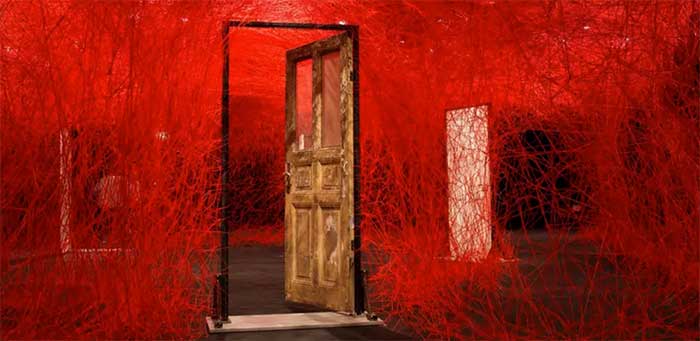
I was reminded of this exercise on entering Threads of Life by Chiharu Shiota at the Hayward Gallery. Shiota’s signature installations engulf ordinary objects – such as shoes, keys, beds, chairs and dresses – within huge weblike structures of red, black or white woollen thread. These floor-to-ceiling immersive works explore the body, memory, consciousness and the fragility of existence, while making visible the intangible connections we make throughout life. Shiota describes the making of her delicately woven structures as painting three dimensionally in a space with string.
She says: ‘This exhibition reflects the often-hidden connections between us, with each thread becoming a trace of our shared existence, weaving visible forms from the invisible threads of life. Through my work, I try to make sense of life and its uncertainties; each installation has grown from personal experiences, such as losing my father, facing death and questioning what it means to be human. While we live our lives separately, we are, at the same time, deeply connected. With this exhibition, I want to highlight the marvellous aspects of ordinary existence.’
The exhibition features new iterations of Shiota’s past monumental installations, including The Locked Room and During Sleep. These use the web of threads to create cocoon-like areas around doors and beds respectively. They enclose us as we walk through the installations and derive from Shiota’s sense of disturbance, through many house moves, leading to a need to emmesh herself and experience a space that was both stable and her own.
Letters of Thanks is the installation that is most clearly and fully about connections. First shown in 2013 in Kochi, Japan, from where Shiota’s parents hail, the installation drew its inspiration from the artist’s desire ‘to convey my gratitude to my father, who had worked so hard for his family’. This prompted the idea of encouraging others to share their own thank-you letters and the piece now includes letters from Brazil, Austria, Germany, Denmark, Japan, and London, representing all the places where it has been displayed. These letters are hung within an installation of hanging lines of red material shaped around a path leading through this constellation of gratitude connecting past and present. Shiota writes, ‘All lives are filled with happiness, suffering, disappointment, and gratitude, and as human beings, we can relate to each other through the simple act of saying ‘thank you’.
Threads of Life also includes documentation of Shiota’s early performances, which probed the boundaries between the body, life and nature, as well as her latest collaboration with writer Yoko Tawada. For Tawada’s daily series The Trainee, published in Japan’s Yomiuri Shimbum newspaper, Shiota created around 400 watercolour and charcoal drawings, each stitched with her signature red threads.
Threads of Life fills the Hayward Gallery’s top floor, while Heart to Heart by Yin Xiuzhen spans the entire lower-level galleries, bringing together seminal projects from the past three decades, alongside new commissions and historic works reimagined for the space. Heart to Heart invites us to see the familiar in new ways through large-scale installations made from everyday objects, industrial materials and used items of clothing, which reveal the personal and collective stories these overlooked items carry.
Yin is a pioneering artist who is renowned for her use of second-hand clothing, concrete, food and household ephemera in her immersive installations and sculptures. Heart to Heart comprehensively presents her artistic journey across installation, sculpture, photography, video, wall-based works and archival materials of her early performances.
Her career developed at the same time as major cultural, economic and social changes in China. Observing the country’s fast economic growth, urbanisation and global integration, she was keen to explore how living in an increasingly connected world can impact identity. As a result, she began working with mundane materials – including cement, ceramics, glass, clay, food and household objects – to uncover the traces of memory, personal history and time embedded within them.
Ruined City is an installation that captures the grief and upset caused by the rapid demolition of old Beijing to make way for postmodern development. The artist has seen multiple tower blocks displace traditional houses and alleys; she has been forced out of her own studio more than once. She collected the roof tiles and domestic furniture from the streets as buildings were demolished. The large mound and a fine coating of dry grey cement in this work symbolise the constant construction dust of 1990s Beijing.
Memories in Transit mimics a transit zone complete with a luggage conveyor belt, trolleys, airport seating and signage. Arranged on the luggage carousel are a series of open suitcases, each containing a miniature cityscape made from clothes donated or collected from those locations. Portable Cities represent cities the artist has travelled to for work, including a specially commissioned model of London. These are not replicas but impressions, capturing the artist’s personal feelings of each city. A model of an aeroplane is suspended from the ceiling above and the fuselage is covered entirely from a patchwork of discarded, used clothing. Yin uses worn clothing because it retains the memories and lived experiences of its previous owners, acting as a narrator for personal and collective histories.
The exhibition takes its name from a new commission: a huge, immersive textile installation shaped like a human heart. This, too, is composed of many used and donated garments. Again, Yin believes this ‘second skin’ over the steel frame carries the memories and experiences of the previous owners. Inviting visitors to step inside, the work can be enjoyed as a communal space for reflection, conversation and slowing down. The mirrored wall reflects the heart structure making it seem as though there are two hearts in this space, reflecting the title of the work. The work draws on the Chinese concept of Xin (heart-mind), where thought and feeling are inseparable, and signifies the gathering of our shared memories to create a space for reflection on how our individual and collective experiences intertwine.
Yin says: ‘The heart is our human engine and, in my culture, it transcends the mind. ‘Heart-to-heart’ is a way to connect and I am delighted to have this chance to engage in a heart-to-heart dialogue with visitors of the Hayward Gallery, drawing on my thirty-plus years of practice; this exhibition is an opportunity for mutual exchange, one I hope will generate sparks.’
Just as I was reminded, while at the Hayward, of the game I used to play with youth groups, so I was also reminded of other immersive spaces I had appreciated previously. The webs in Carlos Amorales’ Spider Web Negative enabled contemplation of personal data-banks, archives or webs of images, experiences and relationships which have formed us and of which we are a part. Elpida Hadzi-Vasileva’s Fragility, which was first installed at Fabrica, a converted Regency church in Brighton, routed light through hanging strips of animal membrane juxtaposing experience and materiality. As Gill Hedley has described, Fragility, like much of Hadzi-Vasileva’s work, elevated her animal membrane material from the everyday or overlooked, through an emphasis on the elegance of the web-making effect of lace, and took her audience beyond the fabric to think of transformation and wonder, making beauty out of what is thrown away or unappreciated.
Similarly, Yin and Shiota are two innovative and globally celebrated artists who use ordinary materials to create extraordinary works on a monumental scale. These exhibitions explore the different ways both artists interweave textiles and found objects into deeply personal reflections on memory, identity and the human condition. The exhibitions are, as Yin notes, an opportunity for mutual exchange. They reveal that, as Shiota states, ‘While we live our lives separately, we are, at the same time, deeply connected.’
.
Jonathan Evens
Yin Xiuzhen: Heart to Heart, Tue 17 Feb – Sun 3 May 2026
Chiharu Shiota: Threads of Life, Tue 17 Feb – Sun 3 May 2026
Hayward Gallery, London
.