
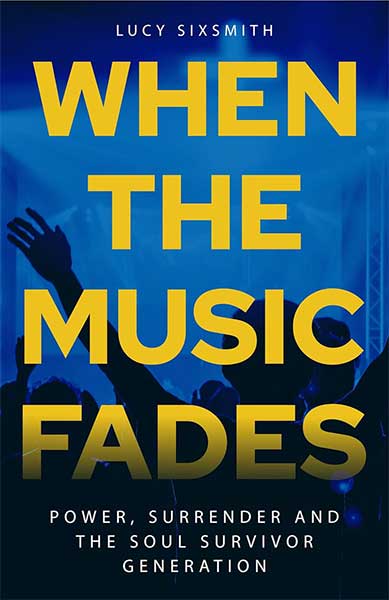
When the Music Fades, Lucy Sixsmith (Canterbury Press)
If you were paying attention to the news in 2023, yet another Christian minister was being accused of abuse. He was head of Soul Survivor, mostly known as a week long festival held each summer, but also it turns out a church. Lucy Sixsmith’s book is subtitled Power, Surrender and the Soul Survivor Generation, so I assumed it was going to be a kind of critical exposé, like many other books about cults and conspiracies. It isn’t.
Or in many ways it isn’t. From the word go, Sixsmith makes it clear she was part of Soul Survivor, at least she attended the festival and was part of the charismatic church, a branch given to bouts of praise, worship and evangelism. The reader is immediately drawn into a different world when they open the book: just as UFO believers and MAGA conspiracists have their own terminology and understanding of the world (or universe), Sixsmith immediately places us within a world of conviction, belief and persuasion.
There is no big denouement or put down here, no confessions of being abused or abusing, just a gentle questioning, often self-questioning. ‘We thought we were part of what God was doing, you see,’ she says early on. Christian songs and choruses are quoted without any excuses for their bizarre language, praying is the norm, and the notion that God might have better things to do than zap people with his spirit to make them talk funny or fall over, have better taste in music than the hymns sung to him, or really not need bigging up by human beings, is never considered.
In a way, this is what makes the book such interesting reading. Sixsmith can no longer attend Soul Survivor Festival, as it doesn’t exist any more, but she is still a Christian, albeit one that now questions some of what went on whilst she was growing up. Evangelical Christians are not much into the possibilities of different routes to God or keeping their faith to themselves, they are out and about persuading, hectoring and perhaps bullying people to believe the same as they do. Charismatics are obsessed with the idea of the Holy Spirit and the gifts it bestows: prophecy, spiritual power, speaking in tongues (glossolalia), healing and conversion.
So revival-type meetings, long persuasive talks or sermons, repetitive singing of already-repetitive contemporary hymns or choruses, and a final call out for people to come to the front and meet Jesus are the norm. The songs and metaphors may be new but the format and style go back centuries, something which is kind of acknowledged here as Sixsmith briefly introduces this kind of belief and how it sprung from primitive Methodism and other branches of the church. She doesn’t, however, seem to be able to totally detach herself from her personal history and see that it is something that has repeated itself over the centuries.
There have always been groups and cults who felt they had their finger on the pulse of things. Be it religious groups hidden in bunkers expecting the end of the world, Jehovah’s Witnesses praying backwards through genealogies to convert the dead and fill up heaven, Californian hippies trying to find eternal life through Jesus rock and communal living, or the stark austere lives of the Shakers and Amish, Mormon polygamy or Catholic priests buggering their pupils at boarding school, there are always people who can defend themselves with Biblical texts (usually taken out of context) and claim The Spirit is upon me and that The time is now. That is to say, I am right and you are not. Sixsmith was not alone when she
expected the power to fix things would flow like electricity when the
Spirit moved, and there was a time when I thought we could fix
everything between us if we tried hard enough.
Throughout the book there is a gentle awakening to some of the issues that have come to light on the back of Soul Survivor’s collapse, but also from Sixsmith’s adulthood and self-questioning about her life and faith. She realises that persuasive public or private speaking always involves power, and that this can be abusive; that the idea of the saved and unsaved produces an us and them divide; and that being instructed or feeling obligated to witness, lead the singing, preach or whatever, may not suit everyone. She is clear that talking about humility and sacrifice negates true humility: the speaker is always more powerful or famous or respected than those listening or being instructed. She also recognises that she, along with all the campers and day visitors, was complicit in all this, which was harming to both others and herself.
Somewhere along the line Sixsmith recognises she wants quiet and space, time to reflect and consider, and that trying too hard – supposedly for God in this instance, but also for leaders, family and herself – doesn’t get you very far. There are brief glimpses of regret here, too:
The cost I paid the charismatic church, along with all my tithes and
offerings, was that I thought I’d had glimpses of the beauty and
majesty of God, but it wasn’t solid enough for me to remain sure
later that I really had. Now the task is to sort through how much of
that was arrogance, and also to find out where beauty remains, if
anywhere.
and an acknowledgement of pain: ‘although we knew we were supposed to count the cost, we paid the wrong cost, in the end.’ As the book ends, having not been to church for several months, Sixsmith has turned to the idea of grace rather than dogma and rules. ‘I have no theology, nothing about any of this makes sense to me’, she says half a page before the end of the book. She has left wooden pews and church rituals behind – perhaps only temporarily – and instead heads ‘into the city [to] find a place where I can see open sky, sparkles on glass towers, gleams on the Thames.’
There is hope in this elegiac and compassionate book, although it is hidden inside a somewhat claustrophobic religiosity that many of us will feel excluded from, simply because it is mostly simply there and not explained in any way. If you persist in reading though, it is both informative and challenging, offering an insider’s view of one church organisation, its creed and ways of working, both good and bad.
.
Rupert Loydell
.