
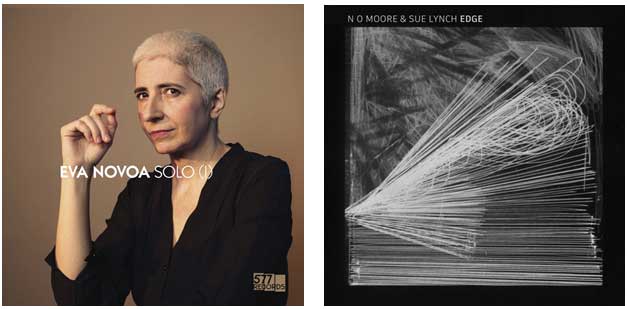
Solo (1), Eva Novoa (577 Records)
Edge, N.O. Moore / Sue Lynch (Scatter Archive)
Skall! Jon Lipscomb / Martin Küchen /Kresten Osgood (Scatter Archive)
San Francisco Encuentro, Blaise Siwula / Ernesto Diaz-Infante (Blaise Siwula)
Remnants, Ash Cooke (Ash Cooke)
Originally from Spain, but now based in Brooklyn, pianist Eva Novoa makes music that draws on all kinds of sources – from the jazz and improvised piano tradition to, by the sound of it, Debussy and Messiaen – yet uses what she finds to forge an unmistakable, individual voice. For some years now, she’s been working with small ensembles. Solo (1) is the first of a planned series of three solo albums.
She is as at home with ‘melodic themes replete with touches of swing’ (to quote the blurb that goes with one of her earlier albums) as she is with spacious, dissonant, architectural structures and controlled, atonal rambles. She incorporates Chinese gongs and percussion into what she does and, from time to time, swaps her piano for a Fender Rhodes (we’re promised electric harpsichord later in the series).
The first track begins in Messiaen-like territory, by exploring the relative sonorities of gongs and piano chords and clusters, building from a rising series of piano sounds, to a more dense improvisation. There is a quietly-stated political aspect to Novoa’s work that sometimes comes to the fore: you can think of it as being, as she’s said in the past of her guitar songs, ‘a bit political (as one of my friends says) or just simply about life’. Here it’s evidenced by the title of the second track, ‘Dime Con Quien Tu Andas’ which translates as the first half of a Spanish proverb, ‘tell me who your friends are, and I’ll tell you who you are’. She intones the words, which become a thread running through the music alongside the piano and percussion.
If the first track explored the universe and the second our relationship with others, the third (probably my favourite), the title of which translates as ‘Quiet Cabin’, is more introspective, spinning an endlessly inventive melodic thread over a gradually-changing chordal accompaniment. I’m not sure if the next track, ‘Just Say It’, is based on another piece of that name, or whether it simply describes what Novoa sets out to do. Either way, it’s a great description of the track, densely packed as it is with inventive improvisation. The next track, ‘Time Will Tell’, is a mesmerising rendition of a composition most commonly associated with Art Blakey and the Jazz Messengers, played here on a Fender Rhodes. The final track, ‘Tumbleweed’ begins with a combination of percussion, piano and whistling that could almost be mistaken for a Western movie soundtrack, which builds into a dense, virtuosic piano improvisation. As this subsides, the music returns to the sound-world of the beginning.
I liked this album from the off, but like it even more, the more I listen to it. Novoa combines energy, creativity and breadth of vision with a truly distinctive voice and a fearsome technique. I eagerly await Solo (2)!
The recent Scatter Archive release, Edge, sees improvising guitarist N.O. Moore teaming up – not for the first time – with sax player Sue Lynch. What we get are five tracks of intense, note-driven dialogue.
In ‘Shatter’, what begins as a thoughtful, two-part invention builds up to an intense, more chaotic climax. In ‘Glare’ a long section of lyrical, responsive playing suddenly contracts to confine itself to small groups of reiterated notes which both players gradually break out of to create an area of more dense, frenzied music which, in the end, comes to rest on a repeated chord before veering off into a frantic, final note stream. ‘Shimmer’ creates a slow-paced, evocative sound-world. I say evocative, but I’m not sure exactly what it’s evocative of. Something – as befits the title – that’s difficult to see, even when it’s there, in front of you, a formulation which reminds me, as I write, of something Moore has said about improvised music, that it ‘proves that something always remains unprovable’. (If someone out there wants to make yet another film of There Is No Antimemetics Division, they could do worse than get onto Moore and Lynch to provide the music). The next track, ‘Serrated’, with its visceral sharp attacks and brief tremolos is nothing if not an evocation of its title. I found it so absorbing to listen to that the sudden change of ambience at the start of the next track was almost palpable. This, the last on the album, was recorded not in a studio but almost a year later at a Sound Bureau event. It’s something of a change of gear, I thought. Nevertheless, it fits very effectively with the music that precedes it.
With Edge, Moore and Lynch have created a great album of rich, varied and imaginative music. It’s a great listen – one which, once I’d reached the end, had me going back to the start to listen again.
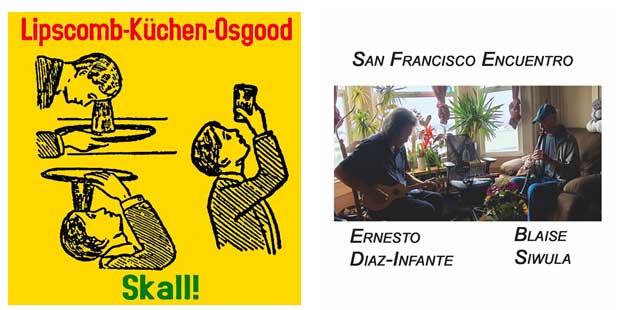
Skall! – another recent Scatter release – brings together guitarist and sound engineer Jon Lipscomb, Danish drummer/multi-instrumentalist Kresten Osgood and sax player Martin Küchen. What we get is a series of sensational improvisations, brimming over with playful invention (Martin Klapper’s artwork for the album sets the tone). That’s not to say it’s not serious: this is definitely music for grown-ups (well, for ones that have retained – or are prepared to rediscover – their capacity for playfulness), but as the album note says, Lipscomb, Küchen and Osgood are ‘doing what everybody needs right now’. It’s great when you sense an awareness of the psychotropic power of music in what people do (for example, they’re centuries apart and the modus operandi is a little different, but you can sense it in much of Josef Haydn’s music, too). One is drawn in not only by the colourful, almost tactile textures they create but also by one’s sense of the uncluttered intuitive connections between them. And once drawn in it’s a world one feels reluctant to leave.
Reed player Blaise Siwula is an improvising musician who has worked with many different artists over the years, including Cecil Taylor. San Francisco Encuentro finds him paired with the San Francisco-based improvising guitarist and composer Ernesto Diaz-Infante. ‘Encuentro’, for those who don’t know, is simply Spanish for ‘meeting’.
In the album notes, these six duets are described as ‘transfictional’. I pondered what might be meant by this. Transfiction is the appearance of a character known in one work of fiction putting in an appearance in another. Prior to this reunion, Diaz-Infante and Siwula had not played together for a long time, so I guess it could be because they’re both known for their work on projects not involving each other and the coming together of their two names – and two musical approaches – on this album resembles the way two fictional characters from different fictional works might show up in a new work of fiction. On the other hand, it could be taken to mean that fiction has so invaded the real world that we can almost think of ourselves as fictional characters. As JG Ballard said, ‘We live inside an enormous novel. For the writer in particular it is less and less necessary for him to invent the fictional content of his novel. The fiction is already there. The writer’s task is to invent the reality’. Hence, here, the characters Siwula and Diaz-Infante are being transferred from the novel of life to another, in this case, musical world, in order to invent and inhabit a new, more authentic musical reality. The two possibilities are not mutually exclusive.
Much of what Diaz-Infante and Siwula do in these six duets orbits around the note D (I could say they’re ‘in D’, but, somehow, that doesn’t quite cover it). Often, it’s present as a drone, repeated like a mantra but, even when it’s not explicitly stated, it, or a note closely related to it, is often implied, a kind of musical ‘elephant in the room’. The music is open to noise elements, too, and often has a folk-like – almost klezmer – feel to it. Diaz-Infante and Siwula describe the album as a ‘reunion recording of sorts as it had been 20 years since the last time we played together. There is an underlying joy expressed in this afternoon gathering that we’re happy to share.’ If they set out to invent a transfictional musical reality, as they suggest in the album notes, I’m happy to say they succeeded. I’m pleased, too, that they chose to share it so that we can relive it.
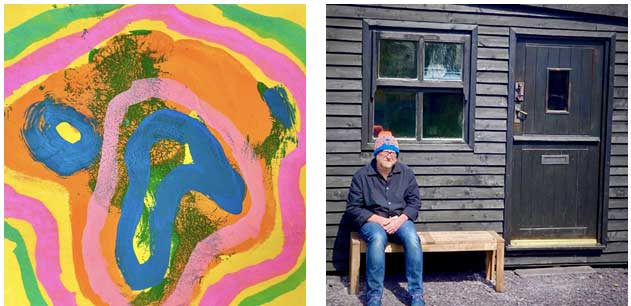
I’m not sure what the Remnants – the title of a recent solo EP by Welsh guitarist, Ash Cooke – are remnants of. The tracks are described as artifacts, which suggests archaeological remains. Left-overs of another project, that though worthwhile, just didn’t fit in with a plan? Or imaginary remnants of a fictional entity that never existed (the way they used to build ‘follies’ that were ruins of imaginary buildings?) Or, perhaps, simply the artifacts you’re left with once you’ve rejected everything that didn’t make the grade? It doesn’t say. It doesn’t have to: the ambiguity is pleasing and adds to the aura.
This is music that is not afraid to embrace consonance and tonal centre. It doesn’t insist upon it – indeed, all it insists upon is its right to do its own thing. There are jazz-like chords and ruminations. The haiku-like album note alludes to – among other things – ‘dissonant expressions’, but these are never allowed to derail the cool equilibrium and, indeed, in the jazz-like context Cooke establishes, dissonance can seem like consonance, or, at its most striking, simply an element of colour. Talking of improvisation, Cooke has said, ‘Derek [Bailey] liked the phrase ‘non idiomatic’ but I prefer ‘self idiomatic’. However you want to describe it, what we get here is almost fifteen minutes of highly listenable mellow invention, which is well worth checking out.
.
,
Dominic Rivron
LINKS
Solo(1):
https://577records.bandcamp.com/album/solo-i
Edge:
https://scatterarchive.bandcamp.com/album/edge
Skall!:
https://scatterarchive.bandcamp.com/album/skall
San Francisco Encuentro:
https://blaisesiwula.bandcamp.com/album/san-francisco-encuentro
Remnants:
https://ashcookemusic.bandcamp.com/album/remnants
.