
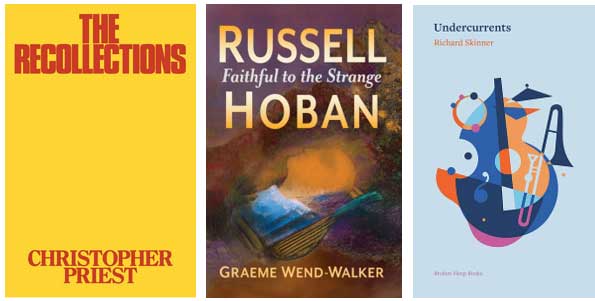
The Recollections: Fragments from a Life in Writing, Christopher Priest (Briardene Books)
Russell Hoban: Faithful to the Strange, Graeme Wend-Walker (McFarland & Co.)
Undercurrents, Richard Skinner (Broken Sleep)
Although often referred to as a science fiction writer, Christopher Priest’s novels were rarely even in orbit around that genre as normally defined. Influenced as much by H.G. Wells as J.G. Ballard, Priest crossed fictional boundaries into writing about magicians, hallucination, doubles, twins and doppelgängers, along with conspiracy theories, somehow still managing to be part of the New Wave of science fiction that Michael Moorcock championed when editing New Worlds magazine.
Instead of spaceships, aliens and other planets, Priest’s work is about liminal spaces such as the Dream Archipelago, whose islands formed both the setting and characters of several of his books. Other titles featured alternative worlds, often very real ones adjacent to, within or hidden from ours. All were written in crisp, lucid prose and mostly found their audience within science fiction and slipstream readers. As Priest writes in one of the non-fiction pieces collected here in The Recollections:
Science fiction writers are blessed with many valuable things. They have
an active, intelligent and open-minded readership. They have a successful
commercial framework within which to work. The ‘science fiction’ label
conceals a multitude of sins, but it also provides a liberal framework within
which to write.
This ‘liberal framework’ extends here to Priest’s own writing about his literary influences, creative ideas, processes and some autobiographical moments. These moments are outward looking: critical reflections, meetings with other authors, or the sharing of research he has undertaken for his writing. (Notably, ‘The Amazing Life and Death of Rudolf Hess’, in relation to Priest’s mention of him in The Separation.) He also ruminates on ideas of Britishness in a Guest of Honour speech at Worldcon in America, asks ‘Where Am I Now?’ in relation to being named as one of The Best of Young British Novelists 1983, and writes in ‘The Magic: the Story of a Film’ at some length about the writing, adaptation and filming of The Prestige, probably still his best-known work.
Priest is uncannily able to step back in this piece to consider the sleight-of-hand, or mystery, which underpins the story, and to coolly document both the written and cinematic processes, along with the often fictional hype, secrecy and speculation that the film conjured amongst fans and critics. Although a good film, I still prefer the novel, where Priest proves that ‘language is the test of reality, the medium of ideas.’ Conceived as a book, it does not need visualising for us.
Language was also ‘the medium of ideas’ for Russell Hoban, another author whose books defied easy categorisation and mostly eluded any mass readership, although Riddley Walker – probably his masterpiece – has achieved cult status as a linguistically experimental post-apocalyptic novel (so influential that Mad Max Beyond Thunderdome lifted several ideas and situations, not to mention modes of speech, without any acknowledgement), and Turtle Diary – his most straightforward book – was made into a film starring Glenda Jackson and Ben Kingsley.
Elsewhere, objects are given their own voices in Kleinzeit, as is Death, who appears in the form of an ape, and words are distributed for free in London’s Underground through buskers singing and as phrases written on yellow paper. Hoban was fascinated by modes of perception and the transmission of ideas: artistic, musical, mythical and social memes. In Russell Hoban: Faithful to the Strange, a well overdue book about Hoban’s writing, Graeme Wend-Walker suggests that Hoban’s innovative writing (with regard to both form and content) ‘points to […] a kind of foundational instability in the reader’s relationship to the text, but also, by extension, with all things. Certainly, there is an instability in any meanings derived from the text.’
With this in mind, Wend-Walker has organised his work into thematic chapters, drawing not only on Hoban’s adult fiction but also his writing for children. The adult novels considered includes the final run of seven novels from 1998’s Mr Rinyo-Clacton’s Offer through to 2010’s Angelica Lost and Found Hoban, which many found repetitive, overly autobiographical and casually written. Repetition may, of course, be a form of instability or emphasis, just as occurrences and objects are open to numerous interpretations when contextualised in a different book.
Hoban wrote about feeling that something was looking through his eyes, directing his optical and imaginary vision. He responded to specific works of art and music, particular artists and composers, and objects which he collected. His study, which I was fortunate enough to visit in the 1980s when I interviewed him, was full of the objects that feature in many of his books, just as the genteel part of Fulham he lived in did. He wrote about his house, locale and activities in his essays and fiction; how he scanned the shortwave radio airwaves for garbled music and speech, how misheard and misunderstood phrases or damaged and decontextualised objects could spark inspiration.
Hence the role of Mister Punch in Riddley Walker and the idiomatic language that the book is written in, not to mention the mash-up of nuclear physics and the legend of St. Eustace which is used as a kind of creation myth by the book’s inhabitants to explain the post-apocalypse world they live in. Pilgermann is a novel that takes the surreal horror of Goya’s, Breughel’s and Bosch’s paintings literally to explore war, torture, religion and pilgrimage through the titular character, a Jew on his way to Jerusalem. Fremder, in a very different way, subverts science fiction for its own aims.
Wend-Walker’s overall thesis is that Hoban’s work offers ‘certain ways of encountering the world’ and
draws our attention to […] the larger human struggle to make of our
world something explicable, something that will stand still long enough
for us to establish some form of mastery over it, drives out of awareness
all that such explication is unable to enclose, which is nothing less, he
feels, than everything that really matters.
In a similar way to Priest, Wend-Walker suggests that ‘words cannot be trusted to pin any- thing down’, citing a line from Riddley Walker to suggest that Hoban might agree: ‘Some times theres mor in the emty paper nor there is when you get the writing down on it’.
However, language – and in this book specifically Hoban’s language – is all we have to go on. Hoban was prone to a gentle mysticism about his creative process, insisting he wrote stories that had to be told, and that characters such as Orpheus (yes, the Orpheus, from Greek mythology), Vermeer’s ‘Girl with a Pearl Ear Ring’ or Medusa demanded to be present in his books.
Wend-Walker is excellent at grounding and contextualising these ideas with wide-ranging references to religion and existentialism, symbolism, technology, linguistics, narrative theory, psychology and art and music criticism. He uses ‘Steiner’s sense of an “order of being rather than of meaning”’ to help understand Hoban’s conviction of the interconnectedness of things, discusses repetition using the ideas of echoes of echoes and ‘attempts to represent the transcendent’, and debunks Hoban’s claims to not know what he is doing when it comes to writing. He also points out that ‘it is clearly possible for structures to emerge along the way of which the author may remain unaware’ despite constant and careful rewriting and editing of a work-in-progress:
As with [Hoban’s] claims that his writing has no structure, that he does not
know what he is doing when he writes, and that he is not concerned with
reader’s responses to it, this too is best read as a challenge to misguided
expectations—as an acclamation in the first instance of the ‘perceptive
ignorance’ that Hoban feels must be cultivated by the writer, and by the
rest of us too, toward the world in general; as a performative defense of
the psychological conditions conducive to an improvisatory mode of
writing; and also as a statement of fact, as no author actually grasps all
the meaning-proliferating potential of what has been written.
This book, which I have only been able to read in small amounts at any one time as the review copy was a PDF and I find sustained reading onscreen almost impossible, is complex but clearly written as it grapples with some heavyweight ideas and concepts. ‘Hoban never stopped looking for ways to be faithful to the strange’ says Wend-Walker, and seemingly agrees with Hoban’s statement that ‘We make fiction because we are fiction’ and his belief that ‘stories […] have a more fundamental existence than we do’. Thinking about that through the lens of Hoban’s numerous books for adults and children makes for intriguing and thought-provoking reading.
As does Richard Skinner’s Undercurrents, a more straightforward collection of essays and reviews that evidence Skinner’s own creative processes and influences as he comments upon the structure and constitution of various albums, books and films and his responses to them, before two examples of life writing, one an exquisite elegy that manages to be both biographical and autobiographical at the same time, and then a previously published interview with Skinner, and Skinner’s own conversational interview with the poet David Harsent.
I know Skinner mostly through his poetry (which you can read at IT here) and it’s good to see his own take on books by Proust, Cortázar, Didsbury and Davie, and albums by Talking Heads, Robert Palmer, Laika, Holger Czukay, R.E.M. and David Sylvian and find out not only what he makes of them but how they (and many others which are new to me) feed into – literally in the case of the texts considered – his own writing. I’m looking forward to the result of Skinner’s intention to ‘try my hand at some “fractal” poems.’
.
Rupert Loydell
You can find out more and buy The Recollections here and Undercurrents here.
Russell Hoban: Faithful to the Strange is available through major online bookshops, and there is more information about it on the publisher’s website, here.
.