
the return of, The Fleeing Villagers (Fred Lonberg-Holm)
Convergência do Vôo, Fred Lonberg-Holm / João Madeira / Bruno Pedroso / Carlos “Zíngaro” (4daRecord)
Transgressive Coastlines, Caroline Kraabel / Pat Thomas / John Edwards / Steve Noble (Shrike Records)
LliFT #18, Llift (Recordiau Dukes)
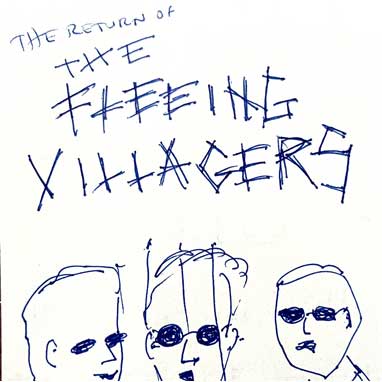
Based in the San Francisco Bay area, Fred Lonberg-Holm is an American cellist or, as he’s described himself, anti-cellist. He studied with Anthony Braxton and Pauline Oliveros among others and is most well-known for his work in free improvisation and jazz, although he’s also worked as a session musician and arranger with rock, pop and country artists. His latest release, the return of by The Fleeing Villagers, is a savage collage, a punk/noise juggernaut of an album which holds a mirror up to the current state of the USA. You’ve been warned. I like it and, indeed, it deserves to achieve some sort of cult status. He also figures on another recent release, a collaboration on the 4daRecord label which is, let’s just say, a more sedate affair. The title, Convergência do Vôo translates as ‘flight convergence’. It describes a meteorological phenomenon, much prized by glider pilots, whereby two air masses meet, forcing air to rise and thereby enabling gliders to gain altitude. I guess it’s intended as a metaphor – and it’s a good one – for the experience of improvising as part of a group. On it, Lonberg-Holm loops the loop – not for the first time – with fellow string players João Madeira and Carlos “Zíngaro”. As a trio of string-players they’ve made at least a couple of albums in the past on which they’ve collaborated with a fourth musician (one features Swiss guitarist Florian Stoffner another, bass clarinettist José Bruno Parrinha). On this occasion, they’re joined by drummer Bruno Pedroso.
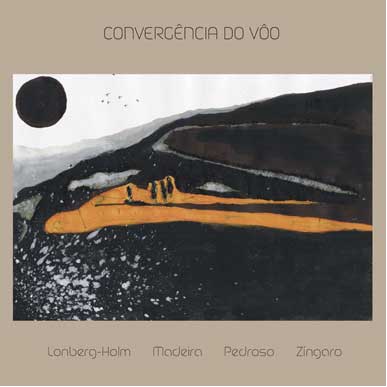
A classically-trained violinist, Carlos “Zingaro” has worked with Derek Bailey’s Company and has appeared on over fifty recordings. Bass player and founder of the 4daRecord label, João Madeira, has conducted research into fado (a form of traditional Portuguese music) and worked across many genres, although his main focus is on free improvisation and composition. Bruno Pedroso has been involved in jazz drumming since 1995. As well as teaching, he’s very active as a freelance performer.
The guy credited with the mixing, Gordon Comstock, deserves a mention, too. A balance between the instruments has been achieved which allows all kinds of textural nuance to come through. And there’s plenty of it, even though the music is often – but not always – fast-paced and dense. There’s a lot of subtle shading going on, and, as I hear it, there’s an improbably lyrical edge to it. Pedroso’s drumming effortlessly joins in the conversation, creatively seeking out – and finding – common ground with the strings in ways I imagine you could only achieve by actually doing it in real time and, indeed, there’s a sense of seat-of-the-pants discovery to the music which adds to it’s forward drive.
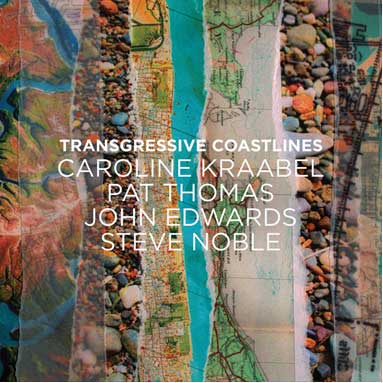
Transgressive Coastlines, the latest release – at time of writing – from Shrike Records, brings together the formidable quartet of Caroline Kraabel, John Edwards, Pat Thomas and Steve Noble. Born in Seattle, Kraabel moved to London in her teenage years and has been a fixture in the free improvised music scene ever since. For almost five years, she had her own programme on Resonance FM, Taking a Life For a Walk, in which she wandered the streets of London with her sax and her children. Among other large-group compositions, she created, for the South Bank Centre, Saxophone Experiments in Space, a ‘site-specific ambulant composition for 55 saxophonists’. She’s also been involved with the London Improvisers Orchestra and, in addition, has regularly worked as half of a long-standing duo with bassist John Edwards. Obsessed with sound from an early age (his brother played the drums, which intrigued him), Edwards took up the bass guitar in his teens, switching to the double bass in his twenties. He’s played with likes of Evan Parker, Derek Bailey, Lol Coxhill and Peter Brötzmann among many others. He’s said of improvisation: ‘the establishment – by which I mean people in offices, suits and government – maybe want people to do nothing. They want to keep people drugged up with the banal, working, doing the same thing. Maybe free music upsets that’. Pat Thomas began playing the piano when he was eight and started to play jazz piano in his teens. He went on to develop a style of his own, drawing on free jazz, improv and new music. As Rae-Aila Crumble put it on Bandcamp Daily, ‘The music he releases is both transcendent and grounded, rooted in his Muslim background and fascination with Islamic mysticism, as well as the histories of jazz afronauts like Sun Ra. Browsing through his … catalog feels like tapping into the secrets of the universe, similar to the way jazz historians describe Coltrane’s discography as always searching for something.’ Drummer Steve Noble got his first drum kit when he was twelve. He was mainly self-taught, but then, as he explained in an interview with Chris Searle for the Morning Star, ‘In 1979 I met Nigerian drum master Elkan Ogunde and we played many concerts [and] workshops together – a great learning experience. By the mid-80s I was organising concerts and festivals and performing with Sheffield guitarist Derek Bailey, another huge influence’. Since then, he’s worked with a wide range of musicians and toured extensively throughout Europe.
Like that of the album, the two-word titles of the three tracks on Transgressive Coastlines all suggest surrealist word-play. In the first track, ‘Dark Rainbow’, the quartet create a complex texture that veers between the polyphonic and the pointillist. You could think of the musical colours here as a rainbow – there are dazzling moments of bright light – but there are others in which the music reaches a point of near stasis which might be thought to invoke the visual impossibility of the title. At first fragmentary, the music of the second track (‘Volcanic Tears’) gradually becomes more dense. The musicians trade explosive gestures which build into something more sustained, at times static, even, only to be sent off in new directions by further explosive activity. The third track (‘Diamond Ashes’) again begins with fragmentary explorations, but this time the music settles into a sustained monolith of sound. A pulsing chord from Pat Thomas within it becomes increasingly distinct, transforming the monolith into a series of repeated chords. It finally comes to an end, but no-one seems to want to move away from the zone they’ve created. The repeated chord idea makes a comeback and the sax, bass and drums continue to pursue their close but inventive orbits around it.
Listening to it all for a second time, I was struck by the sheer virtuosity. Of course, virtuosity isn’t essential to good music (it can even become a substitute for real content), but you get a real sense listening to this that you’re listening to four seasoned musicians in total command of what they do while, at the same time, still finding fresh and inventive things to say.
Which brings me on to LliFT #18. Just to remind us, LliFT are an ‘inclusive community group giving individuals the opportunity to play freely improvised ensemble music on a regular basis in North Wales’. It’s only a few weeks since I was writing about #17, saying how it was one of the best LliFT albums yet. #18 carries on where #17 leaves off. One might think that after an outfit putting out so many albums in quick succession, one might detect a note of tiredness, a drop off in quality. Nothing, however, could be further from the case. What we have here is well over an hour of immersive musical landscapes packed with creativity. Listening to it, I was reminded of M John Harrison’s Light Trilogy: not only on account of the enthralling strangeness of both, but on account of a striking passage in which the book describes how different civilisations living in different parts of the galaxy developed space travel independently of each other: ‘Every race they met on their way through the Core had a star drive based on a different theory. All those theories worked, even when they ruled out one another’s basic assumptions. You could travel between the stars, it began to seem, by assuming anything.’ What he says about space travel here could also, in many ways, be said about the world of improvised music. People navigate musical space with often very different musical ‘star drives’: you can, for example, put together a small group of the most experienced improvisers (as in the case of TC), or, like LliFT, create an ‘inclusive community group’. Neither is a recipe for success or failure, although, in the case of the albums here, both more than succeed.
Dominic Rivron
LINKS
the return of: https://fredlonberg-holm.bandcamp.com/album/the-return-of
Convergência do Vôo: https://joaomadeira.bandcamp.com/album/converg-ncia-do-v-o
Transgressive Coastlines: https://shrikerecords.bandcamp.com/album/transgressive-coastlines
LliFT #18: https://recordiaudukes.bandcamp.com/album/llift-18
.