
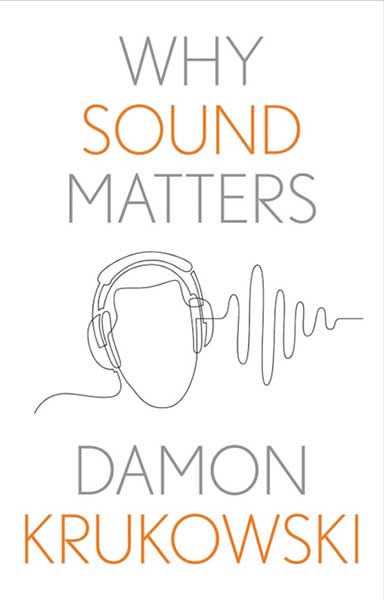
Why Sound Matters, Damon Krukowski (Yale University Press)
This is one of a number of little books which offer – says the little paragraph on the back flap – ‘intriguing pairings of authors and subjects’. Damon Krukowski was part of the indie bands Galaxie 500 and then Damon & Naomi but now writes and podcasts about music.
Why Sound Matters is intriguingly structured, with chapters about more theoretical considerations alternating with more personal reflections and stories. It opens with a chapter about being a sound technician and Damon’s relationship with the musicians he works with at the venue who have hired him, but quickly moves into recounting a couple of stories and situations he was told. It sets the scene for much of the discussion about human interaction which follows.
We have to wait several pages to get back to those stories. The next chapter is a strange piece about how ‘Sound Is a Material’ with – Damon argues – a physical presence and a physical effect. I’m not sure about the former, although sound certainly works within the physical world, moving atoms about that vibrate our eardrums and which our brains then interpret into sounds and/or music, but the latter is unarguable and the chapter moves swiftly to discuss sound pollution and its effects on the natural, animal and human world, changing breeding patterns, architecture, migration, social engagements, hearing and general how things live. It’s a bit of a rant at times but it’s factually clear and obviously heartfelt.
The next brief chapter sees us back behind the soundboard and takes a few pages to introduce one of the main concerns of the book: the value of music. Damon gets in a bit of a tangle over the next 80 pages or so, somehow thinking that because sound is an actual material it must have a financial value and, in a similar way, that the labour of making music deserves financial recompense. This spins out into discussions of the value of online shopping versus independent record and book stores, and how live music, recorded music and musicians’ livelihoods have all been affected by digital streaming and downloading of music.
I have to say there’s a sense of entitlement here at times. We all do things we want to do (and don’t want to do – like hoovering and cooking) that involve both physical materials and labour but we don’t expect to get paid for it. Whilst I miss hanging out in indie record shops such as Rough Trade back in the late 70s and 80s and Binary Star in Exeter in the 90s, I now find small communities of like-minded music fans elsewhere: yes, some are online, but also at record nights, local concerts, in the pub, and in a couple of staunchly independent record shops. In fact yesterday I stood up from a record bin in a charity shop to find the owner of Lucky’s Record Bar standing behind me waiting his turn to rifle through and then later found a new (to me) small independent bookshop a couple of streets away.
So small businesses do still exist, but they have changed their business models, just as the music industry has or will eventually have to. Damon is in the USA which is very different to the UK, but although he discusses how music distribution has changed, mostly not for the better for musicians, he seems to miss the point that bands can now work totally outside the established music industry if they choose to. He does mention direct sales at gigs, merchandise and marketing but I kept waiting for a discussion of what I know as ‘cultural value’, which is not a term he uses to talk about friendships, communities of fans, gatherings at live events, and the possible lasting effects of songs and music for fans.
These can’t be given or assigned financial value, however real they are, but they do have different values, ones that help us make sense of the world, let us dance, share our sadness or joy, anger or confusion. Think about the phenomenon of people declaring that a specific song is ‘our song’, think about the songs from your youth that you can still sing, the music that makes you well up or feel revolutionary.
Yes, of course Damon wants to monetize his music skills but he is dealing with a product that nowadays has mostly cultural value rather than financial value. If he can get his head around that – and as a poet it’s something every poet has had to do at some point – and concentrate on getting people to hear his work rather than buy it (though album and merchandise sales may result), he will be ahead of the game, because big record companies still haven’t ‘got it’, are still flailing around losing money on streaming, still looking for the next big thing, the next number one single, and the next superstar individual or band, whilst creaming off any money they make rather than supporting their artists.
We don’t need all that. We don’t need bands who take two years and spend millions to make records, however good or successful they might be. That’s not labour, that’s fiddling about. The future of music is – to use Robert Fripp’s phrase – small intelligent mobile units, who retain control of their music and can swiftly adapt to where and what they play and how they distribute their own music.
Damon, however, ends his book with a call for solidarity and resistance so that together musicians can demand big changes from the established music industry. Sorry, but I don’t think that is going to happen: the music industry (and the publishing industry) will do its best to make as much money as it can, as quickly as it can, and will eventually implode and go bankrupt because it has stuck to an old-fashioned, well-established and now failing business model. Yes, sound matters, music matters, but far more than Damon suggests. Musicians rights are important, as are living wages, but it may be thinking and stepping outside the box that is required, not some kind of industrial dispute that can’t be won.
.
Rupert Loydell
.