
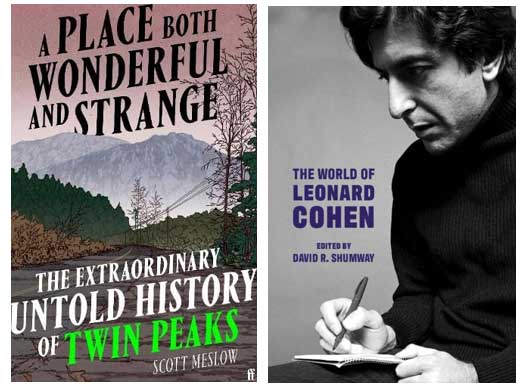
A Place Both Wonderful and Strange: The Extraordinary Untold History of Twin Peaks, Scott Meslow (Faber)
The World of Leonard Cohen, ed. David R. Shumway(Cambridge University Press)
It’s interesting and appropriate that both the quotes used as the back cover blurb on Scott Meslow’s new book about Twin Peaks are bigging up David Lynch’s creation rather than the book itself. A Place Both Wonderful and Strange is both readable and enjoyable, user-friendly even, but there is little that seems untold or extraordinary in its 250 page ramble through Lynch’s groundbreaking and mind-numbing world.
Scott, of course, has the advantage over authors of earlier books on the same subject, of a retrospective overview of the three television series and prequel feature film, along with film outtakes, co-creator Mark Frost’s two Twin Peaks books and several critical volumes. Now that Lynch has died, we know there will be no more visits to Twin Peaks, which allows Meslow to summarise, conjecture and think aloud. Whilst it’s good that he doesn’t try to offer a definitive version of things – which would be an impossible task anyway! – he is prone to both stating the obvious and offering a fairly shallow understanding of things.
The main trouble is that his bibliography is very thin (a mere sixteen titles are listed) and he is very over-reliant on internet discussion forums along with cast and technical staff interviews. He basically doesn’t get very involved in how Lynch constructs his films visually and sonically, let alone explore he impossible cosmologies and tentative spiritualities on show.
There’s a sense of authorial misdirection at work. Whilst this may suit the subject, since Lynch is an expert at misdirection and subterfuge, it sometimes seems that Meslow has concentrated on the wrong things. He has a superb chapter on The Return episode 8, but does not explore the ‘birth of evil’ shown in depth or how it links to the rest of that third series, or indeed underpins the whole Twin Peaks oeuvre. He only mentions Agent Cooper’s escape and return in the third series in passing, with no real discussion of the liminal spaces he makes his way through, nor any in-depth exploration of doppelgängers and tulpas, something that informed a lot of Lynch’s work.
This misdirection or – if one is kind – misunderstanding, is most evident in the brief character studies which act as interludes or interruptions to the ongoing narrative arc(s) that Meslow follows. Dale Cooper, arguably the main character throughout, is relegated to the end of the book, and although important characters such as Audrey Horne, the Log Lady and – of course – Laura Palmer are discussed, Meslow chooses to also feature the likes of Denise Bryson (David Duchovny as a trans woman) and Josie Packard, as well as including a smartarse one-liner about ‘Judy’, the enigmatic goddess or monster or deity who is namechecked in the show.
One cannot argue with Michael Horse’s recorded comment to a bemused Robert Forster at the beginning of series three: ‘You’re not going to get all of this. Just relax and enjoy’, but one can perhaps desire a little bit more than this gentle meander through the world of Twin Peaks. A place and series so wonderful and strange deserves a book more wonderful and strange. And more informed.
Leonard Cohen was another amazing artist, a writer and musician who created and sang about mysterious worlds full of lust, sexual encounters, philosophy, dreams and joy, underpinned with a Jewish/Christian mysticism (despite Cohen being a Buddhist monk), and a self-declared lack of traditional singing skills. Like the inhabitants of Twin Peaks, Cohen seems to allude to secret knowledge and dark deeds, yet hide these within love songs and hymn-like paeans to the great unknown.
The World of Leonard Cohen is a collection of academic essays that comes at his work from a number of angles, loosely grouped together in six sections: ‘Creative Life’, ‘Musical Contexts’, ‘Religious Contexts’,’ Cultural Contexts’ and ‘Reception and Legacy’. There’s plenty of overlaps and dialogues between many of the pieces: for instance Alan Light’s ‘Songwriting: Hymns of the Heretic’ could easily have been placed in the ‘Religious Contexts’ group and two essays concerned with Cohen’s move ‘From Writer to Rock Star’ and ‘How to Be an Aged Rock Star’ might perhaps have sat better in with other work about cultural contexts. After all, the expectations of aging are cultural ideas, just as much as ideas of Matriarchy, the Counterculture and Politics are.
But I quibble. The subjects here are wide-ranging and well-informed, although a number of quotes seem to appear a little too frequently the book, which is an editorial problem rather than an authorial one. I found the discussions of Cohen aging, his relationship with the Counterculture and move from writer to singer (although of course he continued to do both) especially interesting, as well as the contrasting, if not conflicting, chapters on Judaism, Zen, Christianity and the aforementioned ‘Hymns of the Heretic’.
The dullest part of the book is saved until the very end, where Robert de Young’s chapter about ‘The Archive’ feels like a public service announcement advertising the archives structure, content and future plans. Ron Padgett’s chapter about covers, which precedes this, is frankly plain dull, too tied up with numbers and lists rather than any in-depth critical engagement with radically different versions or deconstructions of songs.
Mostly however, this is a book of intelligent, readable and useful essays that explore and show the strengths and depths of Cohen’s poems and songs, and how they have fitted into various musical, social and spiritual contexts since he first arrived on the scene. Who knew that he would be such a big star or his work be regarded so highly despite the fact that – as the Introduction notes – ‘Cohen remains a mystery’.
Rupert Loydell
.
Thanks
I loved Twin Peaks and swallowed it whole when it was broadcast but I haven’t returned to it as often as I expected. Leonard Cohen was one of the first white singers I got into – I grew up on Northern Soul and found acoustic music through blues – and I followed him forever (even when he was supposed to make you kill yourself.)
The best biography of Lenny I’ve read is by Sylvie Simmons – I’m Your Man – but I really enjoyed two fictionalised accounts – A Theatre for Dreamers by Polly Sansom, and the TV series – So Long, Marianne (a Norwegian/Canadian production) both centred around his time on Hydra
Comment by Steven Taylor on 8 February, 2026 at 9:16 am