
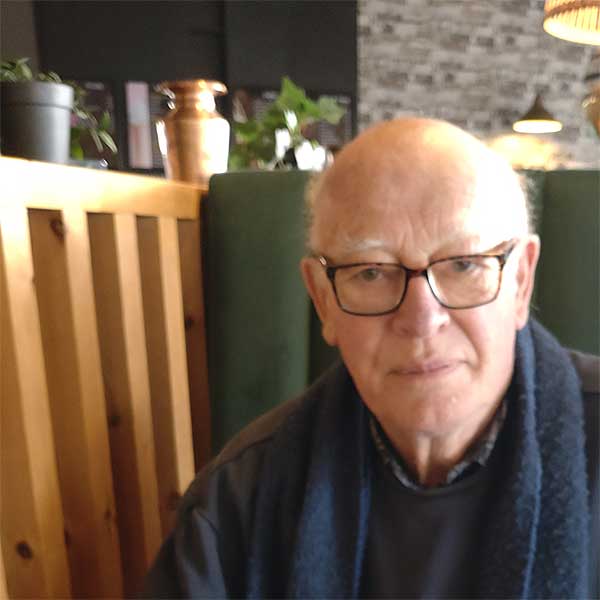
Chris Bill interview with Malcolm Paul
- MP) Chris, if you don’t mind, I’d like to start our interview with a question about your background. Growing up? In the interview you recorded online with your son, you talked about how you were already seemingly proficient in drawing at a young age. You had mastered perspective by primary school age and used your gift of being able to master the drawing of bungalows in perspective as a means of keeping the school bullies at bay. Would you mind retelling that story for the benefit of those who haven’t heard it before?
- CB) From the age of five until I was nearly eight, I lived in West London and, although separated from my mother, my Canadian father paid for me to go to a private preparatory school. Art was taught as a craft. The teacher would draw on the chalkboard a tree, flowers, a house, and we had to copy it in the same way we would copy down timetables. In the process, we copied lines of perspective, and I suppose it just stuck as a drawing skill that I could use later.
- MP) I’m sure the readers are relieved to hear that you were able to distract the bullies by giving them your drawings. It does, however, beg the question, what did you find so interesting about drawing bungalows? Did the teachers think you were on the autism spectrum (though that’s more a recent widely acknowledged diagnosis)? Were you interested in drawing anything else at school? When I was at school many years ago, the artists in the class were very interested in drawing comic book heroes and pop stars, if not inventing their own pop persona or superhero. Did this appeal to you at all? Was there lots of doodling in class as well? Precursors to the Zentangles?
- CB) In 1953-54, my mother, in Dickensian terms, “fell on hard times”. The money for my private education dried up as my father suffered a mental breakdown. We were reliant on my grandparents for our accommodation and had to move to a small terraced cottage in a village near Tunbridge Wells. I went to the local boys’ junior school with an ethos so very different to the one I had left in London. It was a close-knit village and not used to incomers, and I was instantly bullied, verbally and physically, by lots of the boys.
I had nothing going for me. My surname, Bill (Buffalo Bill). I wore glasses (four eyes), I had no father (bastard) and I’d been to Germany (my uncle was an officer in the BAOR). This was only eight years after the end of the war.
On Friday afternoons, we had art – big pieces of kitchen paper, pencils, and no instructions. The boys were hopeless at drawing, but I had perfected drawing a bungalow on a hill, with a long sweeping drive coming from it, all in perspective. I churned out several of these so the boys could use them, take them home and convince their parents they had done them. The bullying stopped.
Bungalows: In the 1950s, there was a Bakelite plastic construction kit called BAYKO. It was a forerunner of Lego. The bricks and roofs were limited in their possibilities, and they mainly built bungalows.
In the 1950s, I used to draw and crayon mountain scenes, design sets for my toy soldiers to ‘fight’ on, but I didn’t count drawing as such as one of my main activities. Where I lived was near Tunbridge Wells Common, and I spent most of my time playing with the other boys, making camps, playing cricket and football.
No doodling in class specifically, that I remember. My fascination with Zentangles came in 2015 when I saw an artist’s studio in Toronto during Nuit Blanche, a through the night, city-wide art exhibition. I bought pens and tiles, three and a half by three and a half pieces of card, and have since drawn over 250 Zentangles.
- MP) Did you have the kind of art master who recognised and appreciated your art and perhaps suggested you take it a bit further and go to art school? In my experience there is an art/drama teacher around somewhere who acts as the saviour of unrecognised talent. Any comments on that? (No intention to denigrate other teachers.) Do you think it’s harder to be a child in school now than say when you were young, or later when you became a teacher and later a Headmaster?
- CB) Art in grammar school in the 50s and 60s was very prescriptive and I don’t think I showed any particular talent for it – certainly not in the sense of an art master wanting to encourage me. It was a hard school based on physical punishment and not encouraging pupils to excel, just behave.
Since the 1960s, and certainly when I started teaching, teachers were free to design their own syllabus at primary school level. The Plowden Report encouraged ‘child-centred learning’ and this permeated schools allowing individuals to flourish in any talent they had.
My experience of secondary schools came through my four boys’ experience, as pupils in the 90s and into the 00s. Except for one, the other three were moderately interested in art, but Alex showed talent in design and technology and fine arts.
As a teacher of primary age children, I taught all subjects, but art and craft were areas I wanted to encourage children’s creativity. So, as I always say with comparisons, “not good, not bad, just different.”
- MP) I imagine you must have had a busy time with your teaching and then with the demanding role as a headmaster at primary school. When did you find time to do your painting and drawing over the years?
- CB) My interest and practice in art forms came after I left school and I worked in the travel business for four years. One of my colleagues ran a wedding photography business part-time and I used to accompany him on wedding days and help him develop film and make prints for albums.
As a result, I took up black and white photography, constructed my own darkroom, and over the course of 20 years produced many hundreds of prints of varying subjects.
When I was a teacher and a father to four boys, time for my growing desire to be creative became squeezed into the time between commitments and I embarked on collage during this time – beginning with the Mexican bus (based on a black and white photograph I took in a rural area of Mexico in 1981), made from one Sunday Times magazine.
I went to paper mâché classes and built quite a few large-scale models, all since deteriorated or destroyed.
- MP) So, looking at the collected artworks in front of me, I can see that throughout your life as an artist, you have changed styles and explored different genres/styles. How did that come about? Do you think we could talk about that for a moment? Was it a fluid transition or something that came in stages
- CB) I think as an artist, I started to flourish in my 40s and 50s. I benefited from not going to an art school and being tutored in the preferred style and medium that becomes the hierarchy’s thrust as to what art should be.
My early grounding in photography and composing images was my start in trying other art forms. I attended various galleries throughout the 60s onwards and was attracted to artists of Surreal, Dadaist, Flux movements and away from more traditional paintings- possibly because I knew I was not talented enough to emulate them.
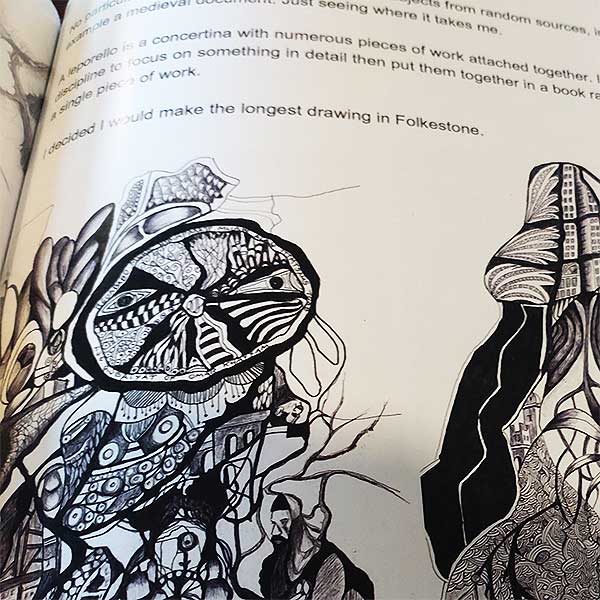
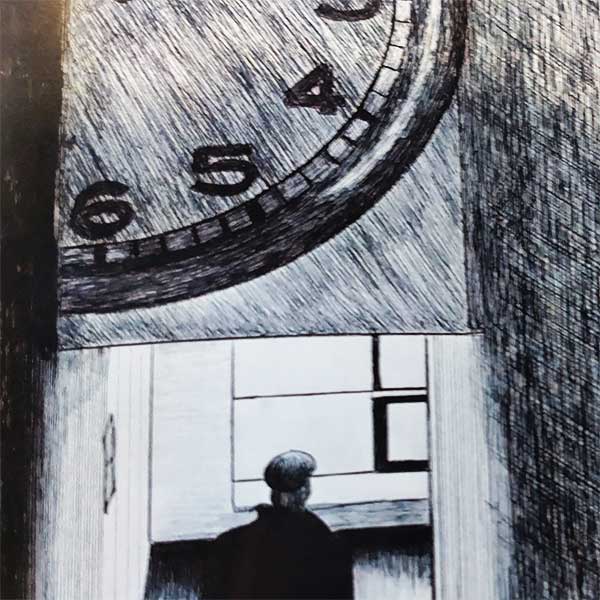
Different styles came about through experimentation. I didn’t have a plan. Collage just ‘appeared’. I found a book on biro art and still find that a very satisfying medium. Zentangles came from a studio visit in Toronto. Drawing from nature came from reading an article in The Guardian’s nature diary by a woman who challenged herself to draw something natural in her garden each day for a year and display them in a leporello/zigzag sketchbook.
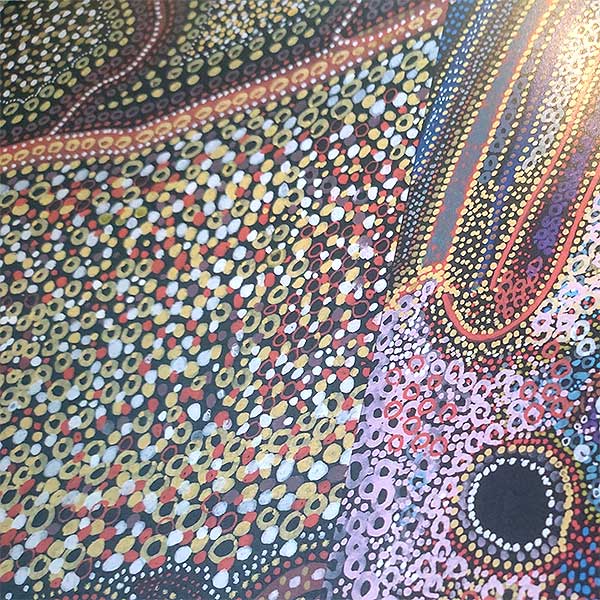
Acrylic/alcohol work came from a “30 artistic things to try during lockdown” Guardian article and my Aboriginal style art came from visiting museums in Perth, Western Australia.
Fluid in the sense that they flow through me. I am the river.
- MP) How did the Aboriginal art phase come about? Did you say that you appreciated that you couldn’t relate to Indigenous Australian art (as they would now call it) in the same way as the Aborigines? But did you feel any kind of communication on a level that had personal meaning for you? More Bruce Chatwin’s ‘Songlines’ than Crocodile Dundee?
- CB) I have a son who lives in Perth in Western Australia, and visited him several times, driving into the barren hinterland and imagining whether the area had Songlines, as in Bruce Chatwin’s book of the same name.
I went to an exhibition of Indigenous art and was attracted to the patterning and the stories leading to the large works of art. I realise the works are not just decorative, and represent aspects of Indigenous culture and deep history.
As for my own artwork on their technique, I thought it would be disrespectful to pretend I could possibly represent the deeper ancient meanings and somehow invent my own.
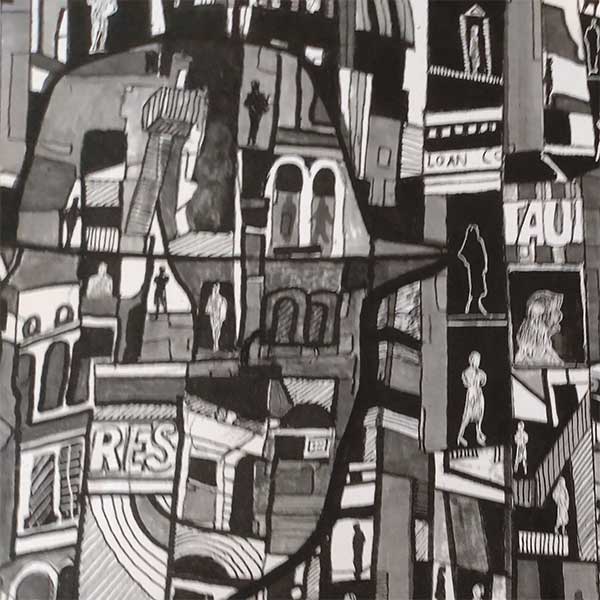
- MP) Some of your figurative drawings have an almost hyper-realism that you might find in, say, Lucien Freud, Ken Curry, Ben Shahn, and Edward Burra. Do you enjoy this kind of precision drawing more than a nebular, “surrealist stream of consciousness”, psychedelic style of painting like your Zentangle drawings? Or do you see these variations as different aspects of your personality?
- CB) I don’t prefer any of my art forms or put them into a hierarchy. I just enjoy doing them at the time. If I happen upon something new, like the alcohol and acrylic medium, I sometimes go back and add it to work I did a long time ago.
As for analysing my personality as to the styles I have chosen, perhaps curiosity and a liking for novelty and juxtaposition are certainly part of my make-up. Pretentiously, I have labelled my artistic efforts JUXTA, because a lot of them are placing unconnected pictures together to make a new piece. Juxtaposition in action?
The Belgian artist Hans Op de Beeck summed up this mixing together of diverse images to make something comical or special.
“The quality or state of being conscious or aware of something. Their mindfulness of the wider cinematic tradition.”
“A mental state achieved by focusing one’s awareness on the present moment, while calmly acknowledging and accepting one’s feelings, thoughts, and bodily sensations, used as a therapeutic technique.”
- MP) Moving on perhaps, we can go back to mindfulness, which, very basically defined, it’s about accepting one’s feelings and thoughts, etc. When we talked recently about mindfulness, you seem to show a genuine interest in the subject. A subject that a lot of people consider as psychobabble. Little more than ‘cognitive therapy with art’.
Is this because you experience some kind of relaxing otherworldliness when you let your imagination and creative energy take you where it wants to flow?
An interpretation of mindfulness is that it’s very New Age and quite frankly faddish. I see the colouring books on the shelves in Smiths and it makes me cringe a bit. Or the books weighing down the self-help bookshelves in bookstores and I think it lacks depth and vigorous insight – it feels like a spiritual hobby. Would you like to comment on my opinion?
You often draw in a busy cafe we both visit – after your croissant and coffee – the leporello comes out. I think that requires a lot of concentration. Are you able to focus on your art in any situation or environment?
- CB) I agree with you that Mindfulness, so-called, and its attendant industry of books and artifacts has become a product of our consumerist age. Mental illnesses as a result of capitalism and the overpowering effect on people’s lives is not to be ignored and individuals need help. However, for me, absorption in my work is my therapy, and a quest to identify the “now” if it is possible. Each mark I make on the paper is in the “now”. So very fleetingly.
As to the self-help industry mentioned above, far be it for me to mock others if consuming New Age ideas if it “gets them through the night” – Lennon.
Drawing cafes, either in my leporello books or the Zentangles, I find satisfying and, in fact, I am able to get absorbed in my work and be aware of how other people use their time, indulging in coffee drinking – a daily view of public chatter or doomscrolling.
- MP) A lot of artists like the Surrealists have used ‘automatic’ drawing and painting as a way of freeing the unconscious – artists like Masson, Tanguy and Michaux see it as a psychological tool to better understand how the mind works.
Before I scare you off, I would just like to ask, have you ever/are you interested in psychology/psychoanalysis, especially in the works of Freud or more recently the Anti-Psychiatrists – Laing, Cooper and Szasz? I think Freud’s thinking/writing influenced a lot of artists and I wondered if you too were inspired by any of Freud’s ideas in any way? Anything to share here? Or perhaps you are more of a Jungian? Could that also be true?
- CB) I am aware of certain artists, such as the ones you mentioned, and also Freudian/Jungian analyses of artistic activity and don’t deny their relevance to some people, but I’ve never been drawn to analysing myself – too busy drawing in cafes!
- MP) Abstract Expressionists though very interested in psychoanalysis also felt an affinity with Eastern religion/thought and looked to the East for answers especially with the teachings of Zen Buddhism. How sincere and long lasting that interest was, is hard to tell – but like the Beats and its sixties offspring counterculture – it was a way to look for answers – that giant question mark: What is the meaning of life? Was there ever a time in your life, past or present, when you felt the need to find some larger meaning in life? Or is that an ongoing quest? Or no quest?
- CB) I have been a member of a philosophy group for about 15 years, led by an Emeritus professor of Philosophy from the University of Kent. Over the years, we’ve studied all the strands of philosophy, from Ancient Greek through to Existentialism, but also other topics such as mortality, aesthetics, and the meaning of life – to no general conclusion. A feature of the modernity of life is to try and “wrap things up”, or any other fundamental issue. I feel trying to find out the meaning of life is like asking, “how long is yellow”, syntactically sound, but semantically impossible.
I feel I need to find a meaning ‘in’ life – at the human everyday level – be it flower arranging in a church, or in my case, the artwork I choose to do, that gives me meaning.
- MP) You attend the philosophy group in Canterbury. Does that satisfy an intellectual itch that needs scratching, or is it part of Chris’s life questioning in another way? Perhaps another influence on your art? If you had to choose a favourite philosopher to spend the evening with, who would it be and why? Were any of the great philosophers tennis players as well?
“Genuine philosophical problems are always rooted outside philosophy, and they die if these roots decay.” – Karl Popper.
- CB) Evening with Heidegger, but not to go on holiday with him.
Briefly, he seems to agree with me/me with him, that we don’t ask to be born, yet we are violently thrust into this life with a musical instrument, which we have to learn to play because there is an enormous orchestra out there playing symphonies and all of the players seem to know what they are doing and harmonising with the rest of the orchestra. What is my role in this as I feebly try to fit in and learn to play my instrument and be like the experts?
As to whether philosophers were artists, I don’t know in the same way I don’t know when you become a philosopher and join an elite club of seemingly serious people existing in an ethereal realm above the rest.
Philosophy means philo + sophia = love of wisdom. Seeking that out is possible at any level. We are all involved in the fundamental questions of reality, morality, and having thinking minds. Philosophy is what everybody knows, put into words nobody understands.
Probably give Schopenhauer a miss. “There are two types of people – avoid both.”
MP)The other subject that I wanted to talk about was the concept/definition of ‘Outsider Art’. As you know, it doesn’t have a very humane background. I belong to an Outsider Art website, and I messaged one of the administrators and asked them, what do you mean by outsider? They sent this back to me:
“Outsider art refers to work created by self-taught individuals who operate outside the mainstream art world’s conventions, institutions, and trends. Coined from Jean Dubuffet’s Art Brut, (raw art), this genre features deeply personal, unconventional, and often unrefined techniques produced by artists who are typically isolated from, or uninterested in, commercial or academic art.”
So do you think it’s about time that fair, open-minded people reclaimed the tainted view that the Art World followers have given the label ‘Outsider Art’ to them? It’s principally associated with the unfortunate with mental health problems. I mean, you don’t have to be ‘mad’ sic estranged from society, and eccentric to want to turn your back on the corrupt, exploitative art world and its emphasis on capitalism and marketing, where a Willem de Kooning can sell for $300 million. Insanity.
- CB) I feel happy with the ‘Outsider Art’ definition, but then I am in a privileged position, as I don’t have to sell my art. I am in a position where I don’t have to enter the brutal, monetised world of commercial art.
Some of my art is quite conventional and would fit into the mainstream and become commercialised, but other things I do are not saleable, and I’m happy with that.
When I was a young teenager, my gran labelled me a ‘lone wolf’ because I didn’t fit in with family and social norms. I found the label a compliment, not a criticism, and maybe that is a characteristic of my attitude to art.
- MP) If you were offered the opportunity for a big retrospective, would you take it – on your terms? As a writer, I’m hardly likely to sell as many books as Richard Osman, but it would be good to reach some readers out there. How important is sharing your art with others?
I know you recently reproduced a copy of a Modigliani for a mutual friend. You sold a life drawing of the guy standing outside a shop that hung in your son’s restaurant in Toronto for a pretty good price, $500. Does that happen often? I think it’s fair to say you enjoy sharing your gift, if that’s a fair comment?
- CB) I have only exhibited my artworks publicly on two occasions, when I first retired. I was part of an art group in those days and we hired a premises in Whitstable. I didn’t like it. I sold three collages for about £300 each, but somehow I felt this wasn’t what I wanted. I felt a bit of a fraud and since then, if people, friends and family, like my work, I prefer to give it away, once I’ve made copies.
The life drawing of the guy standing outside a filling station was a gift to my son. I have no qualms about him selling it for $500.
A retrospective, big or small, does not appeal to me. I waver between fame and anonymity.
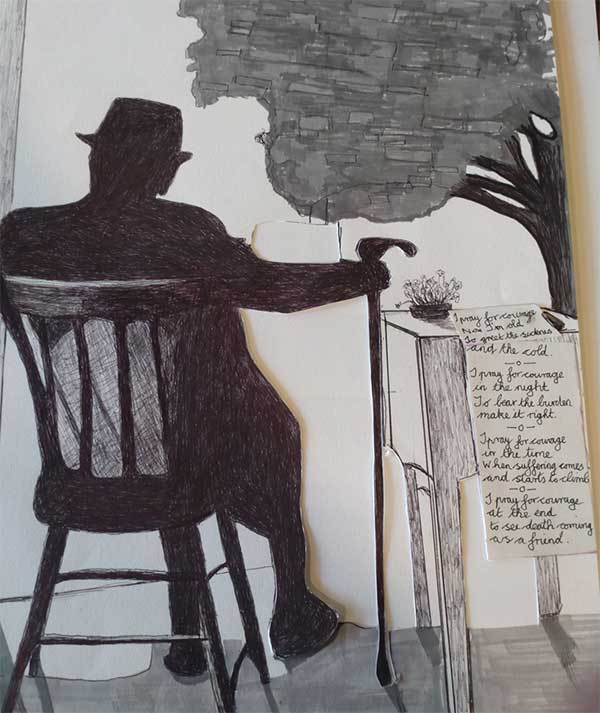
- MP) Chris, I think a lot of people would be interested to know about your connection with Leonard Cohen. His music, lyrics, and how much he inspires your art. Listening to you reciting the lyrics as you point out various Cohen-inspired drawings, almost a reverence, definitely something deep, and if I might say, something very meaningful on a personal level. Am I right here?
Is Leonard’s music and his inspiration perhaps your ‘Dark Side of the Moon’? Somewhere very intense and personal, perhaps a place where some of life’s tougher moments reside, alongside some of the most exalting.
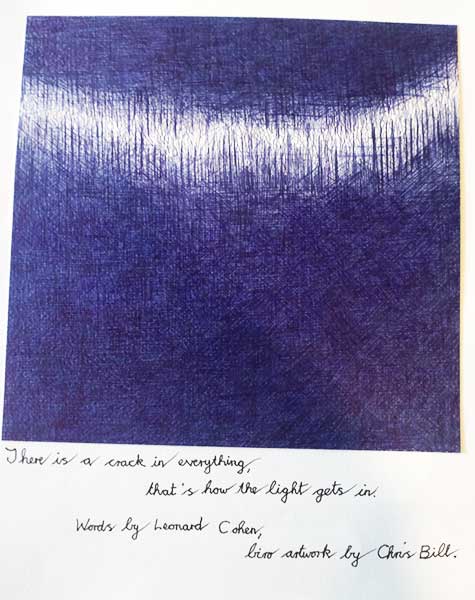
If any musician could touch the listener on so many different profound levels, then it is definitely Leonard Cohen. I have to confess, I think your drawing of “where the light gets in” is one of the most beautiful pieces of art I have seen in a long time. It corresponds perfectly with the song’s lyrics.
Chris, could you say a bit about how Leonard Cohen came into your life and how his music and songwriting inspire you? I think your Leonard drawings are beautiful, and I think many others would agree.
In my opinion, one thing you share with Leonard Cohen is that, in your respective arts, ‘holding things together’ is very important to both of you. There’s fragility and vulnerability that you need to keep in check. Do you think that is a fair comparison? Is Leonard Cohen a place of sanctuary, a healing place? Or just somewhere to sit in the shade and think, relax or meditate? What do you think?
- CB) My attraction to Leonard Cohen occurred and still occurs on many levels, partly because of my Canadian background and being part of the 60s liberation generational experience where his words appealed to the doomed romantic in me at that time.
I have found a lot of wisdom in his lyrics and one-liners which I have ‘itched’ to be turned into pictures. The ‘Where The Light Gets In’ and how best to represent it bugged me for a long time. There are many other lyrics from his songs I can isolate, but the visual language evades me.
I have made collages of Dylan and Joni Mitchell because of the images their lyrics evoke. Cohen is both wise yet vulnerable, as people who wish to quell the disquiet within themselves and still feel unease at the wise saying we’ve internalized.
How the light gets in is quite absolute for me and a useful tool to cut through political and commercial claims. Cohen touches my soul, that inner essence that I feel is the authentic me. I’m old enough and brave enough to admit comfortably to that description.
- MP) Have you always had a love of stories? Did you start reading at an early age? Is reading, from our frequent discussions, a very important part of your life and gives you a lot of pleasure? Are you attracted to any particular type of reading or are you as eclectic in your reading as you are in the variations or styles in Art? Do you like books to challenge you? You quote often from Fernando Pessoa. Do you have a favourite saying you would like to share?
- CB) I have been an avid (overused word) reader of mainly fiction since my late teens. In fact, I have kept a record of my continuous reading since 1999. Of course, I read many hundreds of books prior to my obsession with recording.
I would say my preferences for types of literature are varied, e.g., I’ve read all the Wooster & Jeeves books, yet tend to go for literary novels; Paul Auster, Karl Ove Knausgaard, Javier Marias.
The only challenge I recall recently is my COVID read, Middlemarch, which was not a great pleasure, as with Proust and Ulysses.
Fernando Pessoa, as a poet and a writer, sits nicely alongside my like of Heidegger and the absurdist philosophy of Camus and the bleak essays of Cioran, with the quote, “The trouble with being born”, I guess Pessoa lets the light in on a lot of human follies.
“Some people have one great dream in life, which they fail to fulfil. Others have no dream at all and fail to fulfil even that.”
- MP) Lastly, on the subject of music, I know you said in an interview with your son that your wife is often in the room playing piano while you are drawing or painting. What might she be playing? And if she’s out, what type of music would you be listening to if I walked in now? As the music plays out, how do you imagine, if you do, your art in the future?
- CB) My wife is a very accomplished pianist up to concert level. She loves playing Chopin and Bach and challenges herself with difficult compositions. We rarely share the room when we’re playing or doing artwork – solitude is essential for both of us and we have no problem giving each other space.
Music I listen to? Generally something instrumental and maybe “Outsider“, as broadcast on Radio 3 – Night Tracks or Ultimate Calm.
The future of my oeuvre? I don’t want it to be an emotional burden to my family. When my parents died, they were keen amateur artists – we survivors had the heartbreaking decision of what to keep and what to discard. Mercifully, I will have no control over my legacy.
I must acknowledge my son Alex’s interest in my art. He constructed a website, chrisbill.com, and filmed an interview with me and also had a book printed, The Minor Falls, The Major Lifts, which has examples of all the artistic styles I have tried.
My other sons have had a lot of my work framed and displayed in their homes. My wife Penny has been my audience of one and, being a visual artist herself, has passed a critical eye over my work, and sometimes quite rightly, sent me back to the drawing board!
- MP) Chris, thank you very much for sharing your life and art. I am sure the readers will enjoy it.
.
great interview with a great criminally lesser known artist
Comment by bart on 16 March, 2026 at 6:04 pm