
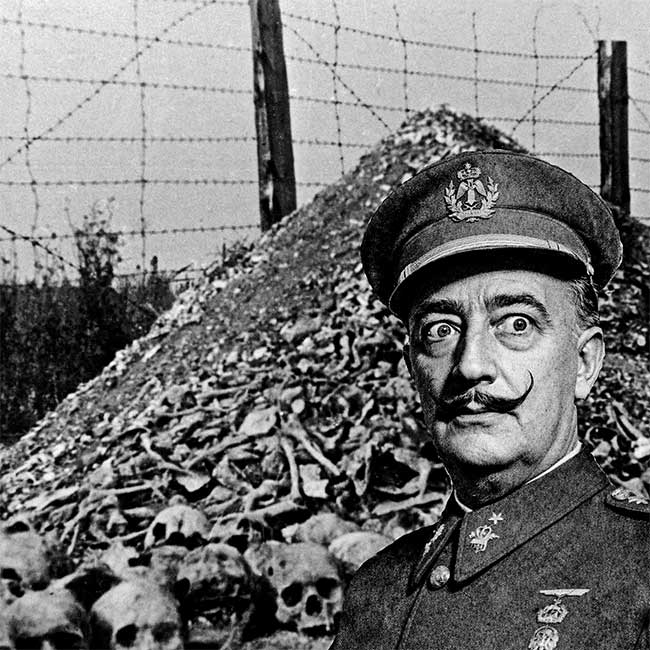
Salvador Dali is too often treated as a harmless eccentric, a flamboyant genius whose political choices are brushed aside as quirks. The popular image is safe and marketable. The curling moustache, the melting clocks, the theatrical interviews. It is all so entertaining that it becomes easy to ignore the darker truth. Dali did not merely live through an age of fascism. He moved towards it. He praised it. He embraced it. That is not a minor flaw in an otherwise colourful life. It is a serious moral failure, and one that cannot be excused by artistic brilliance, eccentricity, or showmanship.
Spain in the twentieth century was not an abstract backdrop for artistic experimentation. It was a country torn apart by civil war and then shackled under the authoritarian rule of Francisco Franco. The regime that followed was not benign. It was calculated, brutal, and merciless. Political opponents were imprisoned, tortured, or executed. Censorship was enforced in schools, newspapers, and public discourse. The arts were monitored, and dissident voices silenced or driven into exile. Fear was not a distant concept. It was a daily reality. And in that climate, moral neutrality was already morally compromised. Public admiration of a regime committed to terror, repression, and the eradication of opposition was far worse.
Dali did not merely stay silent. He sought proximity to power. After the Nationalist victory, he met Franco in person. He spoke of him with admiration. He accepted honours and awards, aligning himself with the regime’s vision of Spain. He cultivated an image that fit perfectly with the authoritarian aesthetic. These were conscious choices. Dali was internationally renowned. He could have lived anywhere in the world. Others, including his fellow Surrealists, chose exile rather than complicity. Dali chose comfort and privilege at the cost of moral integrity.
Some defenders argue that Dali’s fascination with authoritarian figures was purely symbolic, a surrealist curiosity about power, ritual, and hierarchy. This argument collapses under scrutiny. Fascism is not theatre. It is not a costume to be admired. It is a violent ideology that silences dissent, imprisons the innocent, and murders the helpless. When Dali praised Franco or expressed fascination with Hitler, he lent legitimacy to real-world systems of terror. These were not abstract experiments in symbolism. They were real-life endorsements of tyranny.
Dali’s flirtation with fascism began long before Franco’s dictatorship was fully established. In the 1930s, he displayed an unsettling obsession with Adolf Hitler, claiming it was an artistic investigation into the subconscious. His contemporaries were appalled. The Surrealist movement, committed to challenging oppression and convention, expelled him. They recognised a moral deficiency in Dali that went beyond provocation. His fascination was not harmless curiosity. It hinted at a willingness to align with the most repressive powers of the era. History has shown that their judgement was not hyperbolic.
The gap between Dali’s public persona and his political actions is staggering. On canvas, he was daring, revolutionary, and fearless. He pushed boundaries, questioned reality, and exposed the vulnerabilities of the human mind. In life, confronted with regimes that demanded moral clarity, he was cowardly. He did not challenge. He did not resist. He accommodated. He preferred safety, fame, and state approval over principle. This is the true measure of Dali’s character, and it is profoundly damning.
Under Franco, Spain suffered on an unimaginable scale. Families were broken apart by imprisonment, exile, or execution. Writers, artists, teachers, and citizens faced persecution for even the faintest dissent. In that context, Dali’s praise of the regime was not harmless indulgence. It was active reinforcement. His international reputation softened the image of Franco’s Spain abroad. Outsiders, encountering Dali’s genius and charm, might think of Spain as a land of artistic brilliance rather than fear, oppression, and prison camps. By failing to challenge the regime, he became complicit in this distortion.
It is often claimed that art should be considered separately from the artist. In Dali’s case, this argument is hollow. Dali deliberately constructed his public persona. He understood influence. He relished fame. He knew how to manipulate public perception. He cannot claim ignorance of the effects of his political choices. To claim that his art stands apart from his moral compromise is to pretend he was incapable of comprehending the consequences of his actions.
To describe Dali as “complicated” is inadequate. Complicated does not excuse moral failure. Dali had options. He could have remained silent. He could have kept distance from Franco and the regime. He could have used his voice, however cautiously, to express discomfort with oppression. He did none of these things. Instead, he chose admiration. He chose flattery. He chose comfort over conscience. He aligned himself with authoritarian power. That choice defines him as much as his art.
Dali’s brilliance does not erase this failure. Genius does not grant moral immunity. If anything, it increases responsibility. A figure of Dali’s visibility and influence had the power to resist, to challenge, to question, to refuse. He chose none of these. Instead, he lent prestige to a regime that silenced others. That is not eccentricity. That is moral cowardice.
The arc of Dali’s life reveals a consistent pattern. He cultivated images of order, ritual, and hierarchy that harmonised perfectly with Francoist Spain. His embrace of Catholic mysticism and monarchism was not purely spiritual or aesthetic. It fit within the ideological climate of a dictatorship that demanded obedience, reverence, and conformity. Dali made himself useful to power. Whether through conviction or calculation, his choices reflect a deliberate engagement with authoritarianism.
His indifference to suffering is striking. Spain’s prisons were not rumours. The censorship was real. Fear was widespread. And yet Dali’s voice never protested. Instead, he celebrated himself, his art, and the stability imposed by a regime built on fear. Stability achieved through terror is not virtue. It is cruelty masked as order.
To forgive Dali on the grounds of his artistic genius is to mistake talent for morality. He was brilliant, yes, but that brilliance does not mitigate the harm caused by his moral failure. When a public figure of his stature praises a dictator, the effect is profound. It reassures, legitimises, and influences perception. Dali’s fame became a tool for authoritarian propaganda, whether he acknowledged it or not. That is a responsibility he cannot escape.
Inside Spain, Dali’s behaviour sent messages to those who had suffered, resisted, or lived in fear. It suggested that fame and comfort were attainable under Francoist rule, so long as one did not challenge authority. Compliance, it implied, was rewarded. Dali’s proximity to power demonstrated that moral compromise could coexist with social prestige. That is not artistry. That is opportunism.
Dali carefully curated his image as fearless and unpredictable. Yet when faced with real danger and moral choice, he chose flattery over courage. He did not test the limits of bravery. He tested the limits of loyalty to power. His public persona, meant to impress and entertain, obscured the moral cowardice beneath.
Defenders claim he was passive, neutral, or detached. History and evidence show otherwise. Dali was deliberate, strategic, and fully aware of the influence he wielded. His alignment with Franco was a conscious decision, not an accident. It was a choice that secured his position, preserved his comfort, and granted him privileges denied to those who resisted.
None of this diminishes the originality or skill of his art, yet it obliterates the comforting myth that genius excuses moral failure. Paintings cannot answer for the man. The man cannot hide behind the paintings. In the face of a dictatorship built on terror, Dali did not stand apart. He stepped closer.
Salvador Dali chose authoritarianism over conscience. He chose comfort over courage. He chose praise over principle. His record does not vanish because his paintings are admired or because his eccentricities amuse. It remains a warning. Genius and morality are not synonymous. Talent does not absolve. Brilliance does not excuse cowardice.
Even decades after his death, the shadow of Dali’s moral choices lingers. His technical mastery and imaginative brilliance are undeniable. Yet those accomplishments exist alongside an undeniable truth. When confronted with fascism, Salvador Dali did not resist. He did not question. He did not challenge. He embraced. He legitimised. He celebrated. That is a legacy that cannot, and should not, be ignored.
.
by Ade Rowe
.
CHILDREN
the sun flattens the street
and without bothering to think
we lie on our backs
on the warmed-up tarmacadam
as though we’re made of cardboard
used to deliver something expensive
but now bereft of purpose
until a cloud occurs or a car
wants to reverse into the street
in order to change direction
there’s a still from
Un Chien Anadolu
the film made by Bunuel and Dali
just before the razor slides across
the eyeball
but that’s not it, exactly
Dali was more than comfortable
Comment by Steven Taylor on 1 March, 2026 at 7:57 amwith fascism
Great piece of writing Ade..
Dispelling the myth about Dali
Very informative,I hope people will read it.
Thanks for posting it Ade
All the Best
Comment by Malcolm Paul on 1 March, 2026 at 8:03 amMalcolm