
 London’s Last Wilderness, directed by Pablo Behrens
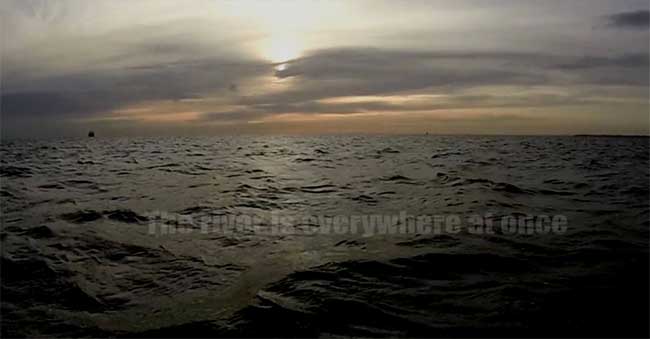
Directed Pablo Behrens has produced an exquisite looking film, which swoops and soars and zooms above the Thames Estuary, and occasionally boards a boat to get a different viewpoint. There are rivulets and runnels, beached barges and moored sailing boats, flights of geese and ducks taking off, and traces of human eneavour slowly disappearing into the mud or quietly rusting away.
Although the film has drawn comparisons with various psychogeographers, for me it is most reminiscent of Patrick Keiller’s Robinson films, particularly in its leisurely pacing and use of literary quotes. London’s Last Wilderness is only an hour-long film but it packs a lot in to that hour.
Unfortunately though, it confuses itself by using several framing devices. The drone footage shows not only instrument readings but has a visitor arriving for the first time from space, discovering the river for himself. He is also in touch with someone on the radio, a distant female supervisor or communications officer who, like the flying machine pilot, has an electronically distorted voice. Despite clear signs of humans sailing and occupied buildings, the pilot notes there are no life forms present on this planet, until a third of the way through the film.
Here we get camera shots of a funfair, dog walkers, hikers and sailors. The boat our explorer is suddenly on is out at sea circling the Red Sands Fort, although he thinks they are immobilised great striding creatures. Then we digress as our pilot conjectures a past war for the creatures and humans, evidenced by rotting industrial terminals, ruined castles and forts, and the wreck of the SS Richard Montgomery, the latter still full of explosives.

This is all an aside really. Gradually we become aware that every onscreen report from the flyby tells us of poor or toxic water quality. We see images of fenced-off areas of river bank where it is forbidden to swim, and we see bones on Deadman’s Island washed out by the constant tides and rising sea levels. Then we get some ominous storm footage, boats riding out huge waves, a strong tide breaking against flood defences, blood-red skys and foggy whiteouts. Of course, this is an ecological film, warning us aginst not only the destruction of this ‘last wilderness’ but also London and civilization itself.
I have no doubts about Global Warming or the seriousness of ecological and social disasters waiting to happen, but Behrens’ film is somewhat clunky. It feels like an art school project, one whose director has tried to put everything in – nature, landscape patterns, global warming, industry, society, ecology, business, a science fiction subtext – instead of simply letting us see the estuary for ourselves and, by the use of storm and pollution footage, work out any ‘message’ for ourselves.
I can’t help but compare it to Roni Horn’s artist book Another Water, and how it’s folio of photographs of the surface of the Thames, plus some autopsy reports of drowned bodies, and a band of short quotes beneath the photos, is much more moving, original and unsettling. Also, Patrick Wright’s BBC series The River: The Thames in Our Time, and the accompanying book (whose first two parts cover the same geographical area as London’s Last Wilderness) which is a straightforward documentary that tells us much more.
I so wanted to like this film. The Guardian gave it a rave review, the trailer is great, I like the Thames and have sailed around a rusting Mansell Fort, the slow elegaic tone is deeply engaging, as is much of the visual content. But we didn’t need the sci-fi overlay, and the sound design does a lot of the work in making the film seem prophetic and gloomy. (Put a different soundtrack to it and I reckon much of this film would appear quite jolly!) Really, this film needs to say less and show us more. Show not tell remains good advice.
.
Rupert Loydell
.