
In Christian tradition, the Stations of the Cross commemorate the Passion of Jesus Christ and the moments of his suffering, death, and burial.
The Stations came into being through travellers visiting the Holy Land. During the 12–14th centuries, these provide the first mention of a ‘Via Sacra’ while the earliest use of the word ‘stations’ for a settled route that pilgrims followed occurs in the narrative of an English pilgrim, William Wey, who visited the Holy Land in the mid-15th century and described pilgrims following the footsteps of Christ to Golgotha. Later, during the 15th and 16th centuries, the Franciscans began to build a series of outdoor shrines in Europe to duplicate their counterparts in the Holy Land.
The 14 stations focus on specific events of Jesus’ last day, beginning with His condemnation. They are commonly used as a mini pilgrimage as individuals or groups move from station to station. At each station, a specific event from Christ’s last day is recalled and those present meditate on that event. Specific prayers are recited, then those walking the Stations move to the next until all 14 are complete. The stations are most commonly prayed during Lent on Wednesdays and Fridays, and especially on Good Friday, the day of the year upon which the events actually occurred.
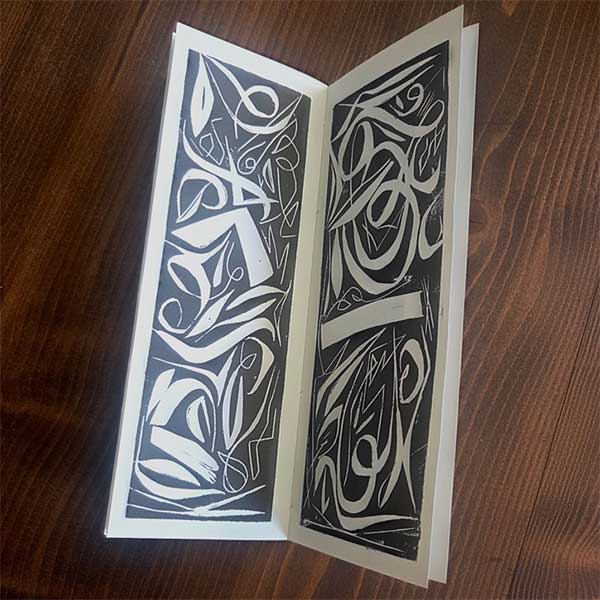
While the Stations project from Dunlin Press forms a non-religious reflection on the fourteen Stations of the Cross while still roughly mirroring the traditional fourteen devotional stages of Jesus’ journey.
The project began as a series of linocuts by Ella Johnston. These translate into linocuts, her practice of making art with the form of a written piece but using the gestures and marks of handwriting to create wordless poems. Asemic writing is a wordless open form of writing with the word asemic meaning ‘having no specific semantic content’, or ‘without the smallest unit of meaning’.
Johnston says of her asemic work: ‘I like the idea of making art with the form of a written piece but using the gestures and marks of handwriting to create wordless poems.’ She also notes that: ‘Outside of my artistic life, I have made a living as a journalist and marketer; writing and clarifying meaning. Using specific words and language to appeal to target audiences. I love the idea of stripping away explanation and specifics, using ‘text’ to create a mood or vibe.’ As she also explains, ‘The non-specificity of asemic writing creates a vacuum of meaning, allowing the ‘reader’ to fill in and interpret.’
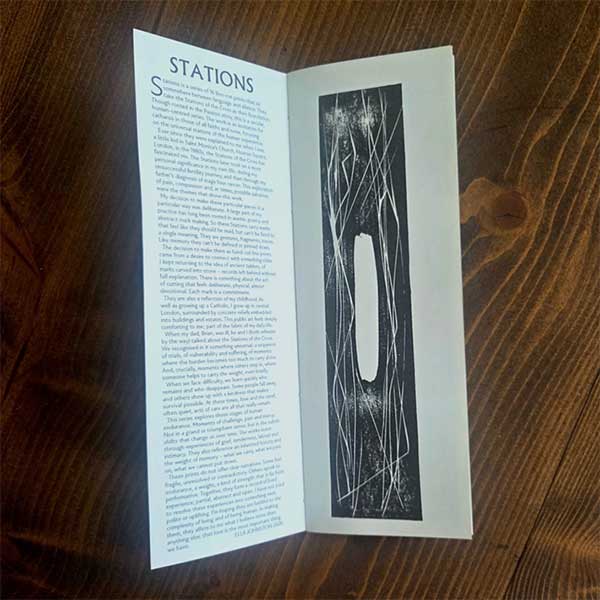
As with these linocuts, she composes her asemic works like a traditional poem in a long column; the visual poems being presented ‘as long thin scrolls that evoke a feeling of a non-denominational religious text’. Her decision to use hand-cut lino prints for this project came from ‘a desire to connect with something older’; ‘the idea of ancient tablets, of marks carved into stone – records left behind without full explanation’. As she notes, these Stations carry marks that are ‘gestures, fragments, traces’ that can’t be defined or pinned down’.
This is appropriate to the themes of life, death, suffering, solace and renewal that form the basis of the Stations of the Cross and which are also the basis for this project. The Stations are ‘a sequence of trials, of vulnerability and suffering, of moments where the burden becomes too much to carry alone’. Experiences of ‘grief, tenderness, labour and intimacy’ that ‘reference an inherited history and the weight of memory’ cannot be ‘fixed to a single meaning’. Therefore, the asemic, abstract and ambient approaches of both Johnston’s ‘abstract and gestural lines and cuts’ and MW Bewick’s music ‘which is mostly an assemblage of single, unrehearsed takes’ are particularly appropriate to use.
The themes explored are ones which connect with Johnston’s work more broadly: ‘I imagine my paintings as spaces bearing the scars of human occupation; once inhabited by conversation and industry, now deserted and slowly reclaimed by elemental forces. Land surrenders to vegetation, weather, and time; rusted architectures dissolve into moss, pools, soil, and mist; infrastructures sag into wetlands. These works propose a speculative archaeology, objects that feel both unearthed and prematurely ancient. They envision a future in which today’s emergency infrastructures have become sacred debris, absorbed into ecological systems and folded into folk memory.’
A pamphlet of Johnston’s work for Stations was published for the Poetry Society’s Free Verse book fair in London on 25 April 2026.
Bewick is a poet, editor, journalist, occasional lecturer, and musician. His Stations album is designed to complement the abstraction of Johnston’s artworks, with fourteen short instrumental pieces, plus a Prologue. While the individual tracks are only numbered – in line with their abstract qualities – the pieces, like the linocuts, roughly mirror the traditional fourteen devotional stages of the Stations of the Cross.
These short, still, evocative, reflective pieces conjure up atmospheres of life, death, suffering, solace and renewal. As emotive ambient soundscapes, they evoke the stasis, stillness, silence, heat, pressure, and oppression of the wilderness in which the events of the Stations occur through a combination of sounds utilising chimes, crackles and plucking, buzzing, blows and drones. Harmony and dissonance both feature in pieces that sometimes build to a climax and others where circling refrains begin and end on the same sound plain.
The music brings vividly to mind the spaces Johnston describes: ‘the scars of human occupation’, ‘deserted’, ‘reclaimed by elemental forces’, surrendering ‘to vegetation, weather, and time’, dissolving ‘into moss, pools, soil, and mist’, sagging ‘into wetlands’, ‘emergency infrastructures’ that ‘have become sacred debris’.
The album was recorded in Wivenhoe, where the couple are based, in early 2026 and was completed, fittingly, on Easter Day. Performances of Stations with live vocalisations by the artist Jo Morrison are planned for later in 2026.
Dunlin Press, which Johnston and Bewick founded in 2015, is a not for profit small, independent publisher and art collective focusing on ‘emerging writers and visual artists whose work is intelligent, experimental, thought-provoking and beautiful, and which for various reasons might prove difficult to place with more established or commercial publishers’.
As a self-funded enterprise, each project they undertake pays for the production of the next. Johnston and Bewick view this as a model that makes them artistically free and not bound by commercial concerns. They see each of their projects as art documents and contemporary artefacts. With this in mind they aim to go beyond the boundaries of book publishing with many of their projects, as is the case with Stations, sometimes incorporating music, installation, painting or film.
As Bewick explains: ‘For Stations, we’re allowing each of us collaborators to bring our own responses to the questions and feelings that the Stations of the Cross arouses. So, the original linocut artworks and pamphlet are Ella’s response; the soundtrack is mine; and in the summer when we move it into a performance-based piece, we’ll have Jo Morrison’s response. We also expect that it will evolve over time and for the specific place we install or perform it. That brings an improvisational quality to the project, which remains in synergy with the way that it started.’
Johnston adds that: ‘This is a very special work for me. It is particularly special the project has been expanded with work from two people who I love working with and trust entirely. So, we also have a soundtrack by MW Bewick … And, very excitedly, Stations is also a performance piece with improvising vocalist Jo Morrison, atmospheric drones by Bewick and live hand-cut lino printing by me. Watch this space for performance dates and venues.’
.
Jonathan Evens
Stations by MW Bewick: https://dunlinpress.bandcamp.com/album/stations
Stations pamphlet: https://dunlinpress.bigcartel.com/product/stations
.