
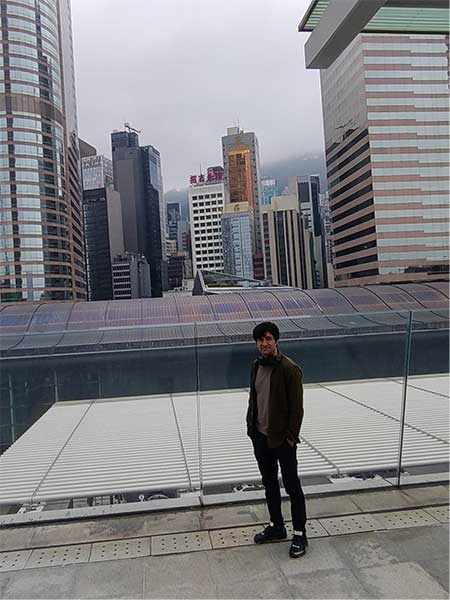
John ‘Outsider’ interview with Malcolm Paul
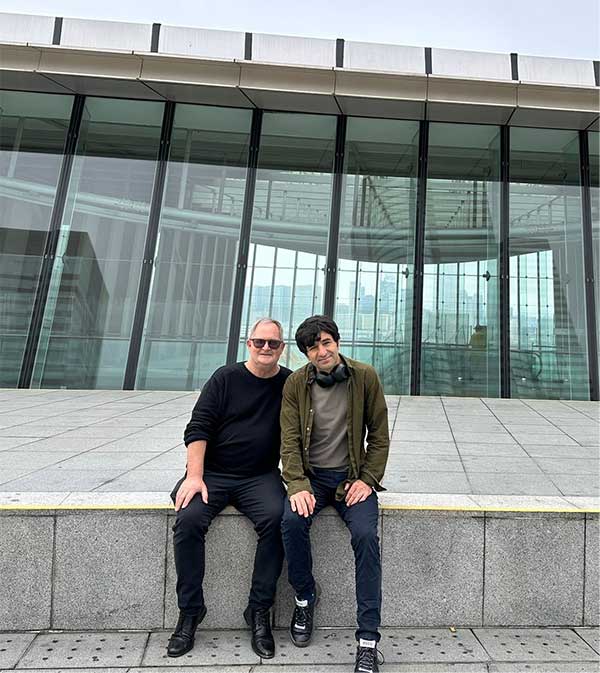
While on holiday in Hong Kong this March (2026) after a brief visit to China and Macau
I found myself with time to kill before my return to the UK. Looking through the Hong Kong ‘What’s On’ page I saw that there was an Open Mic Poetry night the next day – 18th March in Stanley Street. It was a couple of tram stops from my hotel and somewhere in the labyrinth of streets ascending up from the main roadway Des Voeux Rd.
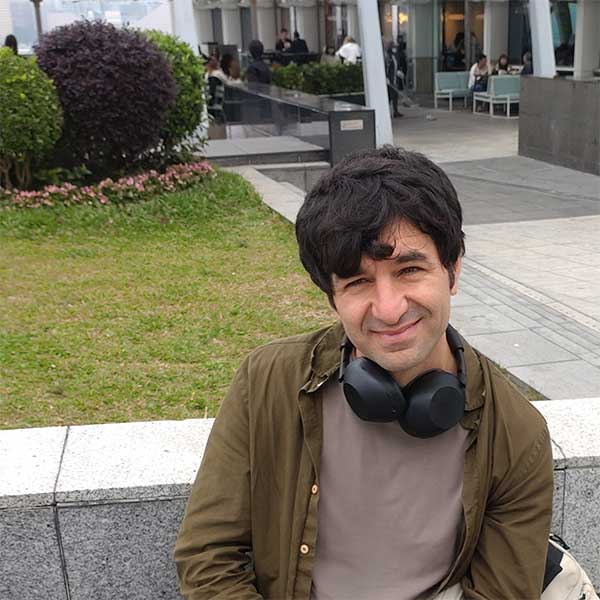
Showing up at the Poetry night I found a fair mix of poets. There were Brits’, one Australian, one Irish, Hong Kong citizens (Chinese?) and Peter the Outsider, who I later discovered was Iranian.
Thinking I might find a writer/artist to interview and whose experience of living in Hong Kong coloured their poetry/writing I took in the people in the room with a mixture of interest and my natural curiosity.
Seeing a man sitting quietly in the corner with a sheath of papers from which he intended to read his poetry I was thinking he was already scoring a plus by not indulging in one of my pet hates, ‘reading poetry off a mobile phone or chromebook’. I like my poetry read the old-fashioned way and off the page. I couldn’t resist going over and commenting on this.
I got into conversation with Peter (the Outsider) and on hearing that he was a refugee from Iran and had lived in HK for 13 years and that he had written 13 books, novels and poetry as well as producing a short film I decided that Peter’s story was worth listening to.
So here it is, in the form of an online interview and the conversations Peter and I had on two subsequent meetings after the Poetry Open Mic evening.
I hope you find John the Outsiders’ story (JO) as interesting to listen to as I found it.
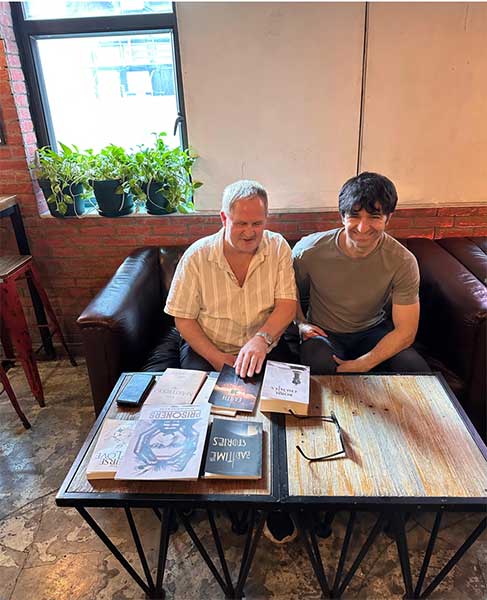
MP) How did you come to be in Hong Kong 13 years ago?
JO) When I was certain that Iran was dangerous (more than usual) for me, I paid a smuggler 15K USD to get me out of the country and he promised that he could take me to Europe with a fake passport. Europe was considered a safe and achievable destination. However, things didn’t go as planned and I was caught in HK before I could fly out.
MP) How do you deal with a prolonged exile?
JO) I won’t call it exile exactly. From the Iranian government’s perspective, I always had the choice to stay and deal with circumstances of my crime. I fled the country as I was sure those circumstances would not be fair.
There are layers to leaving a home country. What you don’t want in the place you are, and what you seek in the destination. I was very clear about what I was running from. I had a typical vision of the destination. I thought I would have a second chance in a safe place to be; a good citizen, contribute to society and progress.
I kind of didn’t get either of them. I was stuck in a limbo between two worlds. Dealing with any unknown situation, requires shortening the time span regarding the future. In the beginning I just needed to survive a few hours, then it turned into days and later on month by month, and finally 6 weeks. (I had to go to immigration every 6 weeks so that I could be detained and forced to be deported.) Still I am unable to foresee a long future and plan for things, but after my refugee status I dared to plan for a year ahead and deal with obstacles along the way.
MP) Is exile the right word? Otherwise what word would you use to describe your situation?
You alluded to moments of desperation. Despair.
Would you be prepared to talk about that happening and how you got through it?
JO) Many might think that when an asylum seeker is out of the country, the hardest thing is to deal with missing home or family. Probably their closest concept to seeking asylum is migration. There is a big fundamental difference between these two concepts while they seem similar in the action. Migration is a choice to move to somewhere better, agreeing to leave things you have behind (knowing you have the option to come back to them) for something better or you desire. Seeking asylum is a desperate move out of fear with no possibility of return.
Many feel discomfort when they realize how important the things they took for granted were.
In the form of asylum seeking, there is no turning back, and there is a new world one is forced to accept, plus, there is a new identity to be adjusted to. That is the hardest step to take.
I have to turn from a man with family, all civil rights, a familiar environment and respected character in a society, into a man with no one, no right, no respect and under the pressures of stereotypes, facing the danger of deportation at any time. Also as an asylum seeker I was expected to react according to social and legal expectations in an unknown place with strange values and behaviour. I was like a goat in a wolf’s body.
Many resist the shift, and some agree to change, but it is a bone crushing process.
MP) Is it still an issue for you?
JO) Adjusting to degrading status is a never ending process. It is like a small cage for a big dog or tight After a while you might get better at dealing with it, but you always know it doesn’t fit you.
MP) Do you get any support from the social services in Hong Kong or does support come from NGOs?
JO) In my recent book (not published yet and title is in progress) I describe that part in detail. Limited support with social services and NGOs, works in a way that never eliminates a problem but deals with the symptoms. It is like having a piece of glass in your eyes and going to the doctor and the doctor gives you eye drops for tears, a pill for the pain and a bandage to cover the eye, but never removes the glass.
I personally refused social service assistance and many NGO helps because of the level of degradation they forced on clients, but many have to play that game to receive assistance. Some enjoy playing the game as they find it a smarter way compared to alternatives.
MP) Persian language/culture/religion? Landscape?
Do you feel alienated from them? And In what ways?
JO) I see any form of forced identity as a branding to enforce limitation, ownership, abuse and control. I was born a Muslim, grew up in Iran and used to speak the language, but I turned my back to all religions. I speak English and avoid Persian movies, music and sometimes even literature. To wash off all the brandings on me took a lot of effort and it is still not finished. Apart from the place of birth, I do not share much common ground with other Iranians. I don’t think, talk or behave like them. In fact it is not only them, most people in the world feel comfortable being part of a group: left or right, Christian, Jew, Hindu…, this country or that country, white, yellow, black,etc. To me any idea that causes separation of human race, consequently creates different values and the moment the group considers themselves with higher value compared to others, they practice violence against them. I think the source of most conflicts are in identity.
MP) Do you feel Stateless now? Does your present ‘stateless’ situation make you feel sad? Angry? Grateful?How many emotions can you feel at any given time?
JO) If we could imagine being free enough to allow people who don’t want to be part of any state to exist, then that would be the states I would associate with.
Emotions are a reflection of the effect of behaviours, words and actions on us. When I receive ill treatment because of my statelessness, it brings temporary negative feelings, yet when I help someone to see another perspective, or when I observe the misery of having a state, positive feelings appear.
I know the dangers of my mindset to the current system, so I understand the devaluation imposed on me. I would be terrified to be valued and praised for being a good obedient citizen in the current world. My nightmare would be to be a good Christian man who is good at his job and follows orders and bombs innocent kids in another country.
MP) When I worked/lived in Switzerland I worked alongside a lot of ‘gastarbeiters’ (guest workers) and Asylum seekers. They lived communally in old barracks or in rundown housing. They never carried photos of their partner/family or children because they said it was too painful and it didn’t help them get through the experience of exile or being separated from their loved ones for nine months (the time they were permitted to work in Switzerland before being made to return home). Is remembering/nostalgia painful?
JO) I can’t represent others. My last memories of the time I was in Iran were extremely Of course sometimes I miss the food, people or unrepeatable good memories, but they have no weight compared to the trauma I experienced.
MP) I found that being in Hong Kong with all the skyscrapers around me made me feel hemmed in. Claustrophobic.
Do you ever feel that way about Hong Kong?
JO) The first year after I was released from a HK prison I lived in a 70 square feet (6.5 sqm), subdivided It was in the crowded area of Kowloon. In that year the city was like a heavy blanket in a nightmare that restrained my movement, vision and even thinking. I am a very lucky man to find a place in a village far away from people and tall buildings. I live close to a swamp filled with birds, mosquitoes, frogs, snakes and all sorts of weird insects. The buildings were not the most annoying thing in the city. I found myself in a rush all the time. One could not pause for a few seconds and enjoy a view or think. The noise pollution, advertisements, announcements, social, facial and verbal feedback were suffocating to me. In the village I am now, I can sit somewhere and think for hours without disturbance.
MP) You said you had created a ‘community’ with your friends – people with a similar status. With a ‘fire’ you sit around and no doubt talking, sharing a drink… camaraderie. Could you describe that community of people, while respecting their privacy?
JO) With the help of my wife, we rented a house (five apartments). We rented the rooms and flats to the refugees who could not afford a place to live with given social assistance. I repaired the place to the best of my abilities and covered the rooftop in a way everyone could use it for gatherings, study, sharing food and drinks. While western media puts a lot of effort into isolation, independence, privacy and walls in fear of security, for people around me the community and sharing became a cure. We feel more secure together and support each other.
MP) It sounds like a situation/environment that you might be inclined to explore in film rather than writing. Any comments?
JO) A film would be an interesting idea but western media seems to be more interested in opposite stories. For some reason Americans hate any idea that promotes community or social based life style.
MP) Like I said when I was living in Switzerland the ‘guest workers’ mainly Yugoslavians lived in barracks and shared everything communally. When I visited them we ate together and they had a little ‘shop’ where they could buy essentials and beer. So after eating they would clear everything away and the chess boards would come out and a concentrated silence would prevail. It’s a picture I still carry in my head.
You recently wrote a piece for a Hong Kong paper about the present situation in your home country Persia, which you have been away from for 13 years. A country once again ravaged by war. That piece was rejected. Why? Does the media think you don’t deserve a voice? How did that make you feel when that happened? Stoic?
JO) That would be a question for the media, but if I am to guess, a few reasons come to mind: After protests in Hong Kong, the media tries to focus on safe and mundane local matters. Also, my points are very controversial and can make many uncomfortable. I attack the common narrative which if it’s understood can disturb the common flow of thoughts. Or, perhaps I didn’t write a worthy piece.
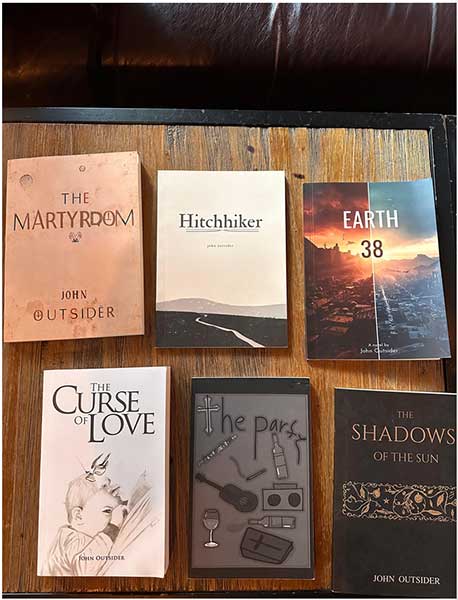
MP) Let’s talk about books.
An author friend of mine Michel Faber once said “all my books are about alienation”.
In our recent talk at the Social Room HK you seemed to be indicating that very often your books are about a duality, a world between two realities, i.e. a good positive world and secondly a contrary view of that same world. Is that dystopian, as in your books ‘Earth 38’ and the animals in ‘Martyrdom’?
Do you like drawing comparisons between how you would like the world/or your life to be?
JO) I describe a world we think we are in and a world we think others (enemies, neighbours, aliens,…) are experiencing.
I believe humans naturally are very hard to control. Therefore the ones in power try to separate them into small groups and often against each other, so they can deceive and use them for “greater purposes” (of which the ones in power are usually beneficiaries). In order to divide people, we need to convince them that they are different and they are better or the right ones against the others. Here comes the identity and branding.
For example, the USA now is divided to right and left, both think they are right and there is no negotiations between them. So they fight each other and consider each other as enemies. While if that label did not exist, they would realise how much they have in common. All of them want a stable country, security, less crime, well paid jobs, healthcare, no corruption in system…, but the label blinds them to things in common and they always end up arguing about minor contradictions like: abortion, gun ownership, migration and maybe two or three more topics which really don’t matter much or could be negotiated if the focus was unity.
In my books I try to reveal these fake identities and challenge the concept of “enemy”.
MP) If you have a common theme/thread, what do you think it is?
JO) Looking at things from an extreme other perspective and then imagining all the ways one can see a situation without letting the identity react to it.
MP) In ‘Enemies’, which is a large book, you put three different stories. Could you say something about how that came about?
In terms of fiction, is ‘Enemies’ your magma opus? Or will you in years to come, write a book that reflects back on a life lived?
That would be your magnum opus yet to come?
JO) I was born at the time of the Iran-Iraq In the news, stories and movies, Iraqis were pictured as ugly, evil monstrous losers that we booed. Also, in the news we were told Americans and Israelis are monsters. Then I ran away from Iran and I saw Iraqi asylum seekers who were very similar to me. I saw movies that portrayed Middle Easterners as a bunch of savages (Team America is a children’s movie confirming that idea). Then I heard how people thought about Iran and the Middle Easterners and saw their reaction to my response to “Where are you from?”.
The idea of the enemy is installed in citizens’ heads to monsterise another group of people therefore to justify any form of unjust behaviour against them.
In the book Enemy I tell the story of twin brothers who get separated and end up in enemy countries. I try to explain that the identity pushed by the leadership does not represent a true self.
My major was not literature so I can’t tell if any of my works are a masterpiece. Especially, considering my lack of vocabulary and techniques to make writing more soul touching.
I don’t consider myself as a writer or even a poet, I see myself more like a story teller with some humour, who is trying to share his observation after seeing both sides of the battle ground.
MP) Your short story collection ‘Bedtime Stories’ seemed to be more personal.
Dealing with personal relationships, perhaps ones you’ve had?
Do you find it hard to write about yourself and your personal life directly or indirectly?
JO) “Bedtime Stories” are more like the Black Mirror” TV series . I try to picture things that we are desperate to ignore. I wrote my personal story “In Escape to Prison” and then when I heard the feedback of the readers, I realised that I didn’t communicate the points I had hoped. I mostly satisfied the narratives or stereotypes people had in their mind. Therefore, I decided to remove that book from the platform and write directly about the points through fiction where readers would not picture me, but themselves as the protagonist.
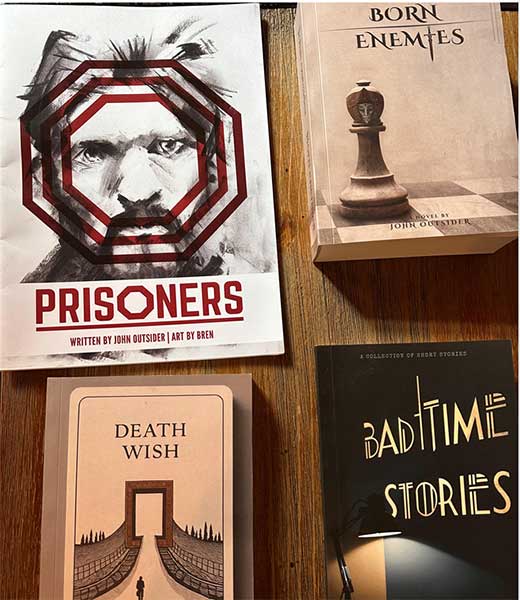
MP) Can you say something about what the stories are behind books such as:
‘Hitchhiker’ and ‘Curse of Love’?
JO) Hitchhiker is a story of a Middle-Eastern looking Western-born man who decides to hitchhike around the country. He faces stereotypes and he also judges people by their colour or shape. In his fight against his perceived identity, he realises the connection between identity and reaction.
Curse of Love was my first story and I was inspired by Christianity. I wrote the book about human focus on things they don’t have and ignorance to the gifts around them in any present moment.
MP) You mentioned love many times in our conversations over two days when we were talking about important things in life. What does love mean to you and how crucial it is to you?
JO) Love has been portrayed as a very positive and sometimes holy concept, yet in my experience it either has not been understood enough or the definition provided to fit something close to it in order to serve a certain purpose.
Nowadays people overuse the verb love. Many refer to the feeling they have when they want to have, own or have control over. “I love these shoes, that car, that pet or person.” Sometimes people use the word to describe their admiration for a thing: “I love that music, that art, that team.”
In these forms of usage, the ego is at the centre and the most important, however, there is another form of love that eliminates the ego: loving children, a cause, democracy, a country, a religion.
I try to be very careful about usage and perceiving love. If love means compassion for others and their wellbeing despite their differences and our comfort, then it could be the solution to all our conflicts, but as long as we deviate from that core meaning, love can be a dangerous tool in hands of the ones who know how to make people extremely emotional about a matter that would make them do illogical and immoral actions.
MP) It may sound like a rhetorical question but I don’t think it’s a given that people
actually ask themselves a question about love and the part it plays in their life.
JO) In my experience one starts asking questions when the identity and the structure of beliefs is shattered. I didn’t question God until I saw prayers were not answered, evil ones got rewarded, innocents punished in the name of religion, the most heinous immoral actions were committed. Facing death is another event that makes one rethink.
When the self that I was told I am, was shattered, then in detention there was a long conflict in my head fighting against accepting that I was wrong for my whole life. When finally I accepted that I was wrong about being a Muslim, Iranian, existence of God, importance of law, reality of social values, reality of financial and social goal… then there was a long silence. I had a choice to rebuild the past structure and hope the next time it would not be shattered, or build something new, which required examining all the stones and bricks carefully. I had to think about the meaning of each concept before placing them in me.
Love was one of those concepts that took very long to replace as it was buried very deep in my psyche.
MP) Are these thoughts a result of your life experiences? Dream and reality? Optimism and pessimism? Are definitions important to you?
JO) Definition and my understanding of each concept is very important to me.
MP) Are they defining what is happening to you?
JO) I don’t see it as necessary. The moment I try to define what is happening to me, I try to limit and control it and by that definition I end up defining myself and limiting who I am. I believe what is happening to me is just a happening, and it doesn’t need any walls around it so others could point at it.
MP) Does being an engineer by profession affect the way you look at the world?
JO) Yes indeed. Being able to recognise the patterns and connections between parts in a machine or any system, helps me to recognise the patterns in human behaviour, social structure, scams, religion, law, financial systems and sometimes even the core of universe and nature.
MP) Could you put your finger on one scene in any of your books and say, yes that is remarkable I just got down exactly what I wanted to say in a way that fitted exactly with what I was thinking?
JO) There are many scenes but one that comes to my mind is a scene when the Goat (the protagonist in the book Martyrdom) visits bears and there the bear explains how he controls monkeys. I manage to show how employment, slavery, social status and capitalism are illusions put inside the lower classes heads.
MP) Is there a book that you can say that really worked for you ?
JO) Your question is like asking parents which kid is their favourite One knows that they have a favourite but always avoids that question. My favourite perhaps are “Born Enemies”, “Bad time stories” and “Earth 38”.
MP) Is form/narrative important to you? Would you describe yourself as having a style?
You said in a recent message that:
“Unfortunately I am not a well read person, especially when it comes to western literature. Apart from 1984, Little Prince and a few works of Paulo Coelho.”
Having looked at your books gathered together when we were in the Social Room in Hong Kong it looked like you had a really good grip on how to write novels and short stories.
JO) As I mentioned before I don’t see myself as a good writer, but more of a story teller with a different perspective. Writing for a long time was my cheapest counseling session. Then when some people showed interest I had to take it a bit more seriously.
MP) Where did you learn your writing skills?
JO) I didn’t have any specific education about writing. Usually a story came to me during a nightmare, bad sleep, in the middle of a shower or sometimes under the influence and then I try to write it the way I would tell the story.
MP) From the parts I read I would say you write very much in the style of writers like Emil Zola and the French Naturalists.
“French Naturalism was a late 19th-century literary and artistic movement, spearheaded by Émile Zola, that extended Realism by applying scientific principles of observation, determinism, and heredity to literature. It portrayed raw, often grim, reality, focusing on how environment and biology shape human fate, typically rejecting idealism and romanticism.”
Do you think you have anything in common with the French Naturalists as they are described here?
JO) Unfortunately I don’t know him or his work, but I guess we both are very handsome people.
MP) Have you written a description of living in Hong Kong in any of your books?
Does Hong Kong inspire you in any way?
JO) In the book “Death Wish” the first half of the book describes the life of an asylum seeker in Hong Kong. Hong Kong appears in one way or another in many of my books and poems.
MP) What about films? Do you get to see the new Iranian films?
There seems to have been a blossoming of the Iranian/Persian film industry over the last couple of decades. Or should I say Iranian film directors getting their films seen more in the West. There was always a very active Iranian film industry making great films, master works. But it just didn’t get acknowledged in the wider world, certainly not winning Oscars or awards at Cannes or Berlin. I think Abbas Kiarostami is probably one of the film directors to get the most attention in the West. Would you agree with that?
JO) I stopped watching Iranian movies, music and literature right after I fled the country. Unfortunately, I cannot make any valuable comment on that.
MP) Would you like to share some thoughts on Iranian cinema when you were growing up? We all remember our first film at the cinema and how it made us feel!
JO) My first movie in cinema was about war and how Iraqis were savages and committed war crimes and how Iranian muslim soldiers were brave, moral and smart.
MP) The Pre -Revolution Persian cinema was very productive and saw a prolific outpouring of films by very gifted directors. Do you remember those years or have you looked back on those years as you planned to one day be a film director in a more extended role than you now have in Hong Kong?
Do you have a favourite Iranian film? And why does it appeal to you?
JO) There was a movie called “Shirin Jam”. It was one of those movies that people didn’t show any interest in. It was talking about a factory with a flawed product but instead of solving the problem they would come up with all sorts of tricks to sell the product.
MP) My favourite one is Taxi (2015), also known as Taxi Tehran, is a renowned Iranian docufiction film directed by Jafar Panahi. Panahi, banned from filmmaking by the government.
My other favourite is A Separation (2011), which became the first Iranian film to win an Oscar, yet it was mentioned only once on Iranian TV. Jake Gyllenhaal has said he loves the film deeply and considers Farhadi one of the most influential directors of the past 20 years.
Do you think other than the truly valuable experience of writing books/poetry you would ideally prefer to be making films?
Or would you like to keep all your artistic components separate?
JO) Making movies is my dream but I know that nowadays only some stories, from some people, can be sponsored. For now what I can do is to write whatever is projected to me or through me.
MP) Did you have favourite films growing up? Iranian or international?
JO) “The Matrix” is my favourite movie, however, I enjoy the agent dialogues way more than “Don’t look up” probably would be the second on the list.
MP) If as an author your writing was pictorial – you saw situations/places visually would it be like a natural transition for you to film?
JO) I sense a big difference between Western and Persian literature and thinking. Western writings are very visual and filled with details. In Iran most writings were about emotions and thoughts. When I have a story, the visual of the situation is not the highlight of it but the emotions and thoughts you experience during that incident.
This difference also appears in vocabulary. The English language has a lot of words to describe shapes and forms and that amuses me. When an Italian poet writes about food, I can’t believe there are so many words to describe taste, smell and texture. In the Persian language, especially the older language, there are words describing emotions or specific states of mind and it is very hard to find an equivalent in English.
I wish I could add more visual details to my writing, perhaps it would become a stronger work.
MP) You seemed eager to make a film and yet were frustrated because it’s so expensive in Hong Kong.
You talked about there being ‘film groups’ in Hong Kong – some experimental – who you could possibly collaborate with. Is this not a possibility?
JO) The first time I had a great script “the Race,” I talked to a few film makers and they said the movie will cost 4-20 million HKD. Then I shared the idea with a friend of mine, who was making commercial advertisement videos and we decided to make the film. But later the Covid situation and costs forced us to stop after shooting 30% of the work.
Then I had an idea for a film which did not need many locations and crew. I did 98% of the work on the short film. It could have been done way better if I had the funding.
There is a saying: “If there is a will, there is a way.” But nowadays: “If there is no money, there is no way.”
MP) The Film you have on YouTube is called ‘The Maker and The Doll final’.
I showed it to my friend the author Michel Faber who has a particular interest in film and photography.
If I share his thoughts with you perhaps you would like to respond.
“I’m impressed with John Outsider’s film. He has significant animation skills. The vibe reminds me a bit of Peter Gabriel’s video for ‘Digging In The Dirt’ but of course John will have made ‘Maker And The Doll’ for a hundredth of the budget that Gabriel had….
The philosophy of ‘Maker And The Doll final’ doesn’t resonate with me, I’m afraid. I don’t know how old John is but the notion that women are a bewitching distraction from the deep conceptual truths that we intellectual males must grapple with seems to me very much a young person’s thing”
JO) I am disappointed with myself for managing to impress people only with the financial aspect of the film. Despite the interesting interpretation, it seems I didn’t manage to communicate. In the film, when the doll asks the lady doll about who she is, she responds, “Others”. I tried to portray the concept of “I” and consciousness in a few dimensions and beyond our reality to point out that we are able to have a journey within to recognise the depth of that “I”, and how we get distracted with ‘others’ and external journeys. It is unfortunate that the interpretation insisted to limit the dimensions to our current reality and limit my point to a box as small as gender.
Of course there are artists who can make the film in a better way to make the message more clear.
MP) Let’s talk about poetry.
John, at what age did you start writing poetry?
JO) In Persian language I started writing poems around 14, but two of my older brothers were way better poets and their criticism was discouraging. Later on, reading amazing poems from Persian poets convinced me that I won’t ever be as good or get any attention, that was while I was very good at comedy. I stopped poetry until the age of 19 when I had a crush on my ex wife.
MP) Do you have any favourite poets?
JO) Romy, Sadi, Omar Khayam and Obeyd Zakani.
MP) Internationally?
JO) unfortunately I don’t know international ones, but Sam from Peel Street is great.
MP) Do you publish in the Peel Street anthology?
JO) Yes, a couple of my works were in their recent anthology. They were kind to include me but cruel to charge me for a copy.LoL
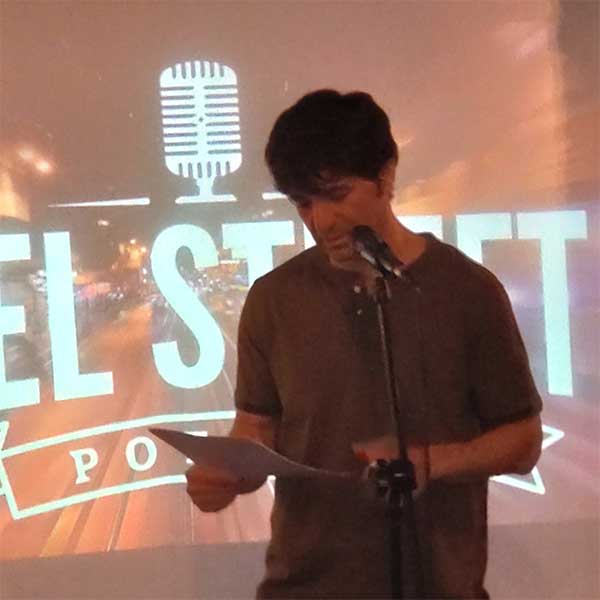
MP) Your poem about the American Tomahawk missile that killed at least one hundred sixty eight school children (Verified videos and satellite imagery show extensive damage around the Shajareh Tayebeh primary school in Minab), which you read aloud at the Open Mic Poetry Night, was one of the most – if not the most – moving experience at a poetry reading I have ever had.
Your tears flowed. It was heartbreaking. The room was in silence. Tears shed by others.
Just you, John, up there with your papers trying to bring to us through your poetry the overwhelming tragedy of so many innocent lives lost! A war crime. A crime against Humanity.
This reading is on Instagram along with quite a few recordings of you reading your poetry at the Open Mic night at the Social Room in Stanley Street, Hong Kong.
I would recommend that people listen to it.
Does that make you feel that poetry can truly change people and through those people possibly change the world?
JO) To change the world, one needs to know the world, it is impossible for one to know the truth about everything. Even if one knows the truth about the world, then one should be able to imagine a better world and plan and take steps toward that vision. To me it seems impossible and any sort of forcing will cause breaking and damage. Therefore I focus on knowing myself and trying my best to be the best version I can be.
Sharing a poem might not change the world, but maybe change the way people look at an incident or raise a better question in their minds.
MP) I would like to quote from the English poet W H Auden writing before the Second World War.
W H Auden wrote: “poetry makes nothing happen” in his 1939 poem “In Memory of W B Yeats,” suggesting poetry does not cause direct, physical change like political actions. Rather, he argued poetry survives as a way of thinking, influencing lives by providing a “mouth” and a “way of happening” for emotions.
Do you think in your life, with your experiences, that poetry can change anything?
JO) Poetry is a way of thinking. It is a tool. On a good day, in wrestling with words, sometimes a rhyming one that captures more parts of a brain, brings clarity. However, poetry might be used by skillful ones to brainwash or promote evil ways of thinking as well.
MP) Is it perhaps that we can change ourselves and then the world around us?
JO) To change oneself, one needs to have an idea of who one To get that idea, one needs to understand the words and concepts. Poetry does not change a person, but if one wants to change, a suitable poetry might make the transition smoother.
MP) I’m also a poet so I could ask myself that same questio
Could we talk about your War Poem in particular?
On the death of school children killed by an American Tomahawk missile
300 plus eyes were shut
300 plus life lines cut
They won’t see new day, new year
new season, next summer
They will never know
What they have missed
They will never know
Why they were punished
170 kids
170 7-11 years old girls
just buried
What kind of a man says
there is file and a blackmail
or a religious mission,
that I can’t fail
So let’s murder
170 kids?
170 kids?
To save a belief
or to save a name?
I don’t get it
I don’t understand it
when I see kids
Not even mine
strangers
On street
And I’m ready
To give my life
To save them
To protect them
I
A serious man
I mock myself
Make faces
To make any kid laugh
To stop them crying
170 kids
For god sakes
170 kids
170 souls
deprived their right
to The gift of existence
their chance to be
to feel beauty
to fall in love
to play,
to win, to lose to fall
all stolen
And they didn’t say anything
They didn’t get the chance
To do anything
They didn’t have political opinions
They didn’t take sides in any war
They didn’t get to chose
What they wear
What they eat
Who they are
They were just kids
They were just kids
And now killed
Yes I know
They could become assholes
They could become teenagers
They could become monsters
With opinions
sudden changes
and mind games
They could become religious
or even fanatics
But it was their chose
It was their land
It was their life
And you you capitalist monsters
Had no say
in what they wanted to be
Or how they end up being
And now
We will never know
What kind of flowers
The burnt forest
Could bloom
We will never know
About their words
Their growth
Their laughs
Their jokes
Their plays
The next season
In the new year
Or decade to come
Their blood on your bombs
And their souls
I don’t know
But the soul of their parents
Their friends
In hell
And no reason
No justification
No Policy
Or Agreement
Can make it just
Despite your shouts
that you had to bomb them
For their nation
While you don’t even know
how to pronounce
Their names.
You are a very different poet – your work is a ‘cry from the heart’. Maybe more.
Louder!!! A ‘scream from the heart’?
As a poet you ask your poetry to carry a lot of life experience. Often pain. As if it were carrying you out of a burning building. Or poetry was a float thrown to a drowning man/woman. Or you were freefalling toward the Earth.
“Their blood on your bombs
And their souls
I don’t know
But the soul of their parents
Their friends
In hell
And no reason
No justification
No Policy
Or Agreement
Can make it just
Despite your shouts
that you had to bomb them
For their nation
While you don’t even know
how to pronounce
Their name”
Is Poetry the most immediate form of expression for you?
JO) It would really depend on my physical and mental state. If I am drunk, poetry is the first reflection, but on other substances, short stories. Sober and nervous a joke is the most likely response, sober and angry, perhaps an article, philosophical or political argument shows up.
Music and natural elements like fire, full moon, singing birds or frogs are affecting the work too.
MP) Do you feel you are exploding with emotion? Letting all your feelings out!
When you are reading your poems as you did when we first met at the Social Room you were so absorbed as if you were ‘at One’ with the poem – totally immersed in what you were doing. Nothing could distract from the message.
JO) If I want to give it a picture, I would say I feel like a star way bigger than the sun but far away. I see a lot and I burn brighter yet I end up being a shimmer in a cloudy I know it won’t do anything and no one will look up, but that’s the only thing I can do.
MP) Do you find it hard to get up on stage and read? Or is it something you do because you just have to feel engaged with others?
JO) Luckily I don’t have much stage fright. Standing on stage is way harder when I do stand up comedy. Usually crowds are not very supportive or forgiving when it comes to comedy. Poetry reading feels like a piece of cake compared to. I share my stories, poems and other works without expectations. I feel as if it’s my duty to share what has been projected to me.
MP) What is your relationship with the listeners?
JO) What I hope is true, is that a listener might find a better question or answer after being exposed to my experience or perspective. But in reality I feel like people are there to be entertained (some people can be entertained by exposure to others’ pain). So I don’t bend my words to please them. I shout the poem out, the same way it was shouted in my brain.
MP) Have you published your poetry? If so, where, and is it available?
JO) I published one short version “misplaced words of a displaced man”. But the rest of my poems will need a proper editing, polishing and selection before I could publish. Unfortunately I don’t have the funds or enough support to do it fast but I am aiming to do short versions once in a while.
MP) Would you like the opportunity to reach a wider readership in the future?
JO) Of course, but as long as it’s not forced or altered by some company or institution. If I can share my work with more people, the way it is, it would be a dream come true.
MP) John I hate to bring up the subject of the future. I know a lot of people will perhaps be wondering what comes next. I know Hong Kong refugee law has never allowed you to work in the last thirteen years and that continues even when you have a confirmed status.
That must be soul destroying and takes away any individual dignity and purpose.
I’m sure having free time to write is a good thing, but being accepted by the HK literati is probably very difficult – as is being accepted by any literary milieu worldwide and earning a living is negligible, almost impossible and self publishing is expensive. How do you manage to publish and distribute your writing?
JO) I have published 13 books and I think I’ll have only two or three more in me. My publications will not be for financial reasons. At this moment talking about the future is a privilege I don’t have.
MP) Do you wake up to a lot of questions everyday?
JO) I am generally a happy person. I usually wake up grateful for being alive and have another day to live. Just in the last few weeks I wake up to check the headlines about the war, otherwise I am happy to wake up hungry or with the occasional morning erection for life.
MP) I really hope that something will work out for you in the future. But meanwhile I hope you will continue to keep writing, performing and filmmaking because without creative people like yourself the world is a poorer place in every way.
.