
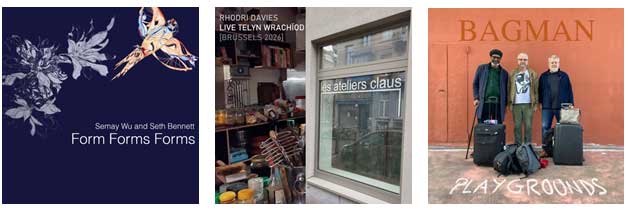
Forms Forms Forms, Semay Wu / Seth Bennett (Scatter Archive)
Live Telyn Wrachïod [Brussels 2026], Rhodri Davies (Scatter Archive)
Playgrounds, Bagman (Scatter Archive)
Forms Forms Forms brings together cellist and media/sound artist Semay Wu and bass player Seth Bennett. Wu has been producing solo work since 2022 (you can check out, for example, her albums Unsteady Stones and Sharmanka on Scatter Archive). She has also created video pieces and installations. During the pandemic she set up, for Manchester, Sounds Like Scran, ‘an audio cookbook that gathers audio (and video) postcards of recorded stories, memories and daily life, experienced through food’. Bennett found his way into music through punk. A self-taught musician, he played in numerous bands while, at the same time, developing an interest in free jazz and improvisation. He gigs regularly and widely (he toured India in 2024 with the jazz quintet MoonMot), not least of all in Dundee, where he’s based. Both artists play together as part of New String Collective, a Scotland-based string orchestra that explores the grey area between composition and improvisation, and – again, you can check it out on Scatter Archive – Ubu Warp Cheer.
I like their album notes, which describe the music of Forms Forms Forms as ‘pure play between cello and double bass’. This is very much the feeling you get from listening to it: an imaginative dialogue in which ideas are spontaneously developed until they spark new ideas all, as far as is humanly possible, free from extra-musical associations. I say dialogue, but sometimes it goes beyond that and you get the feeling (it struck me particularly, in the last track, ‘Alive’) that you’re listening to an impossible nine-string bass instrument (I think Bennett plays a five-string bass) played by a four-handed musician. I love the way the titles of the tracks together form a poem which exactly describes what’s going on: ‘Embedded / In the material / The form reveals itself / To experience the freedom / Of not giving a name to things … No waste / No loss of energy / Alert / Alive.’ It’s the kind of description that might raise eyebrows, as it sets a high bar. Wu and Bennett, though, clear it comfortably. This is the work of unselfconscious musicians who clearly lose themselves in what they do, feel the elation of finding the direction the music takes flowing through them and want to celebrate and share the experience. Great stuff.
Harpist Rhodri Davies is a musician who always defies any effort to pigeon-hole him. A presence on the free-improvised scene, he has also worked with musicians as diverse as Charlotte Church and Éliane Radigue, not to mention being a member of the alternative rock band Hen Ogledd.
The original album, Telyn Wrachïod, came out in 2024. It’s music defies any attempt one might make to pigeon-hole it: semi-improvised, it’s based on melodies the way jazz can be, but without sounding a bit like jazz. What we hear is built out of deceptively simple, folk-inflected diatonic ideas. These, he often builds into a complex, mesmerising, minimalist wall of sound, but – be assured – nothing outstays its welcome. It’s all played on a telyn wrachïod (hence the title), which literally translates as ‘witch’s harp’, the Welsh term for what is known in English as a bray harp, so-called because of the wooden wedges that are driven in at the ends of the strings, which create a buzzing sound which has been compared to the braying of a donkey, although the effect can, in fact, be very expressive. What we get here, with this recent Scatter Archive release, is a live performance of Telyn Wrachïod, given in Brussels, in 2026. It really is worth checking out, even if you’re familiar with the original album: there are tracks from the original, but the versions performed here are generally longer. There are also new pieces, too, plus two tracks entitled ‘byrfyfyr’ or, in English, improvisation.
In the album notes, Davies quotes a harpist from the Tudor period requesting a harp be made with ‘precise, angled brays speaking every profound feeling’. I reckon Huw Machno would have been delighted with the machine Davies is playing here, if Davies’ playing of it is anything to go by.
Bagman is the collective name adopted by the trio of reed player Sture Ericson, drummer Raymond Strid and piano/keyboard player, Pat Thomas, here playing grand piano. The recent Scatter Archive release, Playgrounds (I really like the apt simplicity of the title), is a recording of their second gig, which took place almost eight years ago at the Brötz Jazzklubb in Gothenburg, Sweden.
What they create together is the kind of improv which owes as much a debt to the European post-war classical avant-garde as it does to jazz. And, from the beginning, one is aware that, although it never stands still, this is the kind of music that is not afraid to suspend more conventional dynamic forward movement in order to develop other aspects of musical space, taking time to explore sonorities: music in which, at the same time, you’re always acutely aware of the intense, intuitive interaction that’s going on. I loved the ending of the first track: it has that feeling of rightness you can only achieve in a group when you’re all totally immersed in what one another is doing (how did Semay Wu and Seth Bennett put it? ‘No waste / No loss of energy / Alert / Alive’). I liked the second track, too, with Ericson’s sustained sax tones set against Thomas’ (prepared?) piano bass note fragments, interspersed with Strid’s percussive interventions, all of which finally takes off into a soundscape of faster-moving abstract shapes. In the third, Ericson’s sax gradually emerges from a purely noise-based sound-world, sustained tones little by little giving way to melodic fragments which become progressively more animated. The piano – played conventionally, at any rate – only comes in literally at the last minute, with a playful, stride-like passage of dense chords reminiscent of Thelonius Monk.
A note on the name. From what we’re told and as I understand it, ‘Bagman’ is an imaginary character which sneaks around collecting ‘secret sounds, obsolete objects and wasted visions’ to put in its bag. It materialises at gigs in the tripartite form of Ericson, Thomas and Strid, pulling its collection out of the said bag in the form of music. It’s a powerful idea: as Sartre might have said: in the end, we are what we chose to put in the bag. And I now have an imaginary graphic novel lodged in my head, featuring these three sometimes as themselves, at others – at night, perhaps – morphing into some sort of tripartite super-being that skulks in the shadows of some fictional Latin quarter, snatching whatever takes its fancy to stick in it’s bag. Since I’m not a graphic novelist, it’ll just have to stay in the bottom of mine.
Playgrounds is really quite something – and if you’re new to Bagman, it’ll probably get you seeking out their previous release, Bagman Live at Café Oto on 577 Records.
.
Dominic Rivron
LINKS
Forms Forms Forms: https://scatterarchive.bandcamp.com/album/form-forms-forms
Live Telyn Wrachïod [Brussels 2026]: https://scatterarchive.bandcamp.com/album/live-telyn-wrach-od-brussels-2026
Playgrounds: https://scatterarchive.bandcamp.com/album/playgrounds
Bagman Live at Café Oto: https://577records.bandcamp.com/album/bagman-live-at-cafe-oto
.