

Trestle Bridge, Venice, May 2019
From rain sweeping a pond – a beginning later revealed as probably the furthest ending[i] – a profound foreboding permeates Don’t Look Now. On a first viewing, this foreboding might be delayed, since at 40 seconds[ii], the film’s equivocal title appears in innocuously blue lettering. Even the bell tolling behind a grill as the camera next tilts upwards, is offset by a man humming. Soon, a girl in a red mac crosses a field, a white horse cantering across the background to whinny away any symbolic intention. A boy approaches, weaving through tree trunks on a bicycle. Back and forth, the two children play self-absorbedly across a mellow rural scene, large garden or field, to a poignant theme on piano – performed as if by a child practising.
Although probably filmed in December 1972, these scenes look autumnal, the low-angled sun providing warmth, the breaths of the children only faint. This garden is big enough to be a landscape, an autumn-into-winter Eden . . . Nothing is what it seems[iii] . . . the absurd interjections of an Action Man figure in the clutch of the girl: ‘Mortar attack! Dig in!’. . . the red and white striped ball in the green and the water . . . a precarious footbridge . . . I almost can’t bear to rewatch this opening: its lazy Sunday descent into primeval tragedy.
That our garden in the 70s was 20 feet long with wire fences delineating the plots of neighbours, does not make the scene hard to relate to. Nor that only playing in the road or on building sites could have presented any equivalent danger for me and my younger sister – the same ages in 1972 as the children in the film. I feel the quiet and the threat as both parent and child.
Although by 1973[iv] the child’s ball was almost a cliché in horror and giallo[v] – such hindsight is overruled here by the vivid tactile presence of the natural world enclosing it. Like the girl’s red mac, the ball is a plastic alien element . . . which for the first quarter of Don’t Look Now becomes an idée fixe. A similar ball is played with by the happy or unsettling child in the children’s ward next to Laura’s day room in the hospital (00:19:11). The original ball itself almost seems to rise from Laura’s travel bags in Venice (00:26:09) – as if by the air pressure of being underwater – to contest her new-found sense of spiritual reassurance? Does she smile from relief or wistfulness? Or is it sign of some strange possession? Like so many places and characters throughout the film, their presence can be benevolent and menacing at once. The blind woman (portrayed by Hilary Mason) is the most extreme embodiment of this – a gateway to heaven or hell. When the two sisters are found laughing almost hysterically (00:42:28) in their room, is it over some innocent reminiscence or something more sinister? I couldn’t help thinking of the two shrunken old people cackling away in Mullholland Drive[vi].
There is much that is proto-Lynchian[vii] in Don’t Look Now, but Roeg’s dread and grief (horror is never the correct word for Don’t look Now, even if it has a couple of horrific moments) is closer to ordinary, believable life. In the outback of Walkabout, (1971) Roeg’s surreal flows from the natural world and relates clearly back to it; while even the murky war-torn nocturne of his BBC film Two Deaths (1995) – more psychodrama than anything else – is clearly within this world. Lynch’s sensibility is determinedly further over the edge.

Venice restoration work, May 2019
The enigmatic details which abound throughout Don’t Look Now remain unsettling because rational explanation never quite covers them. You can believe, for example, that the blood red amoebic shape which extends from the red hood of the figure in the church (00:04:58) is caused by the colourless drink John spills on his overhead projector . . . but since when are slides capable of running like paint? This blur could be a premonition of his blood or the blood of other victims in Venice, or it could be a warning of his daughter’s death. As it roughly assumes the shape of a foetus it could also (or rather) be a throwback to his daughter in the womb, accompanied by a sense of the leaf in the blood[viii]. The ominous music may favour the first reading, but we are inevitably rummaging for possible meanings without having time to labour them. Only during the closing montage triggered by John’s death, does the ‘meaning’ of the red blur sequence (partially repeated at 01:46:50 and dissolving into light) appear more specific or finalised.
There was a width of peace more widely available in the 1970s than most of us can ever hope for now – or not without being determinedly luddite. Some essence of this peace often shines from older films regardless of either genre or pace. Projected by the music, the light, the fashions . . . most of all perhaps, it arises from the attitudes of a vanished way of life? An element of this must be nostalgic – but this is nostalgia in the serious sense[ix].
Fascinated by all artistic processes, my dad was vastly impressed by the skilful way Don’t Look Now, was edited together. It wasn’t however, a film he cared for so much as a whole, tending perhaps to prefer art to be somewhat isolated from life. Don’t Look Now’s spiritual or supernatural insinuations, trespassed too far. He preferred his explorations and promises to stay aesthetic. Yet whatever hazards might be concealed in complex meanings, as with Antonioni’s Blow Up, (1966) – a particular favourite of his – he never entirely gave up on the ideal of art as a lifestyle . . . to be able to live in that fascination: photographer, painter, writer or church restorer, it didn’t matter too much. To get away from his working-class background, to elide the daily tedium would have been the primary appeal; to be free to follow your artistic desires. Naturally the wealth and privilege of the Baxters life would also have appealed to him.
Although we both agreed that the arts should be central to life, and that the decline of their cultural importance (in terms of seriousness, not popularity or entertainment revenue) has contributed to the sorry state we are in, in contrast to his view, I’ve always felt that the catalysts of art: light, sound, colour, form, movement and so on, as well as having an instinctive power exceeding that of rational language, reach their most valuable when they clearly relate to things beyond themselves, when they also encompass or suggest their way into the oceans behind religion and philosophy. You need both thought-provoking style and deep wells of content for such art to emerge. Few films achieve that balance as well as Don’t Look Now.
Although it provides a potential to be mined, the Daphne du Maurier short story[x] on which the film is based, is minor by comparison – despite that the occasional silliness of its characters authentically conveys the volatility of grief. In du Maurier’s story, the child dies of meningitis – which would deprive the film not only of its hazy implication of parental negligence (for which, at 00:42:47, Laura gently blames John) but also an initial key to the pervading water symbolism – sinking Venice[xi] itself being a major character.
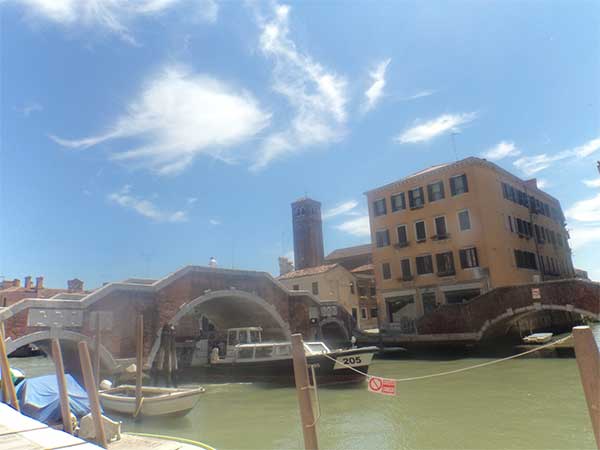
Ghosted light, Venice, May 2019 – heatwave contrast to Don’t Look Now’s winter
When the Baxters first arrive, Venice is only ordinarily wintry in daylight. Menace begins to encroach more inexorably at about 35 minutes – finding an early tunnel when the couple lose themselves in the back alleys[xii]. Here, John (Sutherland) finds a place from the future (00:36:09): “I know this place”. A scene which Illustrates why the best films are made to be viewed over and over: on a first viewing, his recognition is only curious. His and our dread comes later. At 00:37:07, to the relief of characters and audience, the Baxters regain a brighter street fortified by cheerful night-life.
Amid much plot and minimal atmosphere, one interesting moment of du Maurier’s story the filmmakers omit, is John Baxter’s striking final line: “Oh God,” he thought “What a bloody silly way to die….” On the page, this blackly humorous touch has a spark of the gravitas which the story lacks and the film is rich with. Badly done however, in the visual medium, the line might have jarred. Perhaps it was not worth the risk?
Du Maurier’s story insinuates the love scene in two sentences[xiii]. By contrast, in the film, and controversial in its day[xiv], this section lasts approximately four minutes (00:30:13 to 00:34:13) yet is by several calm lagoons the best sequence of its kind I have ever seen on film or television. Despite that Sutherland and Christie were film stars, it features real people, not chiselled fakes. There is nothing either token or exploitational about it, and, crucially, in opposition to the drowning drag of the film’s tragic submergence, it tells an entire warm story itself. It captures the Baxter’s complete past, giving a sense of theirs and other loves through the ages. Skilful, intimate filming and editing, remake the hotel room and bed as a nest or cave. The interlude embodies the best of their love – even as cross-cut details show them readopting to daily life personas with their inevitably fixed attitudes: Laura open to anything which might relieve her grief, John determinedly rational and denying it. Later (00:51:23), John, hoping anger will wipe out all doubts, may protest too much: “My daughter is dead, Laura. She does not come peeping with messages back from behind the fucking grave! Christine is dead! she is dead! Dead, dead, dead, dead, dead!”– yet few would feel at ease supporting Laura’s quailing quest towards a spiritualist balm. Is the drift of descent due to unlucky coincidences, inescapable fate, or supernatural influences?
As with second sight and wider visionary experiences, Don’t Look Now, makes a nonsense of time and perhaps for many people (including my younger self) this is itself frightening, since however much we are annoyed or frustrated by time and the limits of the human condition, generally in the end we become habituated or even revere the apparent order our rational concept of chronology imposes.
But all this – this supposed time, ambition, material theories,
based on surface, enslaved, taken-for-granted senses,
the dismal rubbish we live by and even revere[xv]
Back in 1979 (and in the 80s) rational chronology or not, feeling poor Donald Sutherland[xvi] getting chopped in the neck, abruptly and physically embodied all the semi-supernatural dreads and premonitions pervading the film. Whether or not life is something that ends in nothing, my neck throbbed as if the chop or slice was happening to me – as in nightmares back then, occasionally it did.
As far as possible, I refuse to accept fate, time, space or limitation in life and am always optimistic that films will change! Near the end of Billy Liar[xvii] (1963) when Billy (Tom Courtenay) leaves Liz (Julie Christie’s breakthrough role) on the about-to-depart train, to buy some milk for their journey, I always hope that instead, this time, he will forget the milk and stay on the train. Surely, in Don’t Look Now, John can’t go from determined rationalist to believing the red-coated figure is either his daughter or even a child? No, next time it will be different. Next time he will leave the two old ladies and bump into Laura and they will go and have a happy late dinner together.
Intense empathy for the characters must be what makes Don’t Look Now so effective. Most films classified as horror, giallo or slasher don’t last beyond their shock value because you don’t care about the victims. You are even meant to enjoy their demise. The Baxters are different. You have a sense of the life they could have had. More horrific still, at the chopping point, all the positive insinuations of the supernatural hinted through the film are curtailed, all vague feelings of transcendence, abruptly cut off.
As well as addressing the effects of crippling grief in a society terminally addicted to materialism and rationalism, Don’t Look Now could also be seen as being about the possibility of transcendence. If John foresees his own death, sees outside his life, “A gift which is also a curse” (00.40.46), the implication is that both life (as be all and end all) and chronology are illusions – a knowledge which to those sold on the material world (just about everyone) must be seen as insane. We are habituated to denying or distracting ourselves from our uncertainties and the fear of death. Most of our comforts and beliefs exist to do this. Anyone who tries to regard things metaphysically and yet positively, must therefore be considered eccentric or insane, particularly since any insights gained cannot permanently save us from grief, any more than knowing that worrying serves no useful purpose, saves us from worrying. The death of the daughter is tragic and causes terrible grief. That the blind ‘sister’ sees her happy and laughing only helps those who can grasp some otherworldly faith. Rather than make the leap it is better to take your pills!
Laura (Christie) may declare that she really feels “fine” (00:18:58) and her husband may see this and gradually, happily empathise with her delight, “seeing is believing” (00:19:03), yet both declarations don’t last. The chop to the neck and the ensuing tone of despair are hard to bear and (ironically) force us back into acceptance (and even reverence) of time and space and all our smaller, affiliated illusions.
Time and chronology appropriately break down still further at the end of the film, but it is not John’s life flashing before his eyes, rather it is as if our experiences are flashing before our eyes, and even with the observational distance, there is a strong sense of premonition, of how we might feel at our own death. Although I now find the film’s ending sad rather than horrifying, the intimations of transcendence survive the reduced contrast.
Like all good films Don’t Look Now deepens with subsequent viewings. Viewers can either decide upon meanings or leave them open. This should reflect our situation in life. Unfortunately, the era of science and rationalism is now so suffocating that it’s hard for many to do anything but conform. We are all born into technology’s shrinking cage. John Baxter spends the film conforming against his own instincts, insisting upon rationality, and then – perhaps through sentiment – overcompensates spectacularly.
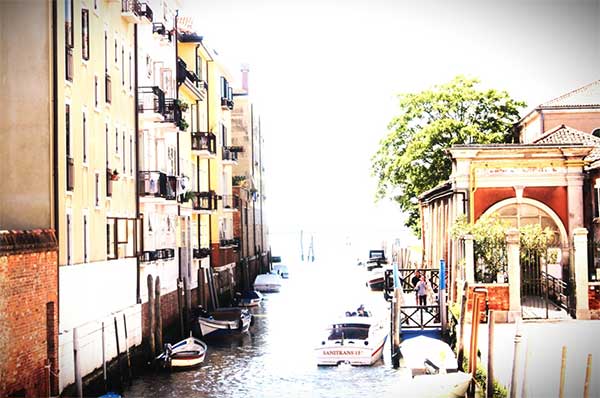
Venice inlet dissolving into light, May 2019
In one of the epigrams to Rupert Loydell’s poem sequence An Atlas of Grief, prompted by Don’t Look Now, Bernard Rose says of Nicolas Roeg[xviii] (echoing Orson Welles) “One of the nice things about film is that you can obliterate time. You can reverse or wind the film backwards. You can slow it down; you can speed it up. You can obliterate hundreds of years with a cut.” All this is true, but you don’t need film to do this – you do it casually every time you remember, think, day-dream or sleep. All higher experience (for want of a better term) dismisses time, revealing its superficiality, and although we can’t entirely live by this, it is important to always hold it in mind.
© Lawrence Freiesleben, Heysham, April 2026
[i] Presumably after the murder of her husband with Laura leaving their house for the last time? (01:46:02) Earlier in the film you only see the car leaving from a distance.
[ii] All approximate timings (from the Criterion Blu-ray) are subsequently written as hours, minutes and seconds.
[iii] At 00.4.01. One of John Baxter’s blasé quotations. Later on (at 00:19:03) ‘Seeing is believing’ also questions perception
[iv] Not that I’d have known this when I first saw the film. Apparently, it wasn’t first shown on TV until 1979 in a late-night Sunday slot on BBC 2 on December 30. Possibly, I first saw it when living at the Redfield community – encouraged by fellow-resident film cameraman and director, Oliver Stapleton?
[v] For example: Mario Bava’s Kill, Baby… Kill! (1966) Federico Fellini’s Toby Dammit (1968) and the more humorous menace of the Avengers episode Something Nasty in the Nursery (1967, season 5, episode 14)
[vi] See: imdb.com/title/tt0166924/?ref_=nv_sr_srsg_2_tt_3_nm_5_in_0_q_Mullholland%20D
Originally Mulholland Dr., I assume the film was retitled because the release title could be read as Mulholland Doctor?
The old couple may or may not represent Diane Selwyn’s distorted memories and guilt. Initially normal-sized and kindly, they later emerge from the blue box, (perhaps symbolising Diane’s secret or death), as shrunken, demonic entities, to cackle and haunt a suicidal Diane.
[vii] Performance (1970, co-directed with Donald Cammell) and The Man Who Fell to Earth (1976), being two other obvious examples.
[viii] In the Nibelungenlied, after slaying a dragon, Siegfried bathes in its blood, to make himself invulnerable, but a linden leaf adhering to his back stencils a blank unprotected shape between his shoulders. This often seems a variation on the Greek myth in which Achilles’ mother dips him into the River Styx to make him invulnerable. Holding him by one heel leaves that area as a weak spot.
[ix] I would not have said that [the] ability – and wish – to expand into the past or rather to allow it to seep through the fabric of 21st Century ‘reality’, was nostalgic. Evidently, nostalgia (dictionary: “a sentimental longing or wistful affection for a period in the past”) means different things to different people and cultural groups, but for me the sentimental aspect is entirely absent. See: https://internationaltimes.it/new-year-sun-on-route-53-impressions-2/
[x] https://www.libraryofshortstories.com/storiespdf/dont-look-now.pdf
[xi] Venice is at risk of becoming permanently uninhabitable or submerged due to rising sea levels and land subsidence, with expert predictions suggesting that unless the lagoon is enclosed, the city could be mostly underwater by 2100 to 2150.
[xii] Easily done even in daylight perhaps owing to the inundation of impressions. See:
internationaltimes.it/the-italian-digression-part-1/
internationaltimes.it/the-italian-digression-part-2-treviso-to-lago-di-barrea/
internationaltimes.it/the-italian-digression-part-9-the-long-journey-home/
[xiii] Page 9 of the pdf annotated above: “‘Now,’ he thought afterwards, ‘now at last is the moment to make love,’ and he went back into the bedroom, and she understood, and opened her arms and smiled. Such blessed relief after all those weeks of restraint.”
[xiv] See faroutmagazine.co.uk/dont-look-now-best-sex-scene-in-cinematic-history-pic/
by Lily Hardman, – which ends: “It’s our loss that no filmmaker has met its high watermark since.”
[xv] From Auld Caledonia (L W Freiesleben February-April 2026) lines 23-25.
[xvi] One of my favourite actors: So enjoyably hammy in early TV roles: The Saint, The Avengers, Man in a Suitcase (1965-68). So deadpan and serious in Klute, (1971) and The Disappearance (1977), so appealing as Mr. Bennet in Pride and Prejudice (2005) – the list could go on and on
[xvii] https://internationaltimes.it/things-behind-the-sun-a-digression-on-memory-trauma-and-mystery/ The ending of semi-Kitchen-sink drama Billy Liar (1963), divides viewers markedly: Some see Billy’s failure to leave as tragic, others as comic, others as merely depressing. Yet Julie Christie as Liz [her breakthrough role 8 years before Don’t look Now] seems happily resigned – as if she’ll soon be back to finally persuade him.
[xviii] https://www.bfi.org.uk/sight-and-sound/interviews/mystic-nic-praise-nicolas-roeg
.
Thanks
A masterpiece – the run of films Roeg made from Performance up until the courtroom scene in Eureka is incredible …. Insignificance is pretty good as well. I saw Don’t Look Now by accident – the film we’d gone to watch in the West End was sold out and we picked DLN on the strength of the actors with no idea what it was about
I left the cinema traumatised and had to see it again the next day to process it
Comment by Steven Taylor on 1 June, 2026 at 7:15 am