Sam Burcher examines the lesser known role of the Poet Laureate as a journalist and spy-writer
during the Great War.
The contribution of the poet and author John Masefield to The Manchester Guardian founded in 1821 has been radically understated, both by the newspaper and by Masefield himself. He was initially employed on a trial basis, becoming a regular contributor after distinguishing himself with several outstanding back pages. The name of the broadsheet was shortened to The Guardian in 1959 after widening its reach to beyond Manchester.
Between 1903 and 1924 The Guardian published some 390 articles by the future Poet Laureate. Of these, only five were poems, the rest were miscellaneous articles, short stories, prose pieces and various reviews.
His debut collection Salt Water Ballads (1902) included perhaps his best known poem Sea Fever, in which he reflects upon the wild call of the oceans. The sea had called him as a thirteen year old orphan to voluntarily join the marines to escape his nagging aunt’s disapproval of what she called his “compulsive reading.”
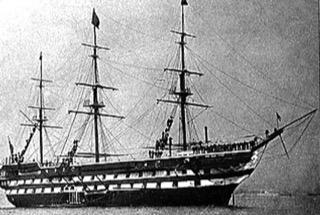
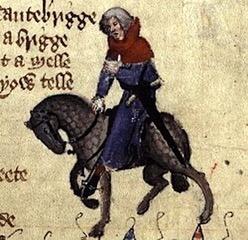
Several years later he jumped ship in New York working in a carpet factory by day and bartending late into the evening. By night he read voraciously, Chaucer’s Canterbury Tales sealing his decision to become a writer. After his discharge as a DBS, a distressed British seaman abroad, Masefield spun the sights and sounds of his awe-inspiring sea voyages and a near shipwreck around Cape Horn into his epic and visionary poem Dauber (1913).
Time spent in America left Masefield ideally placed for the second strand of his role at The Guardian, which was to collect miscellany from the American Press. It is probable that his column inspired the still running Guardian Weekly, which began in 1919. And, as I discovered, his information gathering penetrated far deeper into American society than anyone could have been imagined at the time.
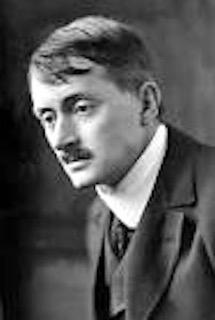
In fact, John Masefield was part of a secret ring of spy-writers enlisted by the War Propaganda Bureau (WPB) during World War I, its purpose to counteract German influence in neutral countries, specifically America.
A Ring of Spy-Writers
By 1916 the head of the WPB, the Liberal MP Charles Masterman employed the talents of twenty five spy-writers to produce an endless flow of pro-war books and pamphlets. Amongst these were The War That Will End War (1914) by HG Wells and To Arms! (1914) by Arthur Conan Doyle, who resurrected his famous fictional detective Sherlock Holmes as a spy in His Last Bow (1917). Doyle had been alerting the British to rising militarism in Germany long before the war, prophetically stressing the need for a channel tunnel between England and France.
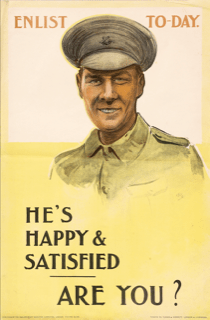
Almost two million propaganda pamphlets, posters, novels, letters and poems were circulated in seventeen languages during the first two years of the war. This information was printed by the prominent publishers of the day, and funded by the Government to keep the world’s focus firmly on the war.
After Masefield was rejected for active service on medical grounds in 1914, he joined the Royal Army Medical Corp and began his training on Hampstead Heath in December that year. The following spring, he wrote to the then editor and owner of The Guardian, CP Scott, requesting a donation for a mobile field hospital in France. A week later he thanked Scott for his £10 contribution, around £1,000 today.
By 1916 the WPB decided to make better use of Masefield by sending him into the Red Cross hospitals in France as an orderly. Several months later his experiences were published by the American Press. Afterwards, he was rushed into writing about the Allies campaign in Gallipoli (1916). Filled with poetic descriptions and illustrations of the peninsular, it was met with great acclaim. In order to get closer to the action he toured The Somme twice to produce The Old Front Line (1917).
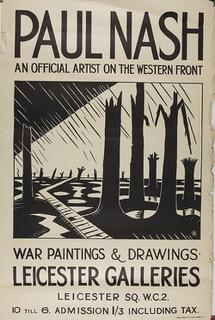
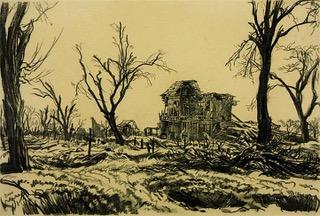
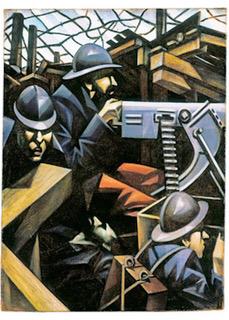
The WPB writers and artists were instructed to transmit strictly positive messages and images of war. Only two army officers were permitted to take photographs at the Western Front. Anyone else with a camera faced the firing squad. Muirhead Bone was the first official war artist, producing 150 drawings in France in 1916 before returning to England. His brother-in-law, Francis Dodd RA, (also on The Guardian), replaced him, but later committed suicide. A further ninety artists were sent to France, including Paul Nash, Stanley Spencer, and the Vorticist Christopher Richard Wynne Nevinson.
Poetry, Propaganda and Prophesy
In January 1916, John Masefield embarked on another mission for the WPB. His brief was to complete a three month lecture tour of America entitled The Sailor Poet in Lectures of Literary Interest. Designed to discover what the Americans thought about the war raging in Europe his vital role in the propaganda machine was kept a secret. He simply exchanged their opinions for his news about European art, drama and literature.
When he returned home, he was debriefed by the British Foreign Office.
It was said his voice could never be mistaken for the voice of any other man. His friend and colleague, The Guardian’s India and War Correspondent Henry Nevinson described Masefield’s way of speaking lines of verse,“that somehow spring out of that little head, with the wide and dreamy light-brown eyes, the deep and sonorous voice, uttering a language so unusual in a jolly jack-tar, and with a punctilious politeness so unexpected in a former dog of ocean.”
His tone was neither showy nor dramatic, demonstrating the calm, concern and encouragement appreciated by American audiences. In 1918 he was welcomed back for a four month lecture tour of army training camps, colleges and clubs. This tour, under the auspices of The British War Mission and The Information Bureau, also served Masefield’s dual purpose of reviving an interest in spoken poetry, whilst building a network of sophisticated and well connected people he called his “helpers” to achieve his vision.
During this time he prophesied a great renaissance in poetry and the other arts after the war. He delighted his audiences by finishing each lecture with a recitation of several of his poems. On one occasion a battalion of black soldiers danced and sang for him after his talk.
The British Government trusted John Masefield, and so did the Americans. By the end of his successful mission it was apparent that pro-British propaganda had been strengthened by his activities. The lectures were a victory for Masefield, whose literary reputation in the US was noticeably enhanced, added to which were the honorary doctorates bestowed by Harvard and Yale.
A Modest Laureate
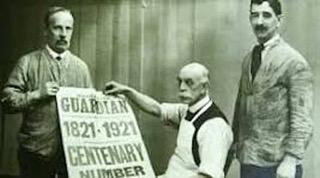
In the years that followed, his war efforts and his role on the paper were barely mentioned in his autobiographies or biographies. In 1951, the newspaper’s acting editor Patrick Markham said Masefield had, “not been a staff member for very long,” and referred to him as, “an occasional contributor.” Yet, Masefield was a keynote speaker at The Manchester Guardian Centenary Dinner in May 1921, sharing the top table with its owner CP Scott, a clear indication of his influence within the publication.
At the Centenary Dinner held at the Manchester Midland Hotel, he had praised, “The great paper respected and honoured throughout the world for encouraging new movements in literature and the theatre and supporting the downtrodden and oppressed.” He added that his time on the paper had been the most romantic delight, which being a part of had filled him with a kind of awe.
With the generous support of his helpers he realised his dream of resurrecting spoken verse. First with The Oxford Recitations (1923-1930), and followed by The Oxford Diversions in which J.R.R. Tolkien recited Chaucer’s The Reeves Tale in 1938 from memory in front of his ten year old daughter.
From an orphan-sailor to a writer-spy John Masefield was bestowed the highest accolade for poetry becoming Poet Laureate in 1930 until his death in 1967. His ashes were placed in Poet’s Corner in Westminster Abbey.
A sad fate befell the WPB’s spymaster Charles Masterman, who died of an alcohol related illness in 1927.
.
.


Thanks
Comment by Steven Taylor on 11 July, 2026 at 6:12 amReally enjoyed this and learnt stuff!