
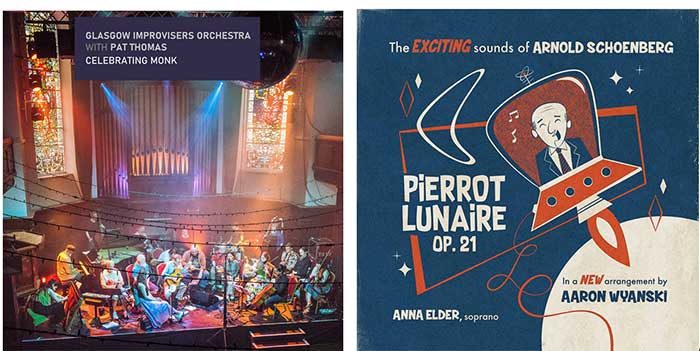
Celebrating Monk, Glasgow Improvisers Orchestra / Pat Thomas (Scatter Archive)
Schoenberg: Pierrot Lunaire Op. 21, Aaron Wyanski / Anna Elder (Aaron Wyanski)
NAWR Gyda Ash Cooke, Excell / Smith / Parfitt / Cooke (Recordiau Dukes)
Lullaby of Broadway, Excell / Smith / Parfitt (Recordiau Dukes)
Compositions & Improvisations, Ash Cooke (Ash Cooke)
Celebrating Monk is a live recording of a concert given at St Luke’s music and arts venue, Glasgow in 2024, as part of the Glasgow Jazz Festival. It features Glasgow Improvisers Orchestra and – collaborating with them for the first time – pianist Pat Thomas.
It’s an intriguing album: it begins and ends with improvised tracks which bookend four composed pieces. I say composed but, from the programme notes, it’s clear that they’re not the kind of pieces in which every note is written down. Rather, they’re the kind in which performers are given suggestions, instructions and a great deal of freedom in interpreting any material they’re given. For example, in the first piece, Una MacGlone’s ‘…stepping into a Dream’, performers can invent material or create new patterns using the chords from the title-track from Thelonius Monk’s 1963 album,’Monk’s Dream’. The second, Raymond MacDonald’s ‘Every Thelonius Monk Tune in Ten Minutes’ is perhaps the most compelling of the four. Of course, the title helps, but it’s not just that. MacDonald’s description of the piece suggests we’re in for a rich, dense, chaotic (in a good way) experience, and the performance here certainly lives up to this expectation: ‘I selected short excerpts, just a few bars, from each piece, and assembled them by sellotaping them onto A4 sheets. Each musician received a unique page containing fragments from three or four different Monk tunes, creating an individualised, but related musical pathway for every performer. The performers were invited to play each fragment at least once, but otherwise they had complete freedom: they could repeat fragments as often as they liked, embellish them, reorder them, and improvise freely.’ The third piece, ‘GOK’, again by Raymond MacDonald, is both the shortest and the only one not specifically related to Monk. It was written as a tribute to Brian Wilson back in 2002. In it, the performers are given notes from the song Wilson co-wrote for The Beach Boys, ‘God Only Knows’ to improvise around. It’s included here as Wilson passed away only two weeks before the concert. I guess, given the freedom allowed to the performers, the piece could take on all kinds of different characters. Understandably, here it has a thoughtful feel: one that at times, I thought, had echoes of Gavin Bryars at his most elegiac. ‘Monk at the Border’ by Maria Sappho is a magical piece, in which individual chords from Monk pieces are stretched out in time, allowing, as the programme-note puts it, ‘the ensemble to inhabit it slowly, sustaining tones, repeating fragments, or sliding between pitches.’ Alongside the instrumental music, Sappho has created a second, electronic sound-world of sustained sine-tones, using just intonation, as opposed to the more usual, equal temperament-tuning used by the instrumentalists. As she explains in the programme note, she wrote the piece while working in the USA and she sees the tensions between the two sound-worlds as reflecting the tensions between different communities there – violent and visible through the actions of ICE and the government – and, as she says: ‘The title draws on the Spanish word frontera, which means both border and frontier. In this piece, the space between pitches becomes a sonic frontera: a contested zone shaped by colonial histories of tuning systems and cultural hierarchies. It is a meditation on tension between worlds.’
I’m not sure how this project came about but Pat Thomas was the perfect choice of pianist for it (perhaps he chose himself?). Monk is one of the musicians one so often hears echoes of in what he does and he’s previously issued other tributes to him. The result of this collaboration with GIO is an album that manages to be deep, thoughtful and playful, all at the same time.
For some time now, American composer Aaron Wyanski has been working away at his Schoenberg in Hi-Fi project, recreating a series of Schoenberg masterpieces with digital audio workstations (Logic and ProTools), in the process reimagining it – without changing a note – as late-1950s jazz. Looked at another way, you could say he’s doing for Schoenberg something very like what Wendy Carlos did for Bach. His arrangement of Variations for Orchestra Op.31 made it to Café Oto last year where, by all accounts, it went down really well. His latest offering, a collaboration with the soprano Anna Elder, is an arrangement of perhaps Schoenberg’s best-known work, the song-cycle Pierrot Lunaire.
The result is quite something. It works on so many levels: Schoenberg and Kurt Weill were both working at the same time and, listening to this you realise how much more affinity there is between them than people often think. It immediately becomes apparent how ahead of his time Schoenberg was, and how what he was doing would inevitably, in time, capture the imagination of jazz musicians. And not only that, but what Wyanski does elucidates the music. Listeners coming to Schoenberg’s atonality for the first time often find it overwhelming and difficult to take in: here, though, the shape, clarity and expressive power of the music shines through.
Hopefully, listening to this will get people new to it exploring the rest of Schoenberg in Hi-Fi. On Wyanski’s Bandcamp page you can check out the Six Little Piano Pieces Op.19. These – in their original version – are a particular favourite of mine: probably because they’re not too difficult and I can actually play them! They always did have a latent jazziness about them that probably gets lost on a lot of classical music listeners. Then there’s the Piano Suite Op.25. Some pieces prior to it partially used or played with the idea, but this was the first piece in which Schoenberg used twelve-note technique throughout. For anyone unfamiliar with it, the twelve notes of the chromatic scale are arranged in a particular order (known as the ‘series’). One can reverse the series, invert it (i.e., turn it upside down) and reverse the inversion. One can transpose it, too. All in all, there are forty-eight possible forms of a classic Schoenberg series. All the chords and melodic shapes in a ‘twelve note’ piece are constructed from them. There’s a school of thought that says Schoenberg’s ‘twelve note’ pieces are less interesting than his earlier atonal music (like Pierrot) in which notes are used freely, but Wyanski’s arrangement of the Piano Suite, in my view, busts this myth.
And it’s serendipitous that Wyanski and Anna Elder just happened to know each other. As Wyanski himself put it, ‘she … mentioned [in conversation] that she was getting ready to perform Pierrot later that season. Seeing this opening as the once-in-a-lifetime possibility that it was, my response was, “Hey, want to make a Pierrot album with me?” and I consider myself extremely lucky that she agreed’. The rest of us can consider ourselves lucky, too. The result is not just a great listen, but a real eye-opener when it comes to charting the directions music took in the twentieth century.
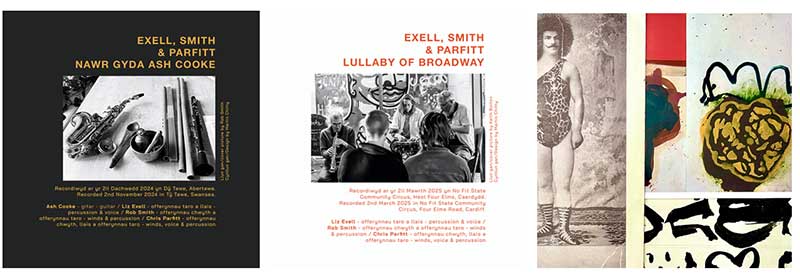
NAWR Gyda Ash Cooke – or in English, NOW with Ash Cooke – was recorded at the Tŷ Tawe arts centre in Swansea, in 2024. It brings together drummer Liz Excell, saxophonist Rob Smith and multi-instrumentalist Chris Parfitt (who have often played together as a trio) with guitarist Ash Cooke. NAWR is a one-day festival held in Swansea every year which celebrates experimental music and the spoken word.
What we get is a single, thirty-three-minute track. The music, for the most part, unfolds slowly, the musicians taking time to develop moods and textures. As one would expect, there are ruminative moments, exploratory gestures, times of complexity and thoughtfully-posited invitations to nudge the music in different directions. The result, though, I thought, is not a music that goes through the motions, that’s merely predictable, but an absorbing listen that goes beyond the conventions of improvised conversation. I reached the end wishing I’d been there when it happened!
NAWR Gyda Ash Cooke is one of three featuring the same performers that came out at about the same time: the two others are another live album, Lullaby of Broadway, which features the trio of Excell, Smith and Parfitt, but without Cooke, and Cooke’s own album, Compositions & Improvisations. And, in a canny bit of marketing, if you buy Lullaby of Broadway as a CD, you get NAWR Gyda Ash Cooke thrown in for free and vice versa. All three albums are well worth exploring.
.
Dominic Rivron
LINKS
Celebrating Monk: https://scatterarchive.bandcamp.com/album/celebrating-monk
Schoenberg: Pierrot Lunaire Op. 21: https://aaronwyanski.bandcamp.com/album/schoenberg-pierrot-lunaire-op-21
NAWR Gyda Ash Cooke: https://recordiaudukes.bandcamp.com/album/nawr-gyda-ash-cooke
Lullaby of Broadway: https://recordiaudukes.bandcamp.com/album/lullaby-of-broadway
Compositions & Improvisations: https://ashcookemusic.bandcamp.com/album/compositions-improvisations
.