
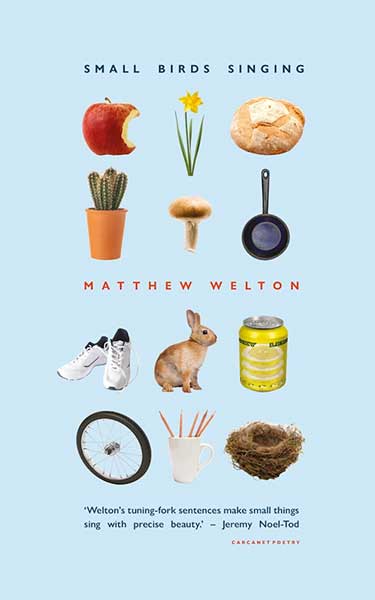
Matthew Welton, Carcanet
Matthew Welton’s new volume, his fifth from Carcanet, describes itself as a book-length poem of fragments. The fragments are of two kinds: images “drawn from a year’s walking through one city’s green spaces” and “reflections on how things around us manifest a kind of ‘thinginess’ . . . . and how this creates the context for our thoughts.” I am quoting the book’s back cover. I struggled a little with the latter proposition, if only because surely it is stating the obvious. Our thoughts exist in the context of everything around us: object, action, idea; noun, verb, abstraction.
Returning to the first kind of fragment, here are one or two examples:
behind me in the mirror a yellow moth hovers
the paint on the garage door never dries
a dozen new biros in an old treacle tin
a candle in a jam jar in the kitchen window
As these appear to have nothing at all to do with wandering a city’s green spaces, here are two that do:
spread out across the grass
a whole pigeon’s worth of feathers
the house where the bins didn’t get put out
the lawn more moss than grass
These observations appear to be quite random. While one can pick up the occasional recurring image (an apple here, a bicycle tyre there) there does not appear to be an overriding principle of organisation. I am not at all sure what the book would be like were this the only kind of “fragment” on offer. It might become a little tedious. Perhaps as a journal one dips into on occasion it would serve, but it would not be very exciting.
One should say at this point that the poem is comprised of couplets (cf. those quoted above) alternatively justified to the left and right margins, a strategy that the back of the book chooses to refer to as creating a zig-zag and as a formal innovation. I am not reproducing that alternative justifying here, by the way, because it is too fiddly, and also pointless.
But there is another kind of fragment with which we must deal i.e. those reflections on ”thinginess”. This is where things become more interesting, and I use the word “things” reluctantly, for reasons which will probably become clear.
Apropos of which, the third couplet on the first page reads thus:
as it comes into being each thing creates
a ripple in its own reality
I have to admit that my knee-jerk reaction upon encountering this was that only the absence of silly syntax prevented it from sounding like something uttered by the Jedi Grand Master Yoda in the swampy Outer Rim planet of Dagobah i.e. something that sounds quite deep but tends to withdraw into the shallows when seriously scrutinised.
Unfortunately, it is this kind of “reflection”, interspersed among the wandering observations, that comprises a substantial part of the book. Some examples:
a thing makes its own statement;
the statement is itself a kind of thing
a thing makes itself available;
its availability is itself a kind of thing
The nature of ‘being’, the question of what a “thing” is, has been the subject of philosophical enquiry since, I believe, the 5th century BCE. I am no philosopher but I know that Heraclitus argued that things are never truly static and that they are constantly in a state of flux or becoming. Famously, he said that you cannot step into the same river twice. Plato talked about ‘forms’, the fundamental properties that make a thing what it is (e.g., a chair must have the essence of a chair, and that essence exists somewhere ‘out there’ – I am not sure where, exactly – and how if those properties are removed the thing ceases to exist. At a much later date there is the proposition that we can only know a thing as it appears to us through our senses and our mind. There are reasons I did not study philosophy.
When Welton states that
it is the elements that things share
which make each of them specific
I began to feel as if I knew what Luke Skywalker must have felt listening to Yoda, who surely must at some point have talked about
the knowability of nameless things
a phrase which, perhaps, sums up everything or nothing. One could spend a lot of time reflecting upon these reflections on ‘thinginess’, but simply asking what on earth they actually mean would be a start. One cannot help but wonder what Plato or Emmanuel Kant would make of them.
But we do not have only ‘things’ with which to deal. There is also ‘thought’. For example:
the thought that thought is a kind of
geometry without objects
thought as nothing
but mushy soup
while we should not forget that
the thing being pondered becomes an action, a thing that takes place
Quite honestly I had had enough of these somewhat pedestrian abstractions, but then, threatening to tip me over the edge, we are asked to consider dimensions. I have always had trouble with dimensions, because sometimes I do and sometimes I do not know what they are, and these were no exception:
thinginess exists in
the dimension of imitation
a thought is a thing
in the dimension of the moment
a moment is nothing
in the dimension of thought
As one may have already noticed, there are times in these pages when simple process takes over. Welton in previous works has exhibited a predilection for process, which is to put it mildly, and process of a very simplistic kind rears its head here a little too often:
the thinginess in the way the birds view the trees;
the thinginess and the way the trees view the birds
the linearity of the particular;
the particularity of the linear
One could do this kind of thing, swapping the words around, until the cows come home. Whether it would be a fruitful pastime is open to question.
I have quoted heavily from the book, perhaps too heavily, but there are times when a reviewer is tempted to say something along the lines of “Dear Reader, I have read this book so you don’t have to”. There is a strand of contemporary poetry that considers it adequate to place before the reader things and events without authorial comment, a sort of poetic res ipsa which does not have much more to it than to display, as if it needed displaying, the multifariousness and confusions and juxtapositions of existence. Some of that is going on in “Small Birds Singing”, while the “reflections” on “thinginess” and “thinkiness” struggle to pass muster as an attempt by the poet to “think” about what it all means. For me, those attempts fail. The poet has nothing much to say but says it at great length, too often by way of insightful-sounding aphorisms that do not stand up to serious scrutiny. What is worse, they can become tiresome. Listing lots of what one sees and then attempting to be profound about it all is one thing. Presenting the entire exercise in a supposedly innovative form which mainly consists of using the Justify Text command on Word is another. Those, I think, are two things to think about.
(c) Tamsin Conde-Noble
.