
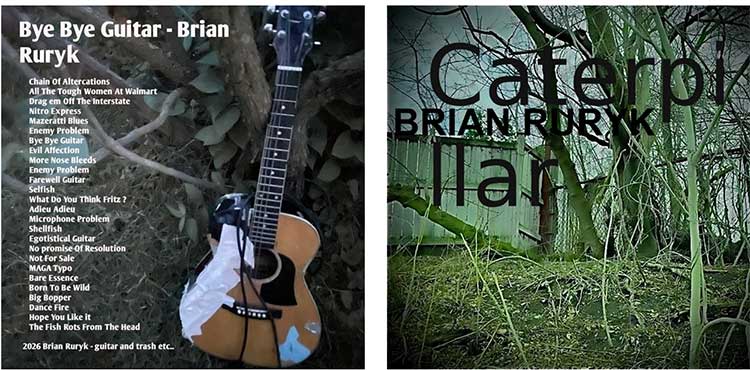
Bye Bye Guitar, Brian Ruryk (Brian Ruryk)
Caterpillar, Brian Ruryk (Scatter Archive)
Sax & Drums Live, Sue Lynch / Regan Bowering (Scatter Archive)
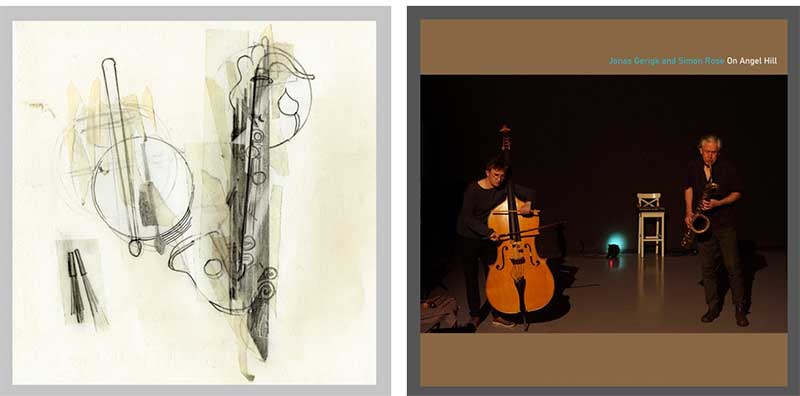
On Angel Hill, Jonas Gerigk / Simon Rose (Scatter Archive)
In the brief – nothing wrong with that – album note that goes with it, Canadian experimental guitarist and noise musician Brian Ruryk describes his latest release, Bye Bye Guitar, as ‘a collection of guitar music recorded over the last few years’. For anyone who’s not come across him before, Ruryk has been active since the 1980s and his output – released on a number of small labels and in a range of formats from home-brewed audio cassettes to floppy discs – has been prolific. As I said in a review of one of his earlier releases, Outside (a collaboration with performance artist Colin Cudmore), ‘imagine if Sam Brakhage, instead of making films, had prepared guitars, made field recordings and processed noise with lo-fi cassette recorders and you’ll begin to get the idea.’ This latest album comprises twenty-six short, action-packed tracks, loaded with Ruryk’s trademark irrepressible creativity. One minute, he’s making an electric guitar sound like a car crash, the next we’re plunged into what sounds like a field recording of a chicken-coop. There are manic tremolos reminiscent of Eugene Chadbourne. Literally anything can happen. It’s magnificent!
And then there’s Caterpillar, the fourth – I think – Ruryk album to be released on Scatter Archive. Listening to it, I was reminded of something I’d read in the notes to an earlier album: ‘If you ask Ruryk he’ll probably tell you he’s been attempting the same piece of music for the past thirty years, each time exposing a different detail, or an alternate view, or just attempting to get it “right”’.
The album begins with the title-track, a collage, I imagine, of field recordings and other sounds – recognisable guitar sounds get a look-in later – which create a curiously almost (but not quite) conventional pulsing, rhythmical sound-world (I particularly like the contribution made by what I think are probably toads). ‘Short Hair Not Bald’ contrasts sustained sea-like pink noise with dry, spiky sounds and, towards the end, a deep, mechanical-sounding drone. The guitar makes a further unmodified appearance in the next track, ‘Return on Investment’. Most of the time, though, the way the sounds are processed, it’s often hard to even speculate how they’re created, but Ruryk is clearly drawn to foregrounding the kinds of sounds we tend to tolerate in the background: traffic, the movement of air, the whirring of various systems. He deploys them with a strong sense of timing which compels one to listen. Yes, it’s playful, but it also has a serious side, and one can suddenly find oneself enthralled by the solemnity of it, as in the fifth track, ‘Industrial Street’, a slow-moving texture in which sounds inhabit a grey area between harmonically-rich noise and chords built of notes. It has a gravitas you can’t turn away from that catches you unawares or, at least, it did me.
If you’re unfamiliar with his earlier work, there are links to it in the album notes. And if you find Caterpillar as compelling as I do, you’ll want to check them out.
Also, I’ve been listening to sax-player Sue Lynch and percussionist Regan Bowering’s album out on Scatter Archive, Sax & Drums Live. To be honest, at first, it took a little while before I felt drawn into it. If you’re not a fan of free improv, I wouldn’t say ‘wow, give this a listen, it’ll open your ears’, but if you are, the chances are it’ll probably have the same effect on you as it had on me, once I got into the groove. Readers who are not fans might suspect they’re being treated to a bit of reverse psychology here and they’d be right, I guess. To put it another way, though, this is not the sort of music that grabs you round the throat: rather, it slowly grows on you, if you let it, until you find yourself in a state of rapt attention, wondering what’ll happen next. Lynch and Bowering are not afraid of silence (fear of silence is the enemy): indeed, they embrace it. I don’t mean by that that they only play when they’ve something to say: it goes deeper. It’s true of music in general, but this is music in which it’s particularly obvious – to me, at least – that silence is not simply the space between musical ideas: it can also be part of the idea. I found myself listening to the spaces, which are every bit as significant as the sounds in this enchanting dialogue.
As I said, I spent the first couple of minutes of this album wondering what to make of it. My first reaction, though, when I reached the end, was to immediately play it again (and I’m listening to it again, now, as I proof-read this and, I have to say, the more I play it the more I get from it). It was recorded last year, at an event that put the Lynch/Bowering duo alongside the Tiger Milk trio (Annemarie Roelofs, Sue Ferrar, and Josefina Cupido). I wish I’d been there.
The album notes for On Angel Hill begin with a poem. It’s a striking piece of writing, written by Somali poet Maxamed Ibraahin and translated by W.N. Herbert. If I’m reading it right, it suggests that the mood of the person the poem is addressed to closely matches that of the evening sky the poet presents us with. There is a whiff of Ruskin’s pathetic fallacy about this, but there’s a deeper aspect, too: it questions whether we can really draw a distinction between what we are and what the world we’re part of is. I might think the fact that I can explain why I feel the way I do sets me apart from the rest of nature, but is this actually the case? What we are, what we think and feel, might be far more a part of what we think of as our surroundings than we routinely think.
This, I’m guessing, is what the poem’s inclusion is all about. The notes also tell us that bassist Jonas Gerigk and sax-player Simon Rose focus on creating ‘living music’. They don’t explain in so many words what they mean by this, but perhaps the poem is the explanation. Music enables us to connect with ourselves without words getting in the way and, when we do, we reveal that connection with the universe the poem explores.
The music itself comprises a single, forty-four minute track, although there are distinct sections within it. Sometimes it’s busy, noisy and rhythmic, falling into trance-like rhythmic ostinati, at others, modal and meditative. Rose has worked with dancers and artists and there is often a sinuous quality to what both musicians do which suggests dance and line. It’s music one might want to move to – doesn’t everyone do this to music now and again in the privacy of their own living room? I’m talking about creative movement, rather than conventional disco-dancing, etc. (If you don’t, do try it!) But even if letting it all hang out isn’t your thing and you want to stay put on the sofa, do give On Angel Hill a listen!
.
Dominic Rivron
LINKS
Bye Bye Guitar: https://brianrruryk.bandcamp.com/album/bye-bye-guitar
Caterpillar: https://scatterarchive.bandcamp.com/album/caterpillar
Sax & Drums Live: https://scatterarchive.bandcamp.com/album/sax-drums-live
On Angel Hill: https://scatterarchive.bandcamp.com/album/on-angel-hill
.