
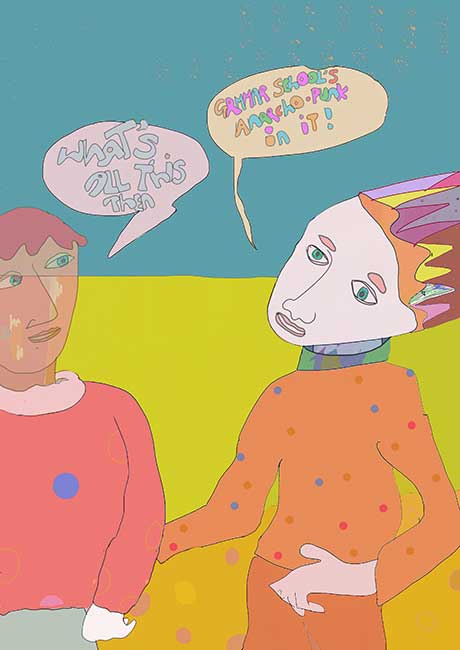
When people imagine British anarcho-punk in the early 1980s, they usually picture squats, benefit gigs, peace camps, dole queues, and black-clad activists travelling between London, Leeds, Bristol, and the industrial towns of a country in recession. It is a story told through Crass Records, anti-nuclear marches, animal liberation campaigns, and the fierce DIY networks that flourished under Thatcherism. What is less often remembered is that some of anarcho-punk’s most committed converts were sitting in grammar school classrooms.
Across England and Wales between 1979 and 1988, a curious contradiction emerged. In institutions designed to reproduce social order, discipline, and academic achievement, a generation of teenagers discovered a movement dedicated to questioning authority itself. The grammar school anarcho-punk was neither the stereotype of the middle-class rebel nor the caricature of the politically conscious sixth-form intellectual. They occupied an uneasy space between privilege and alienation.
Grammar schools in this period were already historical survivors. Most of Britain had moved toward comprehensive education, but pockets of selective schooling remained. Their pupils were expected to become professionals, managers, civil servants, and teachers. Schools cultivated respectability, ambition, and competition. Yet many students found themselves increasingly uncomfortable with the political atmosphere of the era.
If children were formed via hatred rather than love, Ronald Reagan and
Margaret Thatcher would be the parents of Punk.
– Patrick Lyons, “Thatcher’s Gone But She’s Survived By A Bunch of Angry Punk Songs”
The election of Margaret Thatcher in 1979 coincided almost perfectly with the rise of anarcho-punk. While newspapers celebrated enterprise and individual success, many young people encountered unemployment, urban decline, and the ever-present threat of nuclear war. The grammar school environment often amplified these tensions. Students were encouraged to succeed within a system that seemed increasingly unequal.
For some, the first encounter came through music papers. Others found photocopied fanzines passed between desks. A few heard Crass on John Peel. Suddenly there appeared an alternative to both mainstream pop and the macho posturing that characterised parts of the punk scene. Anarcho-punk offered not merely rebellion but a complete framework for understanding society.
Its appeal in grammar schools was surprisingly logical. Unlike many youth subcultures, anarcho-punk rewarded reading. Lyrics referenced militarism, religion, class power, patriarchy, and political theory, record sleeves resembled pamphlets, and fanzines contained essays as often as gig reviews. Students who spent their days studying literature, history, and politics found themselves drawn to a movement that demanded intellectual engagement. Punk’s DIY ethic encouraged writing, printing, organising, and debating rather than merely consuming.
Documents how the students shifted the political critique they learned at school
away from the establishment towards popular culture, and the vehicle they chose
to do this with was punk.
– Susan Pollocks,’Revolutionary Undercurrents in Secondary Education’
School libraries became unlikely sites of radicalisation. Pupils borrowed books on the Spanish Civil War, pacifism, anarchism, and nuclear politics after first encountering the subjects through records. Teachers occasionally discovered that a quiet student who appeared diligent in class was simultaneously producing anti-war fanzines in a bedroom.
The grammar school anarcho-punk often existed in isolation: in many schools there might be only three or four punks, sometimes just one. Friendships developed through letters, record exchanges and weekend travel. A student in Kent could feel more connected to activists in Leeds than to classmates sitting beside them.
The school uniform became a battleground. Black jackets covered in hand-painted slogans appeared beneath blazers. Anti-nuclear badges were removed by teachers and re-attached the next day. Crass logos appeared on the covers of exercise books and some schools banned patches and badges outright. Detentions became part of a weekly ritual.
Yet the rebellion was not always theatrical. Many participants excelled academically. Some became editors of school magazines solely to create space for political articles, others infiltrated debating societies, environmental clubs, or sixth-form committees. Their resistance often took the form of persistent argument rather than outright confrontation.
The Cold War loomed over everything as the early 1980s saw heightened fears of nuclear conflict, and many grammar school students encountered anarcho-punk through campaigns against nuclear weapons. Peace marches, Campaign for Nuclear Disarmament events, and anti-war demonstrations provided a bridge between youth culture and activism. The anti-nuclear message promoted by anarcho-punk resonated strongly with teenagers who had grown up in the shadow of possible annihilation.
Whether bands were writing on topical political events or the more dire images
of nuclear bombs falling, the Cold War was, to quote a famous song of the era,
simply in the air. This would continue throughout the decade, with songs that
imagined what a fallout world would look like or how people would act in the
moment they knew the missiles were coming.
– Ryan Leas, ’38 Songs About Nuclear Anxiety’
The miners’ strike of 1984–85 represented another turning point. Grammar schools often reflected local social divisions. Students from mining families sat alongside the children of managers, professionals, and small-business owners. Arguments that began in politics classrooms continued in playgrounds and common rooms. For many young punks, the strike confirmed their growing belief that official narratives concealed deeper conflicts of power and class.
What made grammar school anarcho-punk distinctive was its relationship with education itself. Unlike some forms of youth rebellion that rejected academic culture entirely, many anarcho-punks absorbed educational tools and employed them. They used research skills to investigate political issues and applied critical thinking to media coverage. They produced surprisingly sophisticated publications using school resources, sometimes with teachers none the wiser.
By the late 1980s the scene had changed. Crass had disbanded and the first wave of anarcho-punk was fading. New musical forms emerged, and political priorities shifted. Yet the influence endured.
Many former grammar school anarcho-punks went on to become journalists, teachers, librarians, artists, academics, environmental campaigners, and community organisers. Some abandoned anarchism but retained a lifelong scepticism toward authority. Others remained politically active for decades. Their stories rarely appear in histories of British punk because they do not fit the expected narrative.
The popular image of anarcho-punk remains rooted in squats and autonomous centres, and rightly so. But another part of the movement’s history unfolded in chemistry labs, sixth-form common rooms, school buses, and municipal libraries. Between 1979 and 1988, selective schools produced a small but influential generation of young people who learned to question the very structures that had selected them.
In that sense, the grammar school anarcho-punks embodied one of the movement’s deepest contradictions. They were beneficiaries of educational success who became critics of the society that rewarded it. Their rebellion was not against learning but against the uses to which learning was put. The history of British anarcho-punk is incomplete without them.
.
Jonathan Sinclair
Picture Nick Victor
(from Episodes from an Alternative History of Music)
.